
I Left my Heart in Pre-pandemic San Francisco
Is this what post-pandemic urban decay looks like? Work from home (WFH) has hollowed out a once vibrant city.
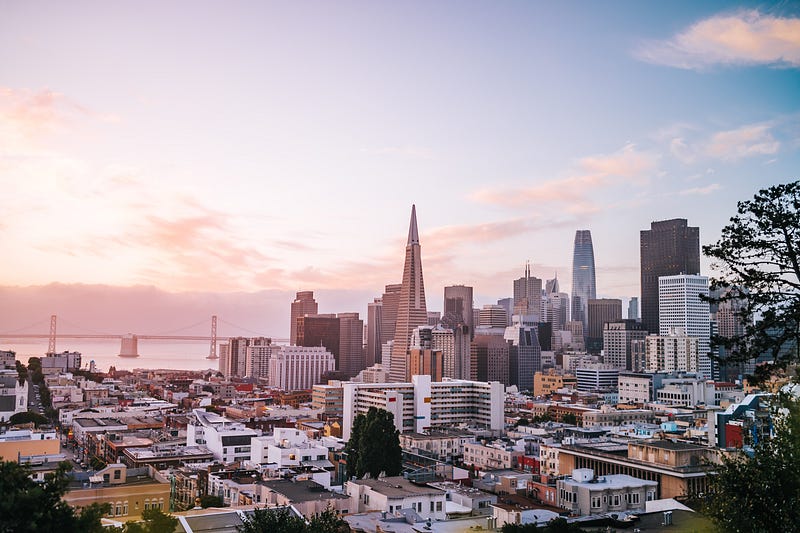
I’ve been in a multi-year love affair with San Francisco.
For much of my 25+ year career, I lived a weird bifurcated work-life split in which my family and I lived in Colorado, while my legal career litigating intellectual property cases was focused in the Bay Area, beginning in 2000 when I joined the legal department of a large and, at that time, very hot Bay Area-based computer company.
Back then, all the action was in Silicon Valley. San Francisco, in contrast, was kind of sleepy. Banks and insurance companies. Yawn.
My, how things change. While Silicon Valley still has plenty of tech companies, over the last decade more and more of them have been establishing headquarters or major operations in San Francisco.
The “talent market” for highly trained employees has seen an even more pronounced shift in The City. Until recently, young professionals in engineering, finance, law, etc. all seemed to crave the social and cultural advantages a compact, the major city had to offer.
The big downside for San Francisco residents and wannabes to the migration from Silicon Valley was affordability. Although no Bay Area community remotely qualifies as “affordable,” San Francisco once was at least relatively affordable compared to the off-the-charts crazy housing costs in places like Palo Alto, Menlo Park, and Cupertino in the heart of Silicon Valley. No longer.
The San Francisco I like to remember
In 2019, my law firm asked me to take over as a managing partner in our San Francisco office. I’d loved the city for two decades, so I was eager to take on the job. But, I couldn’t make a full-time move at that time. So, I rented an absurdly small, and more absurdly expensive, apartment close to our office and commuted from Colorado weekly.
While the commute truly sucked, I came to love San Francisco even more. It is a stunningly beautiful city.
The rolling hills and twisty streets. The wide pedestrian thoroughfares along the Embarcadero. The Financial District’s skyscrapers and the small restaurants tucked in between them and along their back alleyways.
I often had calls with colleagues on the East Coast starting well before sunrise, but the lights cascading down the Bay Bridge and twinkling across the Bay in Oakland almost made the early wakeup time worth it.
After work, I would sit on the balcony of my absurdly small yet absurdly expensive apartment, beer in hand, watching the fog roll down the hills and out over the Bay.
Like I said, stunning.
San Francisco post-pandemic
Everything changed in 2020. I flew back to Colorado one Friday in March, having no idea it would be six months before I saw the city again.
That first visit back was both depressing and surreal. It was the height of the Covid shutdowns, and my beloved San Francisco was truly a ghost town. At midday, I walked the streets near our Embarcadero office without seeing a soul.
I went back again for the first time three months ago, in March of 2022. The first tip-off that the City had not bounced back yet was the cost of hotels. I did a double-take at the price quote I got when booking the room — 70% lower than that same hotel had been going for back in 2019.
While that’s a great thing for business travelers and tourists, it was a harbinger of the pandemic’s long-term impact on the city’s health.
The rest of the trip confirmed what I’d heard from colleagues about the extent to which the Bay Area was not bouncing back quickly. Depressingly, while more active than it had been when I saw it last in September of 2020, the activity level still was closer to the mid-pandemic doldrums than to the vibrant metropolis I’d been so in love with in 2019.
Many restaurants and bars downtown were closed or had radically cut back on hours. The restaurant in my hotel, once a popular downtown watering hole, wasn’t open at all. Looking down from my hotel window at 9:00 pm, the streets looked deserted.
Three months later, my wife and I just returned from a short vacation to Napa and stayed in San Francisco our first night. Not much has changed since my last trip.
I’d spent the afternoon plane ride fantasizing about the prospect of dinner sitting at the bar at the Tadich (the oldest continuously existing restaurant in San Francisco). Nope. Wasn’t opened on a Monday night, nor were any of the surrounding bars and restaurants. Yes, it was the Monday of Memorial Day Weekend, but since when is that a holiday that restaurants in busy tourist meccas shut down?
We ended up having burgers and beers at Gott’s on the Embarcadero, partially because it is the best burger joint on the planet, but more so because it was one of the few restaurants that were actually open. On our walk back to the hotel, we had the streets mostly to ourselves.
San Francisco’s beauty is unique. So is its current “ghost town” vibe.
It would be easy to blame a widespread post-pandemic hangover for San Francisco’s ghost town vibe, but my anecdotal fact-gathering doesn’t bear that out.
I have stayed in close touch with friends and colleagues in other major cities around the U.S., and while we all were in the same boat in 2020 and 2021, in 2022 the energy level in those other cities has normalized.
Friends in New York tell me downtown Manhattan is hopping again. Denver is close to normal. My sense is Washington, DC took a while but is on its way back. I was in Houston a few weeks ago and it was as if the pandemic were a distant memory.
So, why does San Francisco seem so uniquely dead?
My theory: Work from home has hollowed out a city and a region.
The pandemic may have been a convenient excuse for workers with flexible jobs to desert San Francisco. The city and surrounding region had been experiencing declining “livability” for years. Housing prices pushed people with ordinary jobs further and further out of the city itself. Crime had been high for years but spiked even higher during and immediately after the pandemic shutdowns.
Many other big cities experienced similar livability problems pre-pandemic. Yet, most of those cities seem to have bounced back. San Francisco really hasn’t. I have to think some of the explanation comes down to how the biggest industries in the respective cities have approached “work from home” (WFM) policies and their opposite “return to office” (RTO). In those other cities, workers were called back to the office. In San Francisco, they weren’t.
New York, for example, seems to be back to normal activity levels, despite a surging crime rate similar to San Francisco’s. New York’s banking and finance employers were far quicker to mandate vaccination and then far more aggressive in demanding employees return to the office. Other core businesses in Manhattan were quick to follow.
In contrast, the Bay Area-centered tech industry has been far more accommodating toward its employees’ desire to continue to work from home.
This explanation is almost certainly overly simplistic, but I do think the difference in the pace of transition from WFH to RTO explains some of why San Francisco seems uniquely slow to bounce back from the pandemic lockdowns.
Some former residents of the City by the Bay may retort that I’m underestimating the extent to which livability issues, particularly the escalating numbers of the homeless, forced people out of the city. But, as I said, other big cities have similar challenges, including high levels of homelessness. Moreover, I think that explanation puts the cart before the horse.
People in San Francisco complain about the homeless like people in other areas of the country comment on the weather. Yet, on both my recent trips there, I was shocked at how few homeless I encountered compared to 2019. It was a very stark difference.
It’s paradoxical, but I wonder whether the absence of the homeless in a formerly busy city center is one of the most accurate barometers of that city center? To the extent, that the homeless on our sidewalks depend on money from workers trekking those same sidewalks, what happens when all those workers desert the city center en masse in favor of working from home?
Work from home has a cost for communities and individuals
I get workers’ desire to work from home and employers’ desire to accommodate them. But, let’s not pretend it doesn’t come at a cost, particularly for communities, writ both large and small.
For individuals, working from home is convenient and efficient. It allows us to avoid various costs, financial and otherwise, associated with going to work. Avoiding a long commute is certainly a huge plus.
But, it comes at a price. Lower quality training. Decreased opportunities for networking and professional development. A tangible loss of real human connection that offices and on-site work, for all their stresses and limitations, provide.
For employers, working from home may reduce certain hard costs, such as expensive urban office space. On the other hand, it’s hard to quantify the negative impact on teamwork and firm culture when the only thing holding teams together are virtual training sessions and Zoom happy hours.
The impact on communities in the largest sense of liberal WFH policies may be a hollowing out of once vibrant city centers. All those high-rise office towers support an extended hive of commercial and human infrastructure. The Starbucks is just around the corner. The privately-owned dry cleaner in the lobby. The receptionists and waiters and cooks at the local restaurants just down the street. The bartenders at the local watering holes. The security people manning the entrance to the elevator banks. The IT staff maintains all those office workstations and telephones. Taxi and Uber drivers shuttling people back and forth.
It’s all part of what gives a city a palpable sense of energy. And, a palpable sense of something lost when that energy suddenly disappears.
I still have some hope for San Francisco. Unlike some of her West Coast counterparts, Mayor Breed seems willing to take on chronic livability issues like the spike in non-violent crimes. Further, at some point, the negative cultural impact of WFH may encourage both employers and workers to remember some of the positives of the traditional office.
My personal hope is we end up with some “best of both worlds” hybrid that supports the needs of both the individual worker and a vibrant central city commercial environment. Here’s hoping.
In the meantime, I left my heart in San Francisco in 2019 but hope to find it again at some point in this topsy-turvy decade.


