
How I Learned to Believe in Something More
A childhood adventure
When I was a kid, I decided there was no reason to believe in anything. I was gonna be a complete non-believer, an atheist. Yep.
I had good reasons, too. The Easter Bunny, the Tooth Fairy, and Santa Claus had long-since been revealed as total frauds, and I figured there was another old Guy with a long, white beard who wasn’t all that He was cracked up to be either. In addition, nothing interesting or extraordinary had ever happened to me — nothing at all. I had never seen a ghost, or heard voices, or footsteps at night. I’d never been able to read someone’s mind, or make a pencil fly through the air, or bend a spoon, or guess which card was going to come up next. I was just a normal, ordinary, boring kid.
I went on like that for quite a few years, being suspicious of everything. I knew that if just one time, something amazing happened to me, then I would believe that strange and miraculous things were possible. But nothing ever did.
As I approached my twenties, my status as a highly sceptical non-believer was firmly entrenched. You couldn’t pull the wool over my eyes with your cheap psychic sideshows and your woo-woo mysticism. I was too clever for your tricks!
Then around that time, I remembered something that had happened to me years before. I had thought about it every now and then, but the importance of it had never really sunk in.
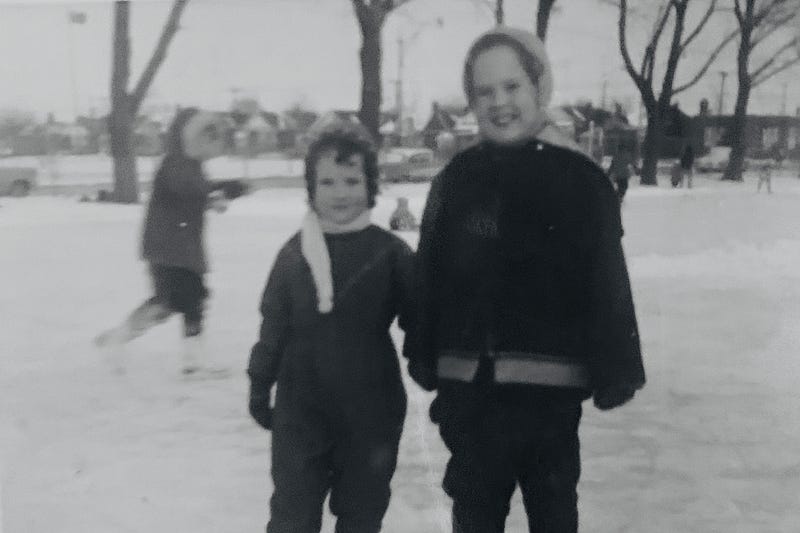
See, I grew up in the East End of Toronto in the 1950s and 60s. The winters lasted for months and being outside in the cold was unbearable — unless you were going sledding. My Dad would occasionally take me and my little sister to a park right on the Danforth, near Woodbine, where there was a steep hill all along one side that was just perfect for caroming down on a wooden sled.
The time I’m talking about I would have been seven or maybe eight years old. It was a Saturday, early afternoon, bitter cold, but brilliantly sunny and bright, so Dad finally succumbed to my pleas to take us to the park. He had to drag my sister along behind him on the sled because my Mom would pack her into so many shirts and pants and sweaters underneath her snowsuit that she couldn’t walk.
I had to wear a padded nylon snowsuit, too, but I was old enough to get dressed by myself, so I still had enough freedom of movement to walk under my own steam. I wore heavy leather mittens over thick woollen gloves because my fingers were always cold and I thought they might snap off from frostbite. I also wore an extremely long knitted scarf wrapped several times around my neck and over my lower face, to keep my breath from freezing before it could get from my nose to my lungs. There was another, shorter scarf wrapped around my forehead, to keep my brain from freezing. (I had a vivid imagination.)
But absolutely the worst, most awkward, inconvenient, abominable, butt-ugly part of my ensemble was the pair of enormous brown plastic snow boots that I had to wear over my regular shoes and two pairs of my Dad’s thickest socks. I mean, I had to put the socks over my shoes. The boots came up to mid-calf and had a strap-and-buckle arrangement that pulled them tight to your leg to prevent the snow from slipping down inside. (It never worked; the snow always got inside.)
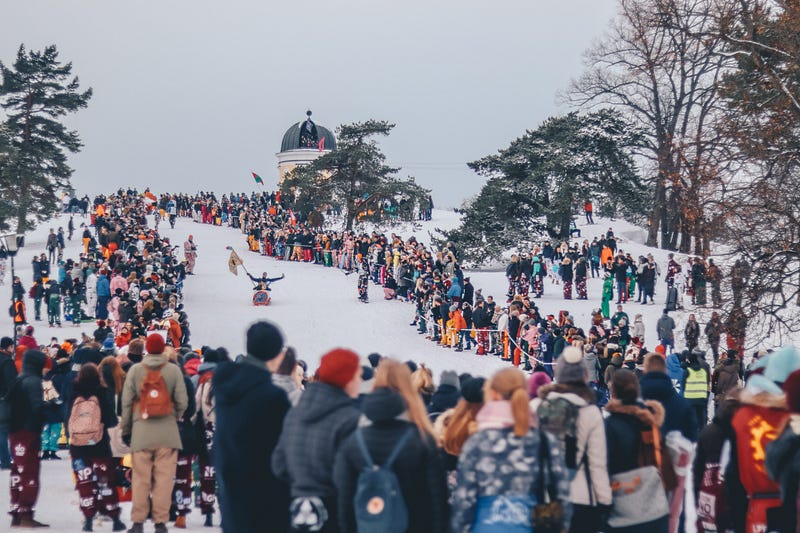
So, we arrived at the park and it was crowded, packed solid, because of the beautiful weather. There were what appeared to be hundreds of kids and teenagers, screaming, slipping, sliding, and racing down that steep slope on sleds, sleighs, toboggans, garbage can lids, and just about anything they could get their hands on — it was chaos. I could tell by the look on my Dad’s face that he was about to turn us around and head back home. No way! I quickly pointed out that, if we walked down to the far end of the park, there was still room at the top of the hill. Dad reluctantly agreed we could give it a try.
When we eventually found an open spot to establish a take-off point, the only problem was that the downward trajectory would bring me pretty close to the park maintenance shed at the bottom of the hill. This was a small, solid, brick building that housed the groundskeeping equipment on one side and washrooms for MEN and WOMEN on the other.
I wasn’t worried because our sled had a nifty steering mechanism — a separate crossbar of wood across the front with a rope attached to each side that you could pull to steer it either left or right. If it looked like I was getting too close to the shed, I would just steer away from it, or so I assured my Dad. He held the sled steady while I settled myself on top of it, seated upright with my legs straight out in front of me, one of the steering ropes in either mittened hand. He gave me a solid push in the middle of the back, and I was off.
Man, it was amazing! I was really warm from trudging along the whole side of the park, so the only part of me that felt the cold was the only part that was exposed — my eyes. They started to tear up with the wind from my rapidly accelerating descent. I didn’t care. I was flying. I don’t know how steep that hill would look to me today, but at eight-years-old it was my own personal Everest.
The icy wind was screaming past me and I had just passed the midpoint of the slope when disaster struck. The steering rope on the right side suddenly snapped off in my hand, and the sled veered violently to the left directly toward the brick shed.
I panicked. There was no way I could risk hitting that shed. I would surely die. I had no choice but to save myself, so I did the only thing I could think of: I rolled to my left, bailing off the sled, and into the snow.
For a fraction of a second I believed I was safe but then I realized I was still moving downhill. I struggled to clear the tears from my eyes and see what was going on, and the horror was plain — the rope that was still attached to the sled was caught around the buckle of my stupid snowboot! The weight of the sled was dragging me closer and closer to certain death. I could see it clearly: my brains smeared red and grey on the pristine snow. (That vivid imagination, y’know?) I closed my eyes and opened my mouth to scream.
And in that very moment, I kid you not, my entire life flashed before my eyes.
Everything I had ever done, or said, or seen, or thought, or worn, or eaten. Every person I had ever encountered, every kid I had ever played with, every book I had ever read, every TV show I had ever watched, every song I had ever heard on the radio. Every puppy and kitten and hamster I had ever petted and cuddled. And I understood it all. It all made sense! I know I’d had a relatively short life up to that point, but the experience was still mind-bogglingly weird.
Instantly my eyes popped back open and there was my Dad, slithering down the slope on one hand and one foot. (For those of you wondering about him leaving my little sister alone at the top of the hill? This was Toronto, in public, in broad daylight, in the 1950s. Nothing was going to happen to her, okay?) He kinda smashed into the ground when he reached me and asked if I was alright.
“Dad. My whole life just flashed in front of my eyes.”
“What?”
“I just saw everything that happened in my life. All at once!”
“Don’t be silly.”
“Yeah, but remember when Butch Castle said that I stole that dime and…”
“Come on. Get up. You’re gonna catch a cold and your Mother is gonna kill me. We have to get back home and now the sled is broken and I don’t know how…”
His voice kinda faded out as he tromped back up the hill, dragging the useless sled.
Later on, I tried to tell my mother what had happened, but her response was pretty much the same: don’t be silly. I think now that they probably believed I was parroting a cliche I had read or heard on TV — someone had said that their whole life flashed before their eyes, and I thought it sounded mysterious and cool. But that wasn’t it at all. It had really happened.
When I remembered that event in detail, at almost-twenty, I was struck by the absolute impossibility of it. I mean, that cannot happen. It isn’t possible to relive your entire life in the flick of an eye, no matter how young you are!
I’ve discovered since that what I experienced is quite familiar to many, if not most of those who have survived a Near-Death Experience, or NDE. It’s called a Full Life Review. Neuroscientists and other physicalists hold that all the phenomena that occur during an NDE are explained by processes within the dying brain as it shuts down.
The thing is, my brain wasn’t dying or shutting down. It was in no danger of dying at all! When that sled finally stopped moving it was at least a dozen metres away from the brick building. All my red and grey matter was perfectly safe, but I didn’t know that; I believed I was about to die. That was all it took to go through a Full Life Review. An impossible event had once occurred in the life of me, an ordinary kid. Wow.
That realization eventually changed my entire outlook on reality. I used to think there were only two kinds of people: those who believed there was something more to reality, and those who knew that there wasn’t. I was the second kind of person. Now I know that there are actually four kinds of people.
- Those who know there is something more.
- Those who believe there is something more.
- Those who don’t know whether there is or not. (Some are curious. Some don’t care.)
- Those who know, beyond a shadow of a doubt, that there is NOTHING more.
The first kind of person has been through what I call a transformational experience, something that has transformed them and their understanding of life in a profound way. They are not the same afterwards. Their experience has granted them what the ancient Greeks called gnosis, a word that has gotten tangled up with religion and occultism. Originally it meant spiritual knowledge. This type of knowledge is true.
The second kind of person has not had a transformational experience, but they have heard about them or read about them and they believe that they happen. These people may be anywhere on a continuum from Fundamentalist Religious to SBNR (Spiritual But Not Religious).
The third type of person we usually refer to as agnostic. They admit that they just don’t know. They haven’t decided one way or the other.
And the fourth type, well, these are the physicalists, the empiricists, the scientific materialists, the ones for whom reality consists of matter and nothing but matter. None of them has the faintest clue how the qualities of experience, like the sweetness of ripened cherries, the scent of an heirloom rose, or the pain of grief, could possibly be generated by matter, but that doesn’t seem to bother them. They don’t know how the physical brain creates consciousness, but they're darn sure that it does.
I also learned something else: that there are other ways to discover the truth than the scientific method. Some truths aren’t scientific; they are spiritual. I know that gnosis is every bit as valid as science and possibly more necessary to the survival of humanity. It is long past time for us to stop ignoring or mocking it. Both types of knowledge can be combined and work together to allow us to understand the Universe, and ourselves. We can only hope it’s not too late.
Do you know that?


