
I Just Had To Do A Kamala Harris on Someone
“Hey, you know what, I’m speaking….I’m speaking, let me finish”.
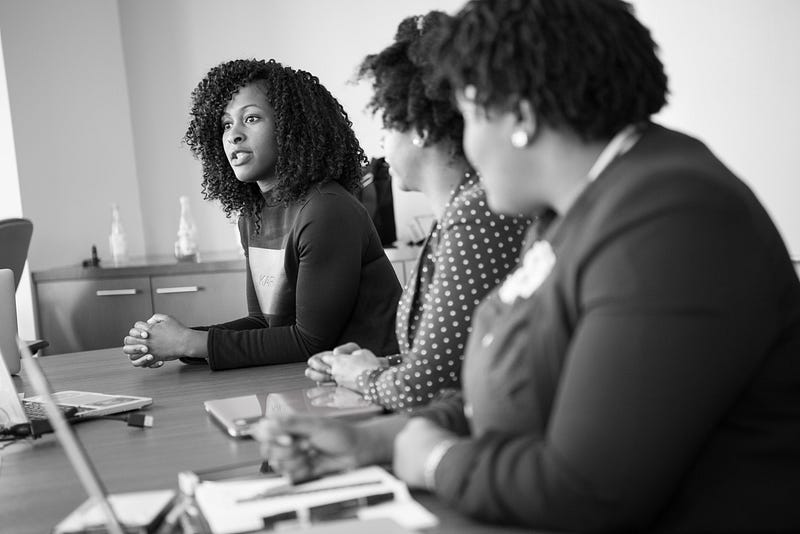
So for most of my professional career, I have had to insist with a smile to get a word into the conversation. I say with a smile, because, without it, I am immediately categorized as an “angry black woman” and disregarded completely.
Imagine the scene, I am at a meeting where my colleagues and I are discussing setting up programs in Africa. I have worked in the space of global health for close to 15 years now.
I am recognized for my knowledge and competence in setting up partnerships on the African continent, yet when I try to give my feedback about how to start a certain project, I am often talked over by mainly the white men in the room.
Interestingly enough, most of the time, they have never set foot on the continent or haven’t developed or implemented a project there either.
So I ask myself, why do they invite me to these meetings if it is to talk over me and not listen to what I have to say.
What dynamics are at play here?
Is it an unconscious and perverse way of showing dominance over me, is it a ploy to say, well the African woman was in the room when we discussed this, so whatever comes out of here has her vetting, and can for sure be run in Africa?
Truth be said, I don’t know what to think. Every time I have this experience, and it is often, I wonder why everyone else in the room can share their point of view legitimately and I cannot.
When it keeps happening time and time again, it becomes frustrating.
And I have tried to deconstruct this situation quite a bit, I have tried to understand why talking over women and especially black women is so common.
I’ve also wondered why other people in the room who see this happening, don’t come to our defense.
And as I am someone who always seeks to fix situations rather than sit there and complain, I have come up with a few recommendations about how companies can actually fix this problem.
But first, let’s get to the deconstructing part:
All through their lives, white men have been told that they can do anything and be anything. When a white man walks into a meeting, he has power, he may not be aware of it, but truth is, he does.
For centuries, this has been the case. The white man hasn’t had to listen or take advice from anybody else — except maybe from other like-minded white men.
With the Women’s Rights movement, females, albeit white women entered the workforce en masse in Western societies only just recently — 60 to 70 years ago.
There are still only very few of them in Fortune 500 company board rooms around the world today.
So, the white man still has a considerable amount of power. He is used to hustling and bullying to get whatever he has wanted through time — no one has ever stopped him.
The black woman, on the contrary, has lived the exact opposite type of life: completely invisible in most boardrooms around the world — and even when tokenly visible, pretty much powerless.
So while diversity may have bought more minorities into the higher echelons of power in some corporations, the still small numbers of these groups are not enough to change the way white men behave in the boardroom.
Take for example, if you have a board of 10 individuals and 6 of them are from different minority groups, and 4 are white. Here you stand more of a chance of building a new culture whereby each member is valued, respected, albeit, on equal footing.
This is what true diversity looks, like, and it is this diversity that drives growth and value-creation in corporations — not the token diversity we see in most companies today.
Let’s come back to the example of my colleagues.
If they had evolved in a work environment where there were equal numbers of black and brown men and women, they would have had to learn to respect these groups and not speak over or cut them off.
My point is if companies want to practice true diversity, they need to create and foster environments where one group or gender does not ever dominate another — in teams, in the boardroom, or elsewhere.
The minute you have domination, you skew the dynamics and find yourselves in situations where some team members are discriminated against based on their ethnicity, gender, and sexual orientation, and behaviors such as talking over them or cutting them off become a part of the company culture.
In some cases, doing this is even equated with a positive personality trait — being aggressive and forceful is seen as winning. No need to look too far — take the example from the first Trump-Biden 2020 presidential election debate to understand that this is the way that some white men behave in the world.
But, things have to change. I and so many black and brown women are no longer willing to sit in meetings and get talked over or cut off.
I have things to say, I am a member of the human race and I am entitled to speak.
When black and brown women say: “Let me speak”, that takes great courage.
Those words uttered with a smile, are our way of telling the world, it’s about time you listened to us too.
As black women, we have lived, we have qualifications, we have leadership skills too. You can no longer ignore us, act like we don’t exist, tokenize us, or use us as an aesthetic in your corporate brochures.
We are here, and here to stay, and we can create strong and sustainable stakeholder value for your companies. All you need to do is give us the opportunity to speak.
Thanks for reading my perspective.


