
I Hit 1000 Views per Day for the Month
I should have been more specific about my goal

When I was starting my Medium journey, last February, any day when I got views or reads at all was a winner. Slowly, that number crept reliably upward. I got views and reads every day. Then double digits. Then triple digits.
I was also reviewing my stats and making a long-range plan for a viable business writing Medium articles . Based on the numbers I was seeing, I set my target at 300 reads per month. At the time, I had about a 30% read rate. So, I targeted 1000 views per day.
I gave myself until the end of the year to hit that target. It was in big block letters on my goal board. Every month, I measured how close I was to achieving it.
The last two days of December, I not only had over 1000 views, I had over 1000 reads each day! I totally nailed my goal!
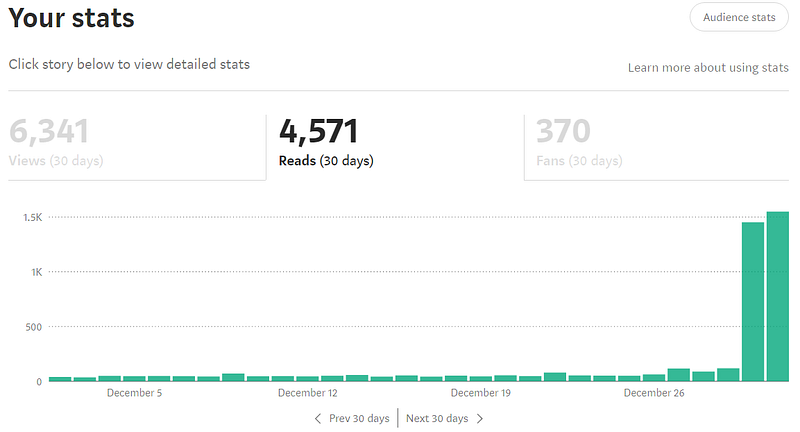
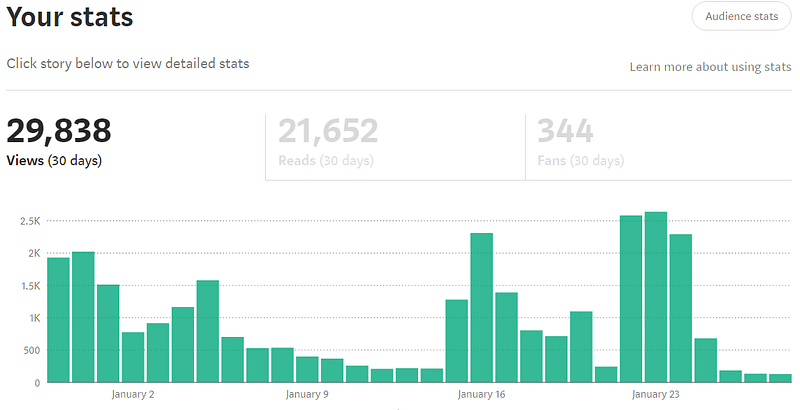
That trend continued into January, averaging about 1000 views per day for the month. Which meant, I should be earning an income that could be used as my primary means of support.
The only problem was, I’d gone from a mid-year monthly high of over $100 (before bonuses) back down to where I’d started. I made $13.63 in January. I’d made $13.66 my first full month of writing for Medium.
How could I have reached my goal for profitability, yet be making less than when I started?
Monitor your metrics
I set the views/reads measurement as my goal, because it was something I could track. I could see how many views or reads my stories were getting. I could tell if the read rate was improving, or backsliding. I could judge how well certain publications were for generating reads, and which weren’t worth the time and effort to submit to.
But I didn’t really care about views and reads, other than it meant my work was reaching more people. They were just the convenient stand-ins for the measurement I really cared about, which was how much my articles were earning.
And because Medium changed its author compensation program, the underlying assumptions my targets were based on were no longer valid.
Change of format
I’d originally calculated my targets when I was writing long-form articles. This summer, I switched to a mix of long-form and short-form articles. This fall, as a result of planning and executing an international move, I wrote primarily short-form articles.
My targets were based on writing articles that were primarily in the 3–9 minute read range. Say, on average, that they were 6 minutes long. The short-forms are 1 minute reads.
That means, just by changing format, I should have changed my goals to seek 6,000 views per day. Yet my goals were still based on the underlying assumption that people spent 6 minutes reading each article.
Change of compensation
Medium has been playing with their compensation plans all year. I benefited greatly from that this spring and summer, picking up an extra $700 in bonuses. But the change this fall torpedoed my earnings.
My strategy had always been to appeal not just to Medium readers, but to external readers. Based on the numbers I was seeing, I could expect about one in every 100 external readers to become a Medium member during the 30 days after they read one of my stories. I’d get a significant signing bonus when that happened.
This fall, however, Medium changed their compensation to reward the person who directly encouraged a person to sign up for membership. That person would get an ongoing monthly payment. Unfortunately, that left a much smaller pool of payments for everyone else.
I still saw signing bonuses. In one case, there was a payment of $.40 for a story, on a day when there was only 26 seconds of reading by Medium members. That was almost certainly a signing bonus. But it wasn’t significant.
To reflect the new compensation model, I should have focused on internal views and reads. That was now the bread and butter of income generation. But my target remained overall views and reads, in part because that’s the number Medium reports.
Adjust your aim
Every month, you should be evaluating your performance against your metrics. But you should also be evaluating your metrics’ performance.
If your underlying belief is that 1000 views will lead to 300 reads, and that 300 reads will result in a liveable wage, put that to the test. What percentage of views did you have? Did you have the same percentage of reads? Did you earn the same percentage of a liveable wage?
While your numbers are small relative to your overall target, they may vary wildly. But as your numbers grow, these percentages should stabilize.
For example, my most profitable story got 3.1k views, 1k reads (33% read rate), and earned $106.64. Based on that, I should have adjusted my metrics. The ratio of views to reads was in line with my starting assumptions. But the money earned was not.
My most popular story got 25k views, 19.1k reads (75% read rate), and earned $1.04. None of my metric assumptions matched reality for that one. I should have adjusted my view to read ratios. And I definitely should have split out internal versus external views and reads.
If I had been adjusting my metrics throughout the year, I would not have been so surprised to reach my target and still horribly miss the success that target was supposed to bring me.
Conclusion
It’s good to have goals. They give you something to strive for, and you feel great when you reach them.
But that achievement will be meaningless, unless what you’re measuring your goals against actually matches what you ultimately want to achieve.
To make sure achieving your goals is not a hollow victory, you need to monitor your metrics.
If the underlying ratios change, adjust your goals to match. For example, your initial calculations were based on a 6-minute read, and your current production is 1-minute reads. Multiply your goals by 6 to reflect your new reality.
If any of the underlying assumptions of your metrics change, adjust your metrics to match. For example, if internal and external viewers count differently toward your results, track them separately.
Over the course of a year, you can and should measure how well your metrics are matching reality. If the metrics are a stand-in for a harder-to-measure goal, did the percentage of metric achievement match the percentage of overall goal achievement? If not, make your metrics better.
If you do this, hopefully, at the end of the year, not only will you meet your metrics. You will also find the success they are directing you toward.


