
I Have a Problem With The International Bestseller ~‘The Courage To Be Disliked’
And I just cannot shrug it off
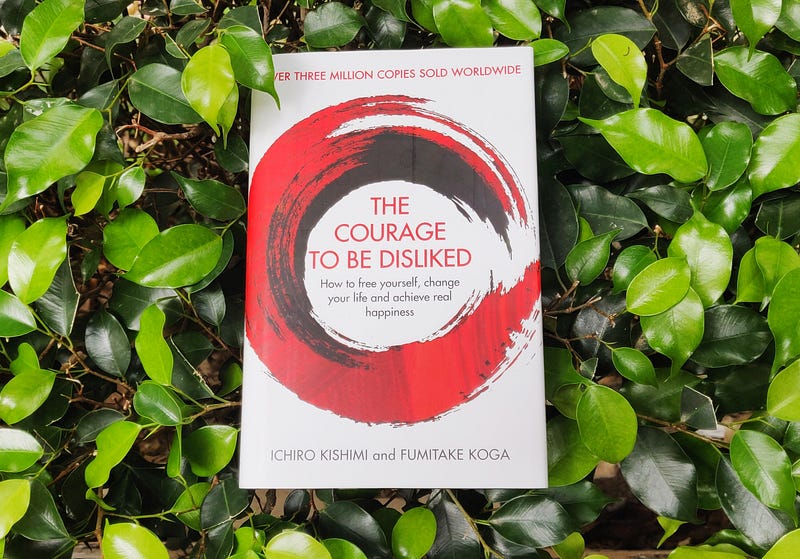
‘The Courage To Be Disliked’ has been doing the rounds like crazy. Everyone in my book club is talking about it. The book has sold over 3.5 million copies in Asia (majorly in Japan and Korea). After its release in the US in 2018, the book is an international phenomenon.
Basically, its a conversation-style book that dissects Alfred Adler’s philosophy for a happy life. Adler was one of the three giants of psychology along with Sigmund Freud and Carl Jung. However, Adler did not agree with Freud’s theories and formed his own school of thought, known as Adlerianism / Individualism.
The book is written as a discussion between a troubled young man and a philosopher teaching him the basic tenets of Adlerian philosophy to overcome his personality problems. The writing is very simple but I took a whole month to finish it. I took notes, wrote down my comments, and underlined the hell out of it.
There is just no other way to say this: I do not agree with this book. Infact, I have a problem with this book.
Disclaimer: I am a lawyer, not a philosopher, psychologist or a certified researcher in either domain. My observations are based on what I’ve read in this book and my general understanding of the various related schools of thought. Since the authors expect the readers to grasp the basic fundamentals of Adlerian philosophy by simply reading this book, I think it is fair to state my issues without going into further reading into the subject.
In this post, I’m going to quote from the book. I will link page numbers to the hardback version available in the Indian sub-continent. The page referencing may vary throughout global editions.
Issue #1: TRAUMA DOES NOT EXIST
Adler states:
“No experience is in itself a cause of our success or failure. We do not suffer from the shock of our experiences-the so-called trauma-but instead we make out of them whatever suits our purposes. We are not determined by our experiences, but the meaning we give them is self-determining.” (pg 12)
When I read the title of this Chapter — ‘Trauma Does Not Exist’, I immediately bristled, but at the back of mind, I expected to find some eye-opening logic in the text. Nope, I didn’t find any. The philosopher informs us that whatever our sufferings may be, we are using them as an excuse to live out our lives because ‘it’s our goal to think that way’.
Immediately, the thought of my grandma enveloped me. Everyone remarked that grandma was a little weak-hearted so we better not play any pranks on her. She was terrified of the dark. We always slept with the bathroom light on. One night, I asked Grandma why she was so afraid of the dark.
She said that when she was a kid, her family had fled to India during the 1948 riots (India-Pakistan partition). At the end, she had to cross the border on foot with her mother and aunts. Her brothers who were guarding them were killed by the rioters with an axe, while my grandma, terrified, ran through the fields in the dead of night.
I wonder how Adler’s logic can help my grandma with the trauma she suffered. Would she really be able to believe Adler’s ‘trauma does not exist’ logic?
Here’s the thing about traumas. They operate on sub-conscious level. Somehow, it does not sound convincing to affirm your conscious self that there is no trauma and expect things to get better. The work needs to be done on a sub-conscious level, but the book simply asks us to believe another reality. And that does not make me happy.
And that’s the real question: are human minds really as simple as Adler’s tautology suggests — that you set your goal to imbibe a different personality and then just do it?
Do you think you can achieve it?
I’m not positing that Adler is wrong. He was possibly right but the method suggested in the book seems unfeasible, much more so for those who have witnessed soul-jarring trauma in their lives. People go through wars, rapes, family murders, leaked sex tapes, debilitating accidents and what not.
Is it really helpful to tell people that trauma does not exist? You decide.
Issue #2 ADMITTING FAULT IS NOT DEFEAT
I have no problem with the above sentence. Infact, I believe in admitting my own fault. I’ll happily change my mind when I see logic, and I dislike getting into pointless arguments.
While explaining power struggles, the author says:
“No matter how much you might think you are right, try not to criticize the other party on that basis. This is an interpersonal relationship trap that many people fall into… The moment one is convinced that ‘I am right’ in an interpersonal relationship, one has already stepped into a power struggle… If you think you are right, regardless of what other people’s opinions might be, the matter should be closed then and there.’ (pg 86,87)
Now, I understand the point about not getting into a power struggle. Sometimes, we cannot make some people see things from our perspective. And that’s alright. A wise person knows to evolve beyond petty quarrels and carry on living a life of honour.
But there is one thing that immediately comes to mind: what about the aftermath and the side-effects of this?
I agree you doesn’t need to get into a power struggle. The real question is, how does one find the energy to keep up this attitude in the long run? Power struggles — because they are a part of life — do tend to make you bitter (and other attached negative feelings), especially when you’re the one who is always letting go.
There will always be a handful of people in our lives who constantly try to get into a power struggle with us, and we constantly deny them: controlling parents, rebuking mothers-in-law, competitive siblings, jealous bosses and so on.
When others keep releasing their anger on us or act unjustifiably towards us out of rage or envy, does this not adversely affect our mental health as a long term side-effect?
How do I reconcile with feelings of being wronged, again and again? I know myself: I can get bitter when I’m the one constantly choosing not to get into a power struggle every single time. How do I overcome feelings of being victimized?
Am I expected to just forget and let go, tell myself that ‘this is not a trauma and it does not exist’? Again, we circle back to the original question: how easy is it to do that?
Simply denying power struggles all the time does not seem like a lasting, wholesome solution. You need to tell us how to deal with the side-effects of such an approach.
Issue #3: HOW TO SEPARATE TASKS
Adlerian psychology positions that one must separate their own life tasks with that of others. And one must not intrude on other people’s tasks. This is a great philosophy, in theory.
The example given is that of a child who does not like studying and whiles away their time.
Now, the author says:
“…studying is the child’s task. A parent’s handling of that by commanding the child to study, is, in effect, an act of intruding on another person’s task… We need to think with the perspective of ‘whose task is this?’ and continually separate one’s own tasks from other people’s tasks.” (pg 121)
So, the question is: how does the parent deal with an unresponsive child?
The book opines that:
‘one tells the child that that is his task, and one lets him know that one is ready to assist him whenever he has the urge to study. But one must not intrude on the child’s task.’ (pg 123)
Honestly, I don’t mind the overall approach of ‘separation of tasks’ for general life (utopian as it sounds), but I do not believe that a child can accurately discern what’s best for them before they reach a certain age. Parents are necessary devils, or ‘meddlers’, as Adler puts it, and reasonable parental discipline is required to monitor and guide a child to get things into perspective.
I am not a parent yet but I would love for parents to comment on this aspect of Adlerian psychology. Does it actually work to just tell a child that it’s his task and let them be?
It also got me thinking about the general complexity of human action-reaction system. I mean, there is so much grey area here. How does the ‘separation of tasks’ philosophy bear upon misguided, disillusioned or indecisive people? What about addicts who know their tasks but just can’t help themselves? Do we not need the support (or even intervention) of a friend or a spouse who refuses to give up on us while we’re down?
Can we really judge, correctly so, what our tasks are? Can a child do that, as well?
Think of a time in your life when you needed that kick between the legs. What if your friend thought, ‘well, that’s not my task and I don’t need to interfere in his task’.
Where would all of us be without someone telling us the hard truth about a situation at the cost of being meddle-some?
While ‘separation of tasks’ is a great idea in theory, implementing it upon the nuanced, complex reality of human life sounds utopian.
Issue #4 THE CARDS TO AN INTERPERSONAL RELATIONSHIP
In this part, the philosopher recounts his turbulent relationship with his father who used to hit him when he was a child. The philosopher says that, to keep on thinking that ‘because his father hit him and that’s why their relationship went bad’ is an aetiological way of thinking (Freud’s cause-and-effect psychology), but the Adlerian way has taught him that he is bringing up the memory of his father’s abuse because he does not want his relationship with his father to get better.
When he finally resolved to repair his relations with his father, he decided to let go of issues like what his father’s reaction would be, or what his father thought of him at this point. The point being, the philosopher did not change to change his father but only his own attitude towards this interpersonal issue.
The philosopher says:
‘Even if I change, it is only ‘I’ who changes. I do not know what will happen to the other person as a result, and that is not an aspect I can take part in.’ (pg 150)
My first reaction was: Oh my God, that is so true but I wish it were that simple. Now here’s the truth: most families are dysfunctional, some more than others. While all of the above sounds great on paper, I’m just wondering if the reality of any interpersonal relationship is as cut and dry as the author makes it out to be?
There are many reasons for this. Firstly, relationship issues are an ongoing problem. Usually, if you have problematic relationship with your parents, it’s usually because of ‘how they are’ and not because of ‘that one thing they did in the past’. For example, one of my closest friends has a borderline-narcissistic mom. How can she implement the philosopher’s advice? Even in happy families, people sometimes don’t see eye to eye with their parents or siblings, and that’s why interpersonal issues are a constant process.
How do we actually separate tasks, then? How does one ‘repair’ a complex, tangled relationship within family, on the basis of separation of tasks?
Secondly; the philosopher asks me to not allow others to meddle in my life tasks. This (most probably) leads to a power struggle between me and say, my mother. On the other hand, the philosopher also asks me to not criticize my mother even if I’m right because that would lead to a power struggle between us.
In this case, how do I separate my tasks from a parent who has a different perspective but also comes from a place of concern? And how do I deal with a somewhat-meddlesome-but-kind-parent (or a loved one) who feels hurt when I actually communicate that I am separating my tasks.
Because the truth is, communication is complicated, more so between families. To me, a real-life interpersonal situation is not as simple as forgiving an abusive father and just carrying on for the rest of your life like it never happened.
Issue #5: DO NOT REBUKE OR PRAISE
One of the main tenents of Adlerian philosophy is to ‘build horizontal relationships’. A vertical relationship is where one part views themselves as better than the other party, and exhibit this tendency by rebuke or praise. For example, when a parent either praises or rebukes the child, they are imposing a hierarchical relationship.
The author says:
“In Adlerian psychology, we take the stance that in childrearing, and in all other forms of communication with other people, one must not praise… One must not praise, and one must not rebuke. That is the standpoint of Adlerian psychology.” (pg 178, 179)
Why, you ask?
The philosopher says:
“In the act of praise, there is the aspect of it being ‘the passing of judgment by a person of ability on a person of no ability’.” (pg 179)
“When one praises another, the goal is ‘to manipulate someone who has less ability than you’. It is not done out of gratitude or respect.” (pg 179, 180)
“Adlerian psychology refutes all manner of vertical relationships, and proposes that all interpersonal relationships be horizontal relationships.” (pg 180)
I am quoting heavily from the book because I do not want to seem pointlessly critical without giving a complete perspective of their philosophy. The World might be a better place when all relationships are horizontal and nobody feels that they are superior to another. But, again, the idea of ‘no rebuke/no praise’ just sounds so clinical.
It is incorrect to say that all praise is given out of a desire to manipulate. At a party, recently, I praised Noah Baumbach’s dialogue writing style to no end. I do that a lot — praise artists fervently during conversations. What could my motivation be other than to express my wonder and delight at a genuinely moving piece of art? Do I want to manipulate the artists who will never hear my wide-eyed litany, or the group of people who I may never meet in my life again?
What about honest, genuine praise because you’re proud of your sibling’s achievement? What about well-meaning, direct rebuke to a friend who is unable to see their own part in their troubled life? What if certain kind of manipulation is good? Like, a parent’s praise to encourage their child to make their own breakfast, because ultimately, that is a life skill they need to learn.
Overall, my main problem throughout this book has been that it gives out these really radical principles but, neither does it help me understand how to apply those principles, nor does it answer any of my key concerns emanating from the application of those principles.
GENERAL COMMENTS
This post is not an attempt to trash the book. Adlerian philosophy has some brilliant, life changing advice as well. I will try and put them in a separate post.
In its defence, the book does make it clear that Adlerian philosophy is not easy to grasp or implement. You pay the price of letting go of some key relationships, and other equally important aspects of life, but in the bargain, it promises that you gain mental freedom and real happiness.
Another aspect that I want to highlight is that according to Adler, it will take half your age (in years) of your future to be able to fully imbibe Adlerian philosophy into your life. Given the simplicity of its principles and the complexity of the human world; I would say it’ll take me the rest of my life, were I to try.
I do not believe or profess that you cannot implement Adlerian philosophy. At the same time, it’s not for everybody.
Your suitability to it depends on your temperament. Some people can be very ‘cut and dry’ about their relationships and they might relate to it more. But ig you’re like me, somebody who is governed by emotions and instinct , you’ll have a really tough time.
People come in various shades: some of us are are more sensitive than others. Some of us thrive on encouragement and praise. These people will have a tough time with this book. Nobody’s wrong though; we’re all just built differently.
The Adlerian philosophy of life is perfect, if applied on a communal level. For example, if an entire family decides to follow the philosophy of ‘separation of tasks’, it might work. At an individual level, it is going to be an arduous, upstream swim in a rocky river.