I Hate That I Love to Talk About People Behind Their Back
Understanding the mechanics of why we do it, how to do it right or stop doing it altogether.

Strong minds discuss ideas, average minds discuss events, weak minds discuss people — Socrates
I really don’t like this about myself. I keep falling into the gossip trap time after time; have you heard about (..) And it makes it even worse that I am aware of it. Some of my most common victims are Bosses, co-workers, neighbors and mutual friends.

So, why do we do it
Is it because of resentment? Envy? Is it just a way to keep the conversations going? Or is it because they differ from us?
When I outlined this article, I asked my 10-year-old daughter why people talk about other people behind their backs. She answered this:
I don’t know. Maybe because they are struggling or something?
Is it? Is this some weird self-treatment? Do we feel better when we trash talk? Is this a way of escaping, or maybe defending our own shortcomings? I don’t know, but it’s something to think about.
Is it OK to talk about people behind their backs?
The easy answer is a big fat NO. But it’s more complicated than that. I don’t think it’s OK to talk badly about other people. What about our boss and the way he/she’s handling things? Maybe. If the focus is on their function and not their person.
We need a steam-valve, somewhere to occasionally vent our frustrations.
What about Co-workers, Neighbors, and friends?
We teach our kids to be nice and fair. We teach them how to resolve conflict face to face and not talk about other kids behind their backs. We teach them how to handle confrontation and not to bully. Do we practice what we preach?
If something annoys us about another person, we will continue to search for things to enhance that annoyance unless we do something about it.
It is difficult to tell someone you work with or relate to regularly that you don’t agree or like the way they act. It’s easier to talk to someone else about it. And done right, that may actually be OK.
How can we vent our frustrations without feeling like jerks?
Sometimes we just have to Cowboy up and ‘do the talk’. Done right it could even be a good experience, for both. Here are some tips:
- Don’t be angry when you talk to them. If you are angry, cool down first.
- Make a plan for what you will say, and how you will say it. Don’t improvise.
- There is a reason we have two ears and only one mouth; we should listen twice as much as we talk.
- Tell them how YOU feel. Don’t blame someone else. Everybody feels that you are (..) It is not true and makes it much worse for the receiver.
- Be direct but kind. Don’t go around the bush. Say what you have planned to say and stop.
- When you have said your thing — SHUT UP. Let them react. Don’t start an argumentation or discussion. They need to process, and you need to listen.
Core Quadrant — Focus on the good
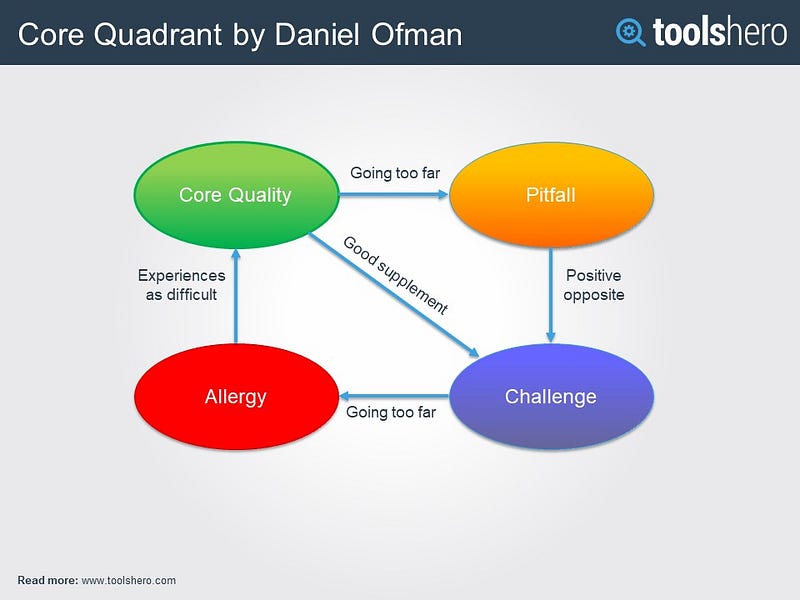
If we need to talk about someone, talk about their talents and their core quality instead of our own allergy (see illustration below). If we learn why we react the way we do it is easier to understand the other person.
Example:
Person A’s core quality is decisiveness, their pitfall may be nagging, the challenge is patient and the allergy passive.
Person B’s core quality is modest, their pitfall passive, the challenge initiative, and allergy obtrusive.
Person A and person B may easily end up being each other's allergies. If you know what their challenge and core qualities are, it´s easier to see that it‘s not ill will, but only a talent that’s gone too far.
It's all about being mindful. Try to think what drives the person to do what they do, instead of believing they only exist to annoy you. They don’t.
I started with Socrates, and I will end with the test of three:
One day the great philosopher came upon an acquaintance, who ran up to him excitedly and said,
“Socrates, do you know what I just heard about one of your students?”
“Wait a moment,” Socrates replied. “Before you tell me, I’d like you to pass a little test. It’s called the Test of Three.”
“Test of Three?”
“That’s correct,” Socrates continued. “Before you talk to me about my student let’s take a moment to test what you’re going to say. The first test is Truth. Have you made absolutely sure that what you are about to tell me is true?”
“No,” the man replied, “actually I just heard about it.”
“All right,” said Socrates. “So you don’t really know if it’s true or not. Now let’s try the second test, the test of Goodness. Is what you are about to tell me about my student something good?”
“No, on the contrary…”
“So,” Socrates continued, “you want to tell me something bad about him even though you’re not certain it’s true?”
The man shrugged, a little embarrassed.
Socrates continued, “You may still pass though because there is a third test — the filter of Usefulness. Is what you want to tell me about my student going to be useful to me?”
“No, not really…”
“Well,” concluded Socrates, “if what you want to tell me is neither true nor good nor even useful, why tell it to me at all?”
The man was defeated and ashamed and said no more.
Ses! (Norwegian slang for see you later)