
THE CANCER CHRONICLES
I Graduated From Chemotherapy Class!
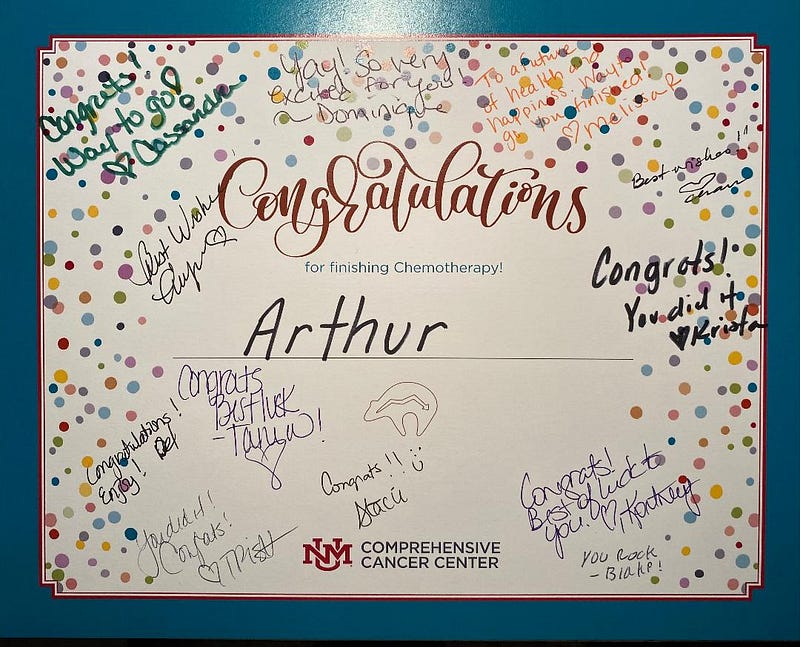
And here’s the certificate to prove it
April has been a hard month.
I’ve only managed to publish six articles, and I feel they were uninspired at that. It happens when you’re lethargic — when you feel like you don’t want to do anything.
My cancer journey has seemed so rote.
You go to the ER for one thing, and the next thing you know, you’re put through a series of tests that seem to have nothing to do with your condition. You don’t question; you just do. At least that’s how I did it.
In my case with lymphatic cancer, the pet scan, the final test before treatment began, was all we needed to know that it was time for action. Between my neck and my waist, there was purple. Lots of purple. Purple is bad.
And so it began.
It didn’t seem so bad at first. In fact, I was looking forward to the downtime—time to catch up on reading. I’d bring my laptop with high hopes of being more prolific in my writing. But in hospitals, there’s no rest for the weary. I could barely get in a twenty-minute nap without being interrupted.
Before my first chemo infusion, the doctor prescribed three anti-nausea medications. I took them after the first couple of infusions but then began feeling that it was too much combined with all of the other medications I take. In addition, recreational marijuana had just become legal in New Mexico, so I decided to go that route.
Nausea only came once, and it wasn’t severe. But mostly, I felt drained, lacked motivation, and was extremely tired.
It was the long-term side effects that troubled me the most. I wondered what all of those chemicals were harming besides doing their job of killing cancer cells. They are harsh on your internal organs, especially your liver and kidneys. All kinds of trouble can arise from those being compromised.
For the first time in my life, I thought long and hard about my drinking patterns. I’d been drinking almost every day in the years leading up to this. I wasn’t a drunk, as I’d only have one or two drinks an evening. But to me, that was enough to call it “alcohol use disorder.” It was the cumulative effect that I knew should be worrisome. Since this, I’ve been drinking far less, as it’s within my control. And I want a functioning liver.
So, some good has come out of it, and I’m sure I’ll be looking at ways to eat more healthily and live a more sustainable lifestyle.
When I first “achieved” the above certificate, I was very grateful for the oh-so-caring staff at the UNM Cancer Center. There wasn’t a bad apple in the bunch. “How can these people be so cheerful and uppity all the time?” I thought.
Then I laughed. I compared the certificate to today's kids in various competitions where everyone often gets an award just for participating. I was another one of those kids who showed up.
I’m an optimist, but I’m not cured. I’m in remission, just like almost everyone else who has had cancer. But unfortunately, the likelihood of lymphatic cancer returning in 5–10 years is around 70–80%. Or so I’ve read.
My cancer was at stage three when it was discovered, and my oncologist said it was rather aggressive. But it could have been so much worse. There wasn’t any pain, such as what you might have in other types of cancer. If it had gone on unchecked, who knows. We who have had cancer will have screenings for the rest of our lives.
Before this, I thought I was still middle-aged, somewhere between 40 and 55. However, cancer taught me something different, and now at 64, I’m at a crossroads—no more pretending to be younger than I am. But no need to be a stodgy old bastard either!
It’s time to respect my age. I’ve gotten away with so much. It’s time to grow up.
Here are a couple of other articles from the series:
If you like what you’ve read, why not become a Medium member? It’s just $5/month and gives you access to all of my stories and those of all the other fine writers on Medium. Plus, I get a small commission which helps a lot! Just click on the link below. Thanks for being a member!


