
I got to see Bard in action and it's amazing!
Discover the Surprising Winner in ChatGPT vs Bard
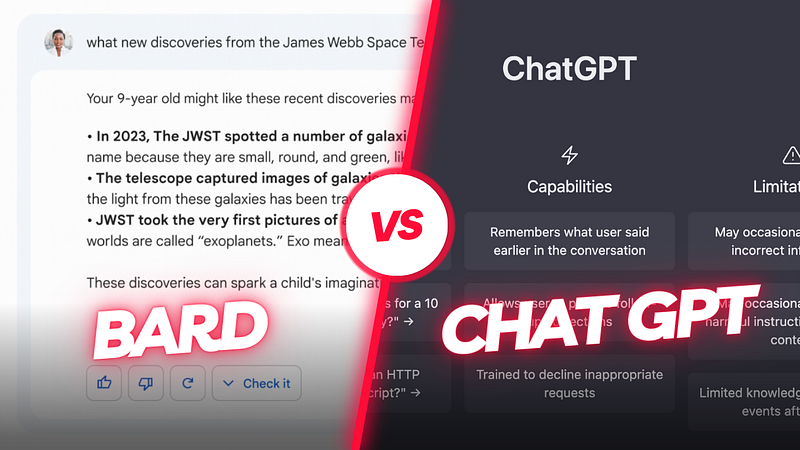
Google is notorious for releasing AI-related announcements with no way for the public to test them. I thought the same will happen when Google CEO Sundar Pichai announced the release of Bard a couple of hours ago. But luckily this time I got to see the AI in action. And trust me, it made me say Wow! even after playing around with the ChatGPT for the past 2 months.
What is Bard?
Bard is Google’s answer to ChatGPT. Bard is an experimental conversational AI tool built on top of LaMDA.
LaMDA is a language model developed by Google using a two-stage training process. The model was fed a large dataset of 1.56T words obtained from public dialogues and web documents, which was nearly 40 times larger than the data used to train previous language models like Meena. The dataset was tokenized into 2.81T SentencePiece tokens, and the model was pre-trained using a GSPMD approach to predict the next word in a sentence based on the previous words.
LaMDA model has proven to be useful for various natural language processing research across Google, including program synthesis, zero-shot learning, style transfer, and participation in the BIG-bench workshop.
Bard vs ChatGPT:
A basic comparison of ChatGPT and Bard gave the following results.
- User interface: The Bard user interface is slightly more refined compared to ChatGPT. The material design concept used by the Bard team is really giving a cool feel to the UI.
- Response time comparison: It’s difficult to accurately assess the speed of response as it depends on the number of users both applications are serving. ChatGPT serves millions of users simultaneously, resulting in frequent system overloads and slower response times. In contrast, the Bard instance I observed is used by less than 1000 users at the time, making it noticeably faster.
- Accuracy in facts: Both systems are highly accurate when it comes to retrieving factual information. They performed similarly on questions regarding dates, quizzes, and even solving riddles.
- Subjectivity accuracy: This is where the two systems show some differences. Bard provides more polished answers compared to ChatGPT. At times, Bard’s answers seemed overly diplomatic and hesitant to fully commit to a stance, opting to acknowledge the existence of multiple valid perspectives. If you need support for your opinions or concrete opinions, ChatGPT is the definitely way to go.
- Effectiveness in generating Essays: Both Bard and ChatGPT are language models designed for text generation. Bard is designed for a more specific use case of generating academic quality writing, and it definitely has an edge in generating clear and concise essays with fewer prompts. The quality of text generated by ChatGPT depends on the quality and specificity of the prompt given to it, and with a proper prompt, it can generate essays that are just as compelling as those generated by Bard. Ultimately, the choice between the two hinges on the specific needs and requirements of the task at hand.
So which is better Bard or ChatGPT?
Both Bard and ChatGPT have their strengths. A clear winner can only be determined after extensive testing of both tools with comparable loads, but initial tests do suggest Bard may have a slight advantage over ChatGPT.
Integrating Bard with google search and its impacts:
Google Search has the potential to be even more efficient and effective with the help of the AI technology utilized by Bard. AI integration will make it easier for users to find what they’re looking for and gain knowledge more quickly.
No more scrolling through pages of irrelevant information, AI will guide you to the heart of the matter.
Currently, people turn to Google for quick factual answers, but increasingly for deeper insights as well. However, finding the information and understanding a topic can be time-consuming and involve searching for diverse perspectives on different websites. AI can assist by synthesizing information from multiple sources and presenting it in an easy-to-understand format, providing users with a comprehensive overview of a topic.
Soon, Google Search will be updated with AI-powered features that streamline the information-gathering process and make learning even more accessible to millions.
How to get access to Bard?
Google has announced its plans to release its new AI technology, Bard, to a select group of external partners before giving public access. The company stated in a blog post that the public will have access to Bard’s AI-generated text, in the near future. The exact timeline for the public release has not been disclosed.
Starting this week, the general public will have access to search results that may feature AI-generated text, particularly for complex queries. This means that when a user searches for information on which career opportunity, engineering or medicine, is the better option, the search results may contain AI-generated text that provides insights and analysis.
Where Bard and LaMDA will be Implemented Next?
LaMDA and Bard will soon be making their way to various google Products and we can expect to hear more announcements this quarter:
- Google Search
- Google Cloud
- Gmail
- Google Workspace (G suite)
Bard and LaMDA are paving the way for AI integration in Google products like Gmail, Google Cloud, and Google Workspace.
is Bard sentient?
Initial interactions with Bard didn't give any indications that the AI tool is sentient.
Parting thoughts:
Bard is an enjoyable tool and has technically very solid, but whether Google will make it as accessible as ChatGPT remains uncertain.
The success of Google’s new tool in capturing public attention and integrating the tool into various applications will determine if the company will maintain its position as the leader in organizing the world’s information or if it will be surpassed by new competitors.


