
I Got The Johnson & Johnson Vaccine The Day Before It Was Paused
Should I Worry?
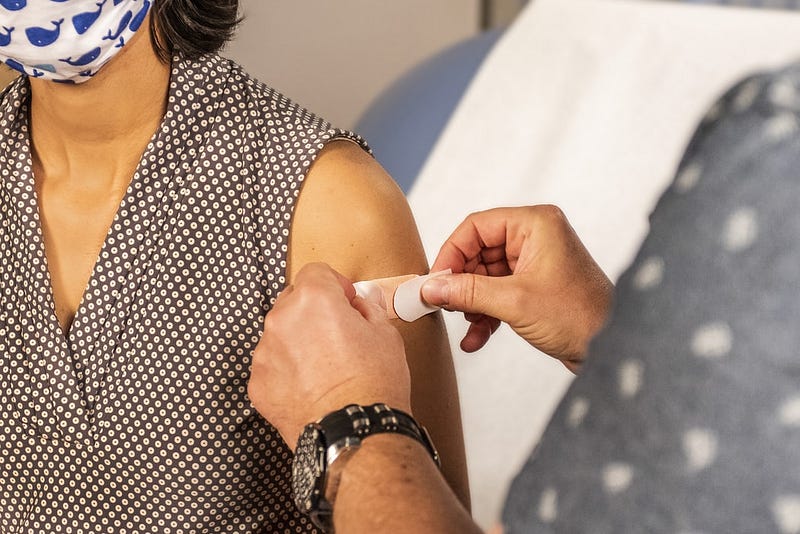
My partner and I were excited. A small pharmacy in Walhalla, South Carolina, had called to confirm that we could schedule an appointment for the Johnson & Johnson COVID-19 vaccine.
We set up our appointment for April 20, then heard the news. The J&J vaccine supply would be cut by 88 percent, due to a human mistake at one of their vaccine production plants.
Afraid the vaccine supply would run out before our appointment, we called the pharmacy and discovered we could get vaccinated as soon as Monday, April 12. Elated, we hopped in the car and drove two hours to South Carolina.
I am a South Carolina resident and my partner lives in Georgia, so we were eligible to get vaccinated in either place. But it had been harder, so far, to get vaccinated in Georgia.
We pulled up to the pharmacy at 10 o’clock in the morning, and there was a parking space right in front of the quaint, old-fashioned store. Only two people, a woman who looked to be in her thirties and a man who looked even younger, were ahead of us in line.
We filled out the necessary forms, presented our medical insurance cards, and waited five minutes before the pharmacist, Youssef Elaffy, called my name: Breattie.
“You’re the only person who has ever pronounced my name right on the first try,” I joked as Mr. Elaffy, who was from Egypt, prepared to give me the shot.
“You know this is Johnson and Johnson. Only one shot, right?” He asked.
“That’s why I want it,” I nodded.
There was a brief sting, no worse than the flu shot I get every year, and I was done. The pharmacist presented me with the coveted vaccine card and told me not to lose it. Just to be on the safe side, I took a picture of the card on my phone.
I knew I would need the card. There had been talk of requiring vaccine passports to board cruise ships, airplanes, and to get into other countries. One of my friends said a vaccine card might even be required to see plays and get into movie theatres.
My partner and I high-fived each other when we were back in the car. Most of our friends who were in their sixties and seventies had been vaccinated weeks ago, and we felt a sense of freedom at joining the ranks of the vaccinated.
Side Effects Kick In
But that night, my high spirits ebbed as I grew feverish. Headache, chills, and body aches followed. I was awake all night with flu-like symptoms.
My partner didn’t have any reaction, but I am prone to extreme reactions to medicines that don’t phase most people, so I took it in stride.
The next morning, I was much better until he said, “Listen to the news.”
It was all over television. The J&J vaccine we had been so relieved to get the day before was being paused because six women had suffered a severe and rare type of blood clot from 6 to 13 days after being vaccinated.
“Great,” I mumbled, still weak from my sleepless night. “Now I have to wait three weeks to see if I’m going to get a blood clot.”
An “Abundance of Caution”
The U.S. Centers for Disease Control and Prevention and the U.S. Food and Drug Administration were strongly recommending that dispersal of the Johnson and Johnson vaccine stop out of “an abundance of caution.”
Once the South Carolina Department of Health and Environmental Control (DHEC) received word of the pause, DHEC issued a statement about the state’s compliance due to concerns with blood clotting.
“The pause will affect the current supply of vaccines around the state, about 35,000 doses will be stored and labeled “DO NOT USE” until further recommendations are issued,” according to the DHEC statement.
The Johnson & Johnson vaccine had accounted for only 7,000 doses a week in South Carolina compared to more than 40,000 each of the Moderna and Pfizer vaccines.
According to the state health agency, millions of people and about 87,000 people in South Carolina have received doses of the Janssen vaccine with few side effects. None of the clotting cases occurred in the state.
In an updated statement Tuesday, Johnson & Johnson said it was “aware of an extremely rare disorder involving people with blood clots in combination with low platelets in a small number of individuals who have received our COVID-19 vaccine.”
“We have been working closely with medical experts and health authorities, and we strongly support the open communication of this information to healthcare professionals and the public,” the company said.
South Carolinians who were scheduled to get the Johnson & Johnson vaccine are being urged to get one of the other vaccines.
As of this writing, there has been no word on when the J&J vaccine will be available again.
The Advisory Committee on Immunization Practices (ACIP) met to discuss whether currently, available information is sufficient to make age or risk-factor-based J &J vaccine recommendations.
But rather than make a recommendation, the ACIP moved to extend the pause and meet at a later date.
The types of blood clots observed in 6 out of 6 million people who have had the J&J, or Janssen vaccine, is called cerebral venous sinus thrombosis and is occurring in combination with low levels of platelets.
Why We Wanted The J & J Vaccine
Reports of blood clots are similar to reports seen in Europe after vaccination with the AstraZeneca vaccine, which has been halted in several countries.
Although all the U.S. cases occurred in women, in Europe both men and women developed blood clots, although there was greater frequency among women.
My partner and I had wanted the Janssen vaccine for several reasons. The fact that it is a single shot was a huge advantage, in our opinion. The other vaccines require two shots.
My partner also liked the idea that it was more of an “old school” regular vaccine. The Moderna and Pfizer vaccines use mRNA technology, and the Johnson & Johnson vaccine uses the more traditional virus-based technology.
We had read that it was slightly less effective than the other two vaccines, but all three vaccines had done well in preventing serious disease and death.
Finding out a day after I got the vaccine that six women had suffered blood clots after receiving it brought home the truth that there are many unanswered questions about the vaccines. That’s probably why pausing the vaccine’s distribution to find out some answers is probably a good thing.
But six people out of more than six million shows how rare these blood clots are likely to be.
A study by Oxford University found the number of people who receive blood clots after getting vaccinated with a coronavirus vaccine are about the same for those who get Pfizer and Moderna shots. This study contradicts the reports I heard, which were that there had been zero association with blood clots from the other two vaccines.
According to the study, 4 in 1 million people experience cerebral venous thrombosis after getting the Pfizer or Moderna vaccine, versus 5 in 1 million people for the AstraZeneca vaccine.
But the fact to keep in mind, as far as I’m concerned, is that the risk of getting CVT is much higher for those who get COVID-1: 39 in a million patients, than it is for those for get vaccinated.
Researchers at the University of Oxford reported that the risk of the rare blood clotting known as cerebral venous thrombosis is around 100 times greater than normal, several times higher than it is post-vaccination or following influenza.
There are conflicting reports, the vaccines are still under investigation, but having COVID-19 is a much greater risk.
If I don’t come down with a blood clot in the next three weeks, I will be able to say I’m happy I got the Johnson and Johnson vaccine.
The South Carolina pharmacist, Mr. Elaffy, seemed confident he was dispensing a good vaccine without any alarming side effects. Other than my brief bout with flu-like symptoms, I still feel good about it. And the pause should make us even more confident that vaccine safety is a priority.
A survey of my South Carolina subdivision revealed that 90 percent of the residents had been vaccinated. For this reason, the clubhouse is reopening for business as usual. And isn’t this what we all eventually want to happen?