I Get That the Black Community Should Be Skeptical Of Anyone Who Claims to Support Them
At some point, our society must come to terms with the realities of the power dynamics in play in our society
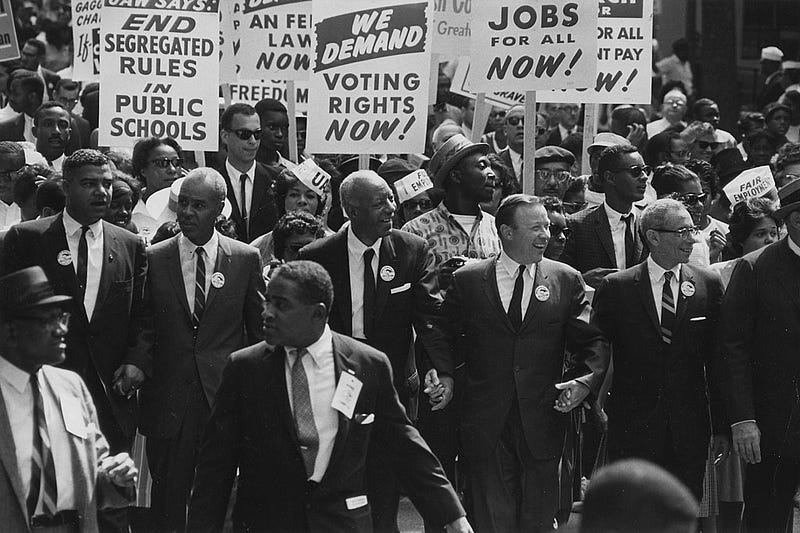
We’ve all been in relationships where there’s been a betrayal of trust. Maybe it came in the form of an infidelity. Maybe it was an act of physical abuse. Maybe it was something as simple as a lie.
There are betrayals that change the dynamic of a relationship forever. Sometimes these relationships survive and the couple remains together, but the dynamic will never be the same. The “puppy love” era has ended. Once the trust is broken, you’re left with only the shards of shattered possibilities.
The relationship between the black community and the white community in the United States is one of broken trust that came as a consequence of abuse. The saddest part is that the white community has never even tried to make amends.
The consequences of betrayal
Human beings are often delusional about the consequences of their actions. Married men indulge in affairs because they think they can get away with it. You see men who risk their homes and their families and everything they’ve ever worked for because they’re so blinded by ignorance and entitlement.
Once caught, some of them have a moment of clarity. They beg and they plead and perhaps they can stop their partners from showing them the door. But from that moment forward, the trust is gone and the interaction is different. Once proven unfaithful, the partner who broke trust loses the benefit of the doubt. Instead, they must spend the rest of their lives attempting to prove their sincerity.
The offending partner will chafe at this eventually. They’ll complain, “That was a long time ago. When are you ever going to let me live that down?” But those statements are dishonest because once the offended party stops watching the cheater like a hawk, he’s going right back to the same abusive behavior.
I feel this scenario can be used as a model to illustrate the dynamic between the white and the black community in the United States. The crimes of the white community are so great that all trust has been shattered. Rebuilding the relationship means that every positive action should be met with skepticism and thoroughly examined for evidence of deceit.
That’s the reality of being in a relationship of broken trust.
You don’t deserve praise for doing the right thing. There should be no expectation of reward for being decent. You should act that way because it’s the right thing to do.
Our society lacks the maturity to recognize that.
You can win power and money by pretending to be an ally
“I can help you, but first you have to help me achieve a position of significance.”
Yeah, funny how that works. By now, everybody knows that when you work together to lift somebody out of a collective pit, that person is likely to just skip away and forget about the people he left behind.
It takes a community to get to the top, but once people arrive there they suddenly start believing in the concept of a “self-made man.”
He can’t even be bothered to kick down a rope. He’s got new friends now. They’ll probably sit together and talk about how important it is to engage in social activism.
In fact, if the people back in the pit criticize the man they helped to elevate, he’ll become affronted. “How dare they? Don’t they realize everything I’ve done for them? How ungrateful! How jealous! Well, I’ll show them, I won’t lift a finger to help them!”
It’s convenient how becoming affronted can be used as an excuse to get out of doing any work. It’s convenient to fabricate reasons why the people who are suffering “deserve” it. Then you can clam to be decent even though you never do anything to help the downtrodden.
White writers who take on social justice issues
Now it’s time for me to point the finger at myself.
I’m not going to lie, I’d prefer to have people say, “Walter, thank you for what you do!” In fact, a lot of people do say that. I appreciate it when they say it, but I have to remind myself that it’s ego stroking.
Nobody’s had their issues solved because of anything I’ve written. Most of the time I feel like I’m screaming at the void.
Quite a bit of the time, I’m livid with the state of our society. I’m fearful for my kids. I’m sick of seeing children get murdered. In fact, it’s been a year since I was among the search party that found the body of the dead 11 year old girl in the woods.
It’s right for people to doubt my sincerity. If you’re trying to do the right thing, it should be expected that you have to prove yourself.
We’re in a relationship dynamic that is built on a betrayal of trust. That’s what that means. There is no place for pats on the back or high fives or any of that. We have to save the celebrations for the day all the suffering and inequality has been removed.
This is where you run into a problem. You see some white activist making some inconsequential effort, but when it’s not met with enough “gratitude,” that activist becomes so enraged he decides to switch sides.
The internet is overflowing with videos of enraged white men who are furious that they didn’t get the pat on the back that they felt they “earned.” They all look the same. They speak at a hundred miles an hour, they talk for 8 minutes straight, and they wave their hands erratically like a toddler reaching for potato chips that are just out of reach.
We have to be willing to be criticized
My greatest fear is that members of the black community will look at my writing and think, “Well, he’s getting a few things wrong, but overall I think he’s making a positive impact so I won’t criticize him.”
Or maybe they think it’s not worth the bother to engage in any form of dialogue because of white fragility. I sense that I have a lot of things to learn, but sometimes I don’t know where to go to get the answers.
It’s one thing to be aware that you have an unconscious bias, it’s another thing to actually identify that bias and try to overcome it. If people don’t feel comfortable to approach me and say, “Dude, you’re blowing it,” then I’ll contribute to harm and I don’t want that.
I must be doing something right because I regularly get insults and death threats from white supremacists. This actually gets pretty complex, some of the forms of camouflage they use can be very deceitful.
I’m quick to block anyone I feel to be an “oppression enabler,” however if I get a sincere criticism from somebody in a marginalized community I will listen. That being said, I don’t expect anyone to give me the benefit of the doubt that I go through this process. I recognize I have to prove myself every day.
The other side of this is that maybe members of marginalized communities have a better understanding of my nature than I ever will. Maybe they know it’s hopeless and they’re right.
After all, the system of abuse has been in place for hundreds of years. There has been an endless line of empty promises that have never been fulfilled.
We’re in a dynamic of broken trust, that’s the reality.
It doesn’t matter if you’re directly responsible or not
When I started bickering with my siblings as a child, my parents used to say, “I don’t care whose fault it is.” They wanted the conflict resolved so they could relax a little bit before going back to work.
Today we have people who say, “What are you mad at me for? I never owned slaves. I didn’t have anything to do with that. It wasn’t me! I’m not at fault! Go be mad at somebody else, I deserve the benefit of the doubt!”
That sense of entitlement is what gets us into problems. It demonstrates a complete lack of humility. So many members of the white community become affronted by the idea that anyone would be skeptical of their true motivation.
“You don’t know me, how dare you assume that I would behave like that! I assure you I’m completely sincere!”
The really dishonest ones try to call that behavior a form of racism. “You’re an anti-white racist!”
Anti-white racism doesn’t exist.
These are all examples that are meant to deny the reality that we have a dynamic of broken trust.
You’ve got to sit and take your lumps
The title to this article isn’t, “My quick and easy solution to solving America’s racism problem.” Nope. That’s because it’s not going to be quick and easy. The way I see it, it actually entails a kind of miserable process. It entails putting ego aside and recognizing that there’s no celebration until there is victory for all.
The problem is that the dominant community is so entitled that it feels it should be able to exempt itself from the pain of process. This is like how your boss at work is really eager to resolve problems at the company right up until you tell him it’s his behavior that has to change.
The advantage of power is that you never have to admit you’re wrong… but there is a cost to that. We all pay that cost.
I’ve been in situations where I was the one responsible for breaking trust. It sucks. At the low point, looking forward, it seems like you’re never going to be allowed to be happy again. But what I’ve found is that when you shoulder responsibility for your mistakes and you dedicate yourself to being better, good things will come to you. There is a way out, but it takes a long time, and you don’t deserve to be celebrated until you actually get there.
Just keep doing good work
I’m a long way from perfect. If you reach out to me and say, “Walter, you’re wrong on this,” you might get a snippy response from me. There are hard days. There are days when I’m fielding so many attacks I don’t immediately perceive which ones are actually constructive criticism. Progress comes in stops and starts.
Liars always become affronted when people are reluctant to trust them. They think they’re entitled to praise. They think they’re entitled to gratitude.
It puts you in a different mental state when you are willing to recognize you’ve made mistakes and you have no other choice but to spend the rest of your days working to make things right. Everyone wants to lift the trophy. Nobody wants to spend the days and weeks and months and years running laps and making sacrifices to get to the championship game.
Rather than waste your energy becoming affronted about the praise you didn’t get, you need to get into the habit of applying that energy to something productive.
When you encounter skepticism, it should motivate you to provide more examples of your sincerity. Keep doing good work. It’s not about recognition, it’s about making progress.
Please don’t hesitate to send me a gentle reminder when I’m wrong about something. But if you don’t want to talk to me, I understand that too. I just hope things get better.
Subscribe to my emails here. Sign up to Medium via my referral link here, and THANK YOU!


_-_NARA_-_542010.jpg)