
I get French people to laugh by asking them, “Where is Brian?”
It’s all about bridging the gap across cultures
A little bit of cultural knowledge goes a long way
When you travel in a foreign country, if you really want to do it well, you need to understand that your behavior can run the gamut from polite to offensive. It is always my goal to be polite. Most of the time I manage to hit my target, but sometimes I unknowingly fall short.
There have been times when I didn’t know the rules of civil behavior and did something offensive. Fortunately, people were gentle with me, realizing that I was not a local and not being intentionally offensive. For example, in Turkey, I sat in such a way that I placed the right ankle of my right foot on my left knee, thus exposing the bottom of my shoe to other people. This would be no big deal in most of the world, but I was about to learn that showing the bottom of your foot is an offensive gesture in Turkey.
An older gentleman approached me and, via sign language, realizing that I was foreign and did not understand the custom or speak Turkish, he showed me that my right foot had to be positioned so that the sole of my shoe was on the floor.
Being polite? Good! Not being rude? Good! Laughing together? Priceless! The more you travel, the more you understand, “We all smile in the same language.”
How do you learn this stuff, anyway?
In the days before the Internet, I often turned to the Culture Shock! book series by buying country-specific books before I traveled to such foreign lands as Netherlands and Indonesia. [Evidently, I missed the edition about Turkey.] Each of these books is subtitled A Survival Guide to Customs and Etiquette. Thus, I was armed beforehand with relevant information that would keep my behavior within the acceptable range.
Nowadays, much of what we need to know is easy to find on YouTube. My favorite YouTube videos are about cross-cultural experiences, with the majority of them related by folks who are all too happy to elaborate about the many discoveries they have made when they have moved from one country/culture to another.
A huge number of these is available. Following are just a few of the names of the YouTubers whose videos I have enjoyed; in parentheses are the names of their channels:
We’ve got Joel and Lia (Those Two Brits) talking mostly about differences between the USA and Britain. From the same country, making similar comparisons, you’ve got Lawrence (Lost in the Pond) who is now married to an American woman and living in Chicago.
Felicia (Feli from Germany) lives in the USA, whereas Nick (NALF) from the USA lives in Germany.
There are plenty of across-the-board global wanderers who can turn up and talk about any number of destinations. You never know where these YouTube channels will take you: Wolters World, World According To Briggs, Travel Addicts Life, Anna Goldman, Traveling with Kristin, Rick Steves, 2GoRoam, Audrey Coyne, Easy Italian, and Drew Binsky are just a few of them: the tip of a very large iceberg.
Specifically for French visitors
Let’s get to my motivation for writing this entry in the first place: foreigners talking about their experiences in France. We’ve got Diane from the USA (Oui in France), Rosie from New Zealand (Not Even French), and Kate from the USA (Unintentionally Frenchified). They all convey their knowledge and experiences with candor, poise, insight, and humor.
It was on Diane’s Oui in France channel that I encountered a video she entitled “9 THINGS FRENCH PEOPLE LOVE (THAT I LOVE TOO)!” Most of what Diane talks about is fairly familiar to me, since I have now been to France twelve times. But in this video, there was one item that was totally new to me, and this is the one that I have been using for eliciting unparalleled hearty laughter and noteworthy connections to French people.
You can see it here: https://www.youtube.com/watch?v=jiZcGicQi-Q&t=500s&ab_channel=OuiInFrance
Within her list, Diane mentions that French people love the name Brian. Several publishers of English textbooks in France have used Brian as a “typical American name” in their books.
If you have ever studied a foreign language, you probably remember the placement of not-so-natural dialogues that are supposed to teach students how to express themselves in the language they are struggling to acquire, mostly by saying things that they will never need to say. It’s one of these dialogues in a French book teaching the English language that has apparently made its way into widespread popular French culture:
Q: “Where is Brian?”
A: “Brian is in the kitchen.”
Q: “Where is Jenny, the sister of Brian?”*
A: “Jenny is in the bathroom.”
[*What native English speaker would say “the sister of Brian” instead of “Brian’s sister”?]
According to Diane, this question about Brian has made its way into popular comedy routines and sketches in France. From what she says, my sense of it is that it has reached the same degree of ubiquity and popularity as such US utterances as, “Where’s the beef?,” “Bye, Felicia,” and, “May the Force be with you.”
Since I am able to converse with people in French, I thought I would try something during my most recent visit.
[NB: When I say I “am able to converse with people in French,” what I really mean is that I can enunciate what I want to say, thus being able to meet my needs. But when I hear most peoples’ response, all bets are off. I may or I may not be able to figure out what the hell it is that people are saying to me.]
I tried asking, “Where is Brian?” to several of my French friends whom I know speak some English. Their responses, which were always hearty laughs, encouraged me to try it out on people I met randomly. Once again, it always elicited laughs.
I live in San Francisco, where we not only have an abundance of tourists, but plenty of French tourists. It’s easy to spot them as I wander the streets. If I don’t hear them speaking, their guide books are emblazoned with words that give them away, such as ROUTARD (backpacker) and CALIFORNIE (the French spelling of California).
Until recently, when I encountered French tourists, I would say Bonjour, bienvenue, and then ask them if they have seen La Maison Bleue, a blue house that was made popular in a 1972 song by Maxime Le Forestier. This house is only a few blocks away from mine, and it’s easy for me to direct people to it in French. It doesn’t even matter to me that I have no intimate knowledge of Le Forestier’s catalogue or this song.
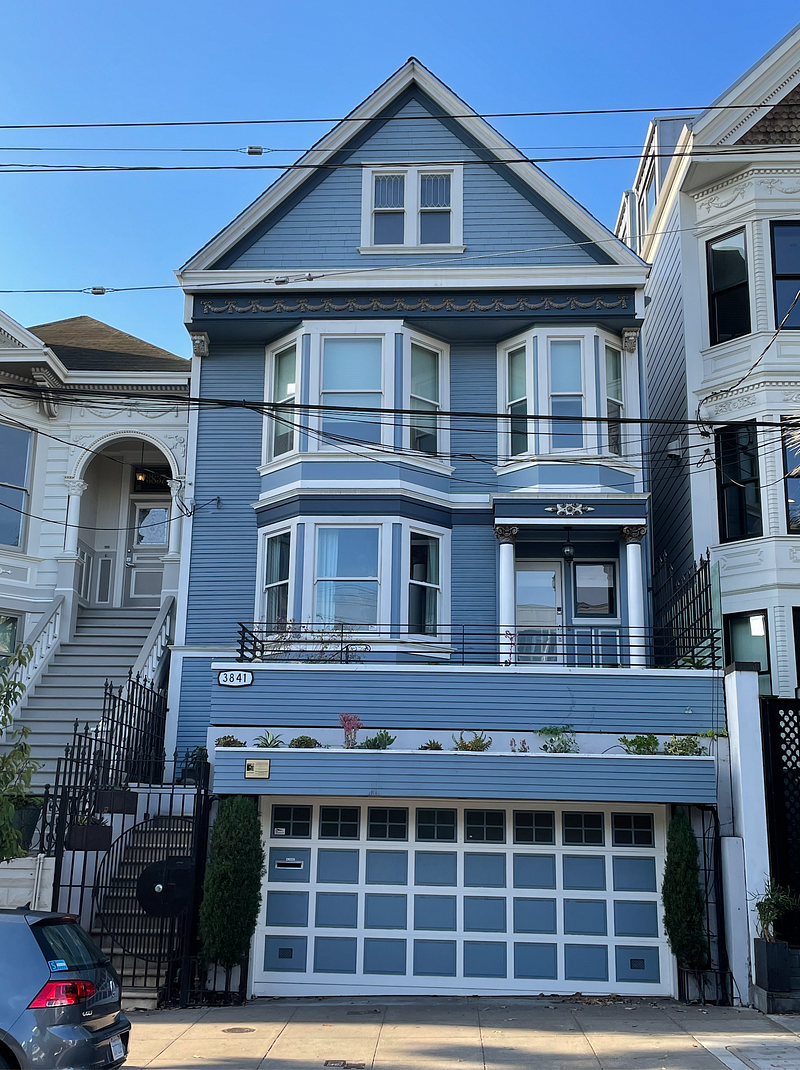
My knowledge of the blue house allows me to offer a double surprise to French tourists: (1) an American who speaks French and (2) somebody who knows that this house is, to some people, synonymous with San Francisco itself. It helps these visitors to feel seen, appreciated, welcomed, and understood.
Since I learned about “Where is Brian?” from Diane on YouTube, I have added that question to my welcome-to-San Francisco repertoire, along with La Maison Bleue, and I must say that the responses have all been very positive.
Don’t all of us want to be seen, appreciated, welcomed, and understood?
Because of my extensive traveling that has resulted in mingling with all sorts of people from marketplace workers to hotel personnel to grocery store employees, I can say that it feels great to be on the receiving end of a smile, indicating that I am, indeed, welcomed. It can happen in the most unexpected places.
My French is good enough to get by, but one thing is evidently unavoidable: I speak with an accent that announces the fact that I am an English speaker. As a result, there are many times when I ask a question in French and get a response in English. The times that this has happened have become memorable to me because they indicate that the other person saw, appreciated, welcomed, and understood me:
A store clerk to whom I said Bonjour responded, “May I help you?”
A Carrefour hypermarket employee of whom I asked the location of an item smiled and said, “Follow me.”
A post office clerk to whom I expressed interest in buying stamps inquired, “Do you want some pretty ones?”
Though all three of these instances happened decades ago, it was the kindness of these welcoming French people that kept them fresh in my mind and in my heart.
If I can do the same thing with La Maison Bleue and “Where’s Brian?” I am delighted to participate in bridging the cross-cultural gap that could otherwise be difficult to navigate.


