
I Found 2608 Photos from the Holocaust and Uncovered the Most Interesting Stories Behind 8 of Them
I’m certain you have no clue about them.
Lately, after finishing reading a book, Eichmann in Jerusalem: A Report on the Banality of Evil by Hannah Arendt, I took a great interest in the Second World War. I found a website with thousands of photos from the holocaust and other significant WWII events, and I decided to write a story about it.
This will be part one of two. Trigger Warning, some events written are a bit graphic.
Book burning in Berlin
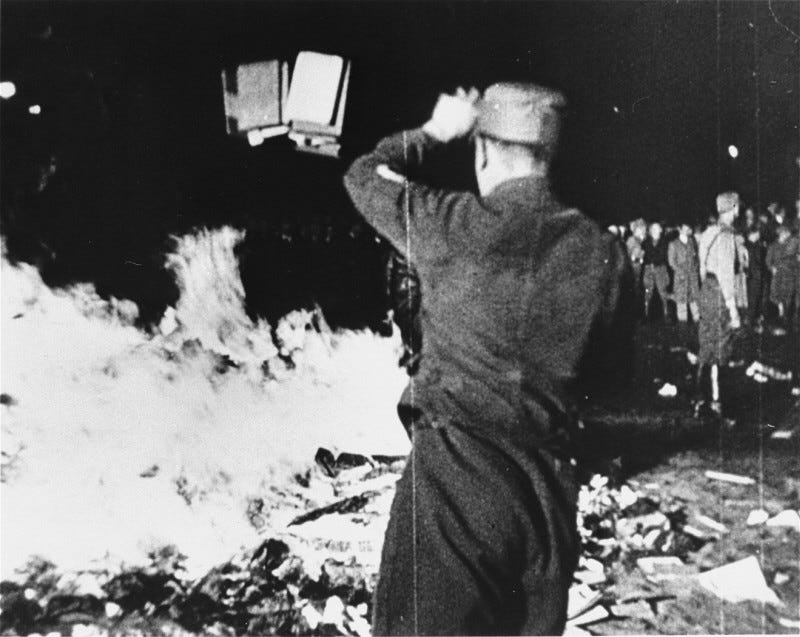
On May 10th, 1933, in Berlin’s Opera Square, the Nazis orchestrated the infamous burning of books.
This event, which was organized by Joseph Goebbels and the Nazi Party, aimed to eradicate literature deemed “un-German” or contrary to Nazi ideologies. Thousands of books authored by Jewish, communist and other perceived “undesirable” writers were burned publicly.
The Opera Square book burning was one of many Nazis’ campaigns to control information. It was one of the most powerful moves to initiate the propaganda which would lead to the initiation of the “Final Solution to the Jewish Question”.
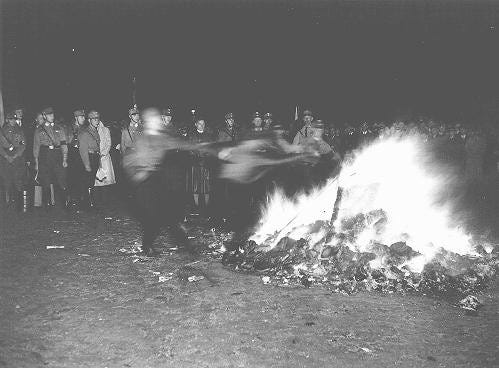
Five days later the same thing happened in Hamburg where members of the SA (Sturmabteilung) and students of the University of Hamburg would also set “Un-German” books into flames. What’s noteworthy is that not a lot of members of the public showed up. For this reason, there was a second book burning on 20 May 1933 at Lübecker Tor, Nazi organizations demanded that thousands of their members attend.
The true story behind the invasion of Poland
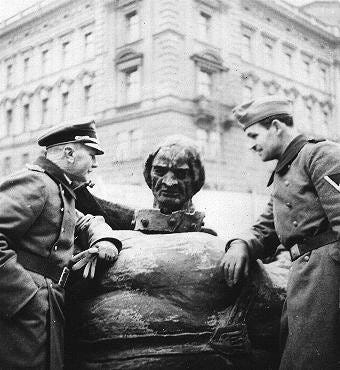
Here we see two German soldiers standing by the toppled Grunwald monument in Krakow Poland, 1940. The invasion of Poland in 1939 was an act of aggression orchestrated by Adolf Hitler and Joseph Goebbels and the way it happened is truly fascinating.
The night before the invasion, the infamous Gleiwitz incident took place, which was orchestrated by SS-Sturmbannführer Alfred Naujocks under orders from Reinhard Heydrich and Heinrich Müller.
German operatives dressed in Polish uniforms seized the Gleiwitz radio station. Broadcasting an anti-German message in Polish, they aimed to frame Polish saboteurs.
To make it seem true, the Germans executed Franciszek Honiok, an innocent Catholic farmer sympathetic to the Poles, and left him at the scene to appear as a saboteur. The Gestapo drugged and killed prisoners from the Dachau concentration camp, disguising them as attackers.
This staged event revealed in Naujocks’ testimony at the Nuremberg Trials, was a crucial element in justifying the Nazi invasion of Poland and the start of World War II.
Operation Anthropoid
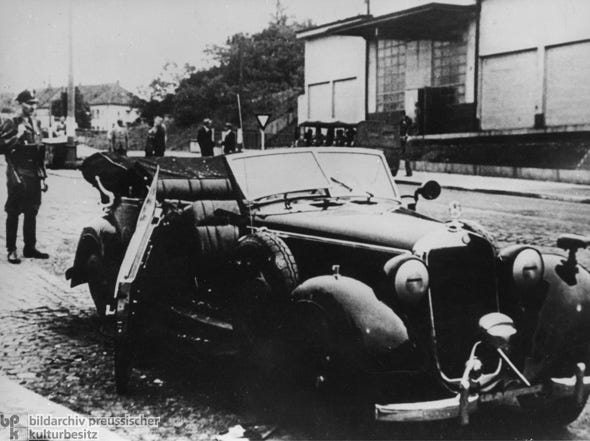
In the alleys of Prague on May 27, 1942, a couple of British-trained Czechoslovak paratroopers executed Operation Anthropoid. This operation targeted the sinister Reinhard Heydrich, who was a chief architect of the Holocaust and a high-ranking SS officer.
Jozef Gabčík and Jan Kubiš, the two Czechoslovaks, ambushed Heydrich’s car. The SS-Oberscharführer Johannes Klein drove Heydrich’s green Mercedes 320 Cabriolet B — shown in the picture — through the streets of Prague. Positioned at a strategic tram stop, Jozef and Jan waited for the car to arrive. As the car slowed around a tight curve, Jozef tried to fire his submachine gun but it jammed, prompting Heydrich to stand, draw his Luger pistol, and order a halt. Afterward, Jan immediately threw a modified anti-tank grenade, but it missed and exploded against the rear wheel.
The blast severely wounded Heydrich. Immediately the Czechoslovaks fled the scene while Heydrich and Klein emerged with pistols drawn, chasing them. They both managed to get away with the idea that their mission had failed.
Eight days later, Heydrich would die from sepsis, making their assassination attempt successful.
Nazi soldiers’ failure to capture the assassins intensified the oppression and persecution of Czechs. Over 13,000 people were arrested and tortured, including Jan Kubiš’s girlfriend, Anna Malinová, who perished at the Mauthausen-Gusen concentration camp. Then a German-Chezch vendetta took place with the execution of First Lieutenant Adolf Opálka’s aunt, Marie Opálková, and the killing of his father, Viktor Jarolím.
During all this, they were both ratted out that they were hiding in Cyril and Methodius Cathedral in Prague. After a six-hour gun battle, in which the Germans lost 14 and sustained wounds to 21 others, Gabčík and the others, except for Kubiš, who was seriously wounded by a grenade, committed suicide before the Nazis could take them alive in the church catacombs.
Operation Valkyrie
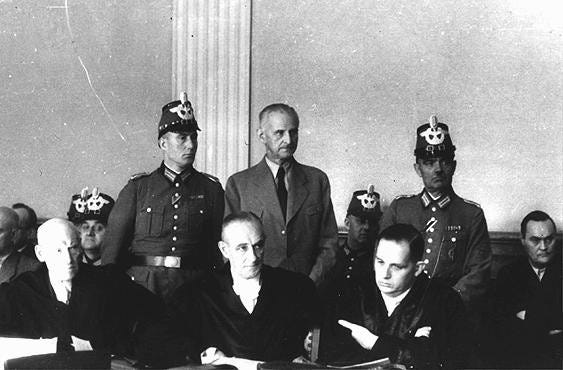
This person in the middle between the two Nazi officials is named Carl Goerdeler, and he was the former mayor of Leipzig. He was trialed and executed for trying to take Hitler’s life. Here’s the story.
A courageous group of conspirators planned, on July 20, 1944, to assassinate the dictator and dismantle the Nazi government. The leader of this attack was anti-Nazi Carl Goerdeler who was fighting for a post-Hitler Germany based on democracy and moral values.
The 20th July plot, also known as Operation Valkyrie, had Colonel Claus von Stauffenberg, as a key figure in the conspiracy. He planted a briefcase bomb during a military briefing at Hitler’s Wolf’s Lair headquarters.
Stauffenberg strategically placed this bomb under the table near Hitler, leaving the room to take a planned telephone call. The explosion, triggered by a deflected briefcase, killed three officials, and a stenographer, injuring over 20 people, and perforating Hitler’s eardrum.
Our protagonist Carl Goerdeler, would then be captured by the Gestapo and put on a trial, which was a sham, where he’d be found guilty of treason. To justify the resistance against the Nazi regime, he provided detailed information in interrogations and written reports about the organization, goals, and participants in the resistance from trade unions, companies, and the church. An informant by accident.
He was later executed by hanging.
The scary logistics of Auschwitz
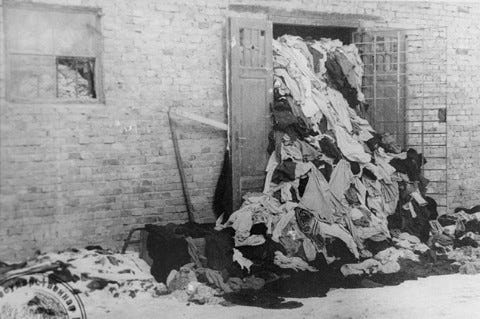
This won’t be a long story, I just found this picture extremely interesting and I’d love to share a fact about it. This was one of many warehouses at Auschwitz in which the Germans stored clothing taken from victims of the camp.
What’s eerie about this picture is not the large number of clothes, it’s the fact that 1,1 million people were killed there. The camp operated for approximately six years, but the mass killing of Jewish people started taking place in 1942, and it was liberated by the Soviet Army in late January 1945.
That meant that on average 1,005 people were killed every day. Before the end of the war in March of 1944, the number of Sonderkommandos who were working in Auschwitz increased by 4x, making them enough to be able to exterminate between six and twelve thousand people per day.
The banality of evil
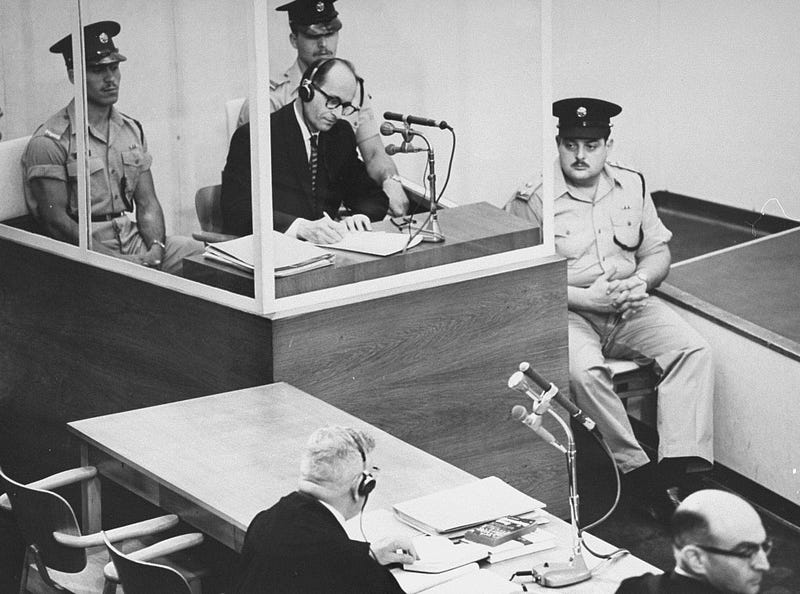
Since I’m writing an article on the book I mentioned in the introduction, I won’t dive too deep into the specifics of this photo. The life of Adolf Eichmann is a story all on its own, and it deserves its own article.
What I will mention, however, is that Adolf Eichmann was a high-ranking SS officer in Nazi Germany and a key architect of the Holocaust during World War II. His extraordinary organizational and bureaucratic skills made him the leader of the coordination and execution of the logistics behind the mass deportation of Jews to concentration camps and extermination centers.
After the war, Eichmann like many other Nazis fled to Argentina, where he adopted a fake I.D. and stayed very lowkey until 1960. He was then captured by Israeli Mossad agents and brought to trial in Jerusalem. Eichmann faced charges of war crimes, crimes against humanity, and other offenses related to the persecution and extermination of six million Jews.
During the trial, Eichmann defended himself by claiming he was simply following orders and insisted that he was not responsible for the atrocities committed.
This massive event led many great writers, such as Hannah Arendt, to write about the banality of evil which basically states that individuals can commit horrific acts without necessarily being driven by malevolence.
In December 1961, Eichmann was found guilty on multiple counts and sentenced to death.
If you want to learn more, there’s an incredible French documentary on Netflix by Michaël Prazan called The Adolf Eichmann Trial. If you want to see a more romanticized version of it there’s also a film by Netflix called Operation Finale.
Ivan the Terrible
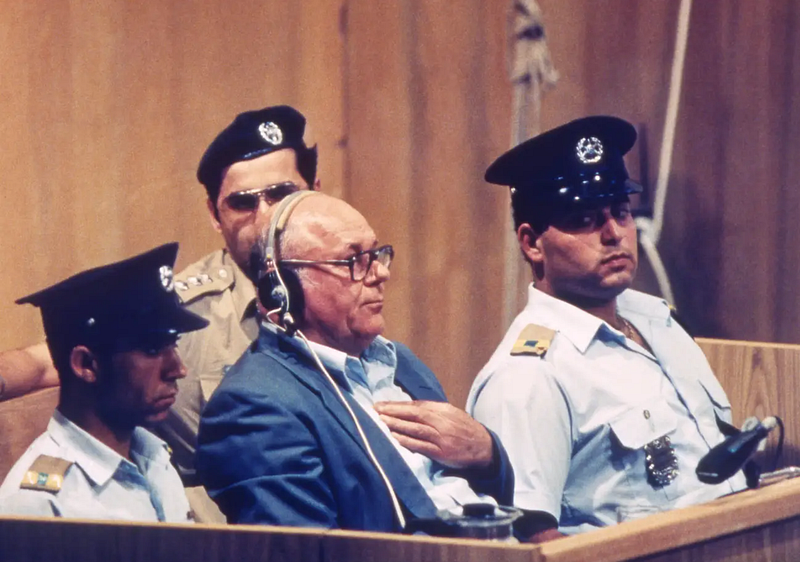
This is John Demjanjuk or how many people used to refer to him, Ivan the Terrible. Stories said that Ivan the Terrible was a guard at the Treblinka extermination camp, which was feared by many prisoners because of his sadistic behavior and the scary tortures he did to people.
Born Ivan Demjanjuk in 1920, in Ukraine, this man was captured by the Germans in 1942 during his service in the Soviet Army and turned from a prisoner to a perpetrator.
After the war, Demjanjuk met Vera, his then-to-be-wife, in a displaced persons camp in Germany. Together, they immigrated to the United States in 1952, settling in Cleveland. Adopting the name John, he worked at a Ford factory. Just like Eichmann, it was very common for Nazis to flee to America.
In 1974, Demjanjuk’s past caught up with him when an American journalist uncovered a list of suspected Nazi collaborators who had become American citizens. Holocaust survivors identified his photo, labeling him as Ivan the Terrible.
This led him to lose his US citizenship in 1981 and to be extradited to Israel in 1986 to be prosecuted for his war crimes.
During the trial, many Holocaust survivors talked about Ivan the Terrible’s atrocities at Treblinka. Demjanjuk claimed he was a prisoner forced to work by the Nazis. In 1988, he was found guilty of crimes against humanity and sentenced to death.
What’s interesting about this story is that Demjanjuk’s conviction was later overturned in 1993 by the Israeli Supreme Court, since new evidence came to light that he was confused with another guard, Ivan Marchenko.
Later he was released and sent back to Clevland until 2009 when he was deported to Germany. A German court found him guilty in 2011 of being an accessory to the murder of 28,060 Jews at Sobibor, sentencing him to five years in prison.
In March 2012 he passed away.
Once again if you want to learn more about this man there’s a Netflix show called The Devil Next Door.
French women getting punished
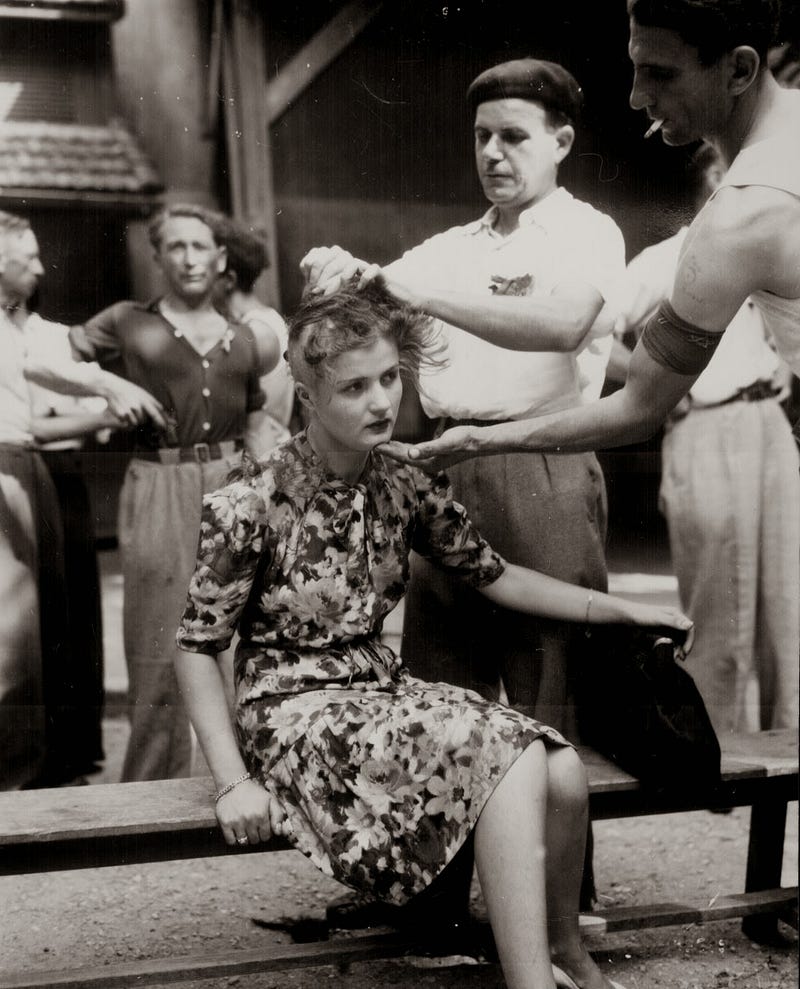
Something fascinating happened in France after WWII. See, many women during France’s occupation by the Germans had romantic and sexual relationships with Germans supporting them, living with them, and so on.
After France was liberated by the Allied Forces, people went to the street to condemn the French people who supported the Nazis, especially the women.
So the witch-hunting began.
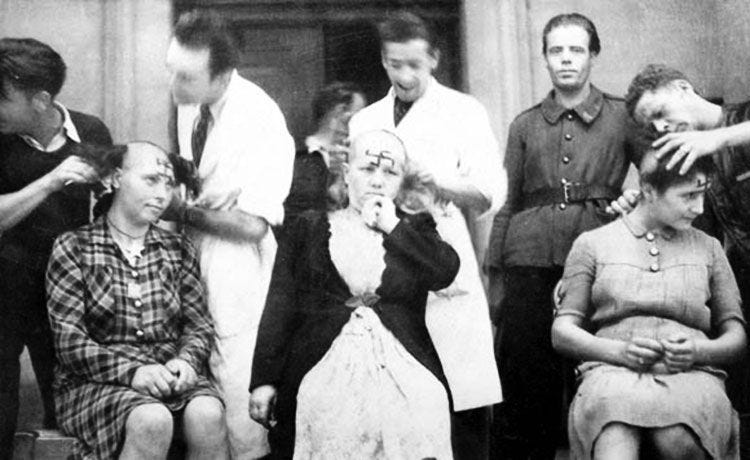
The aforementioned women were gathered in a public setting and people shaved off the hair from their heads, a practice with deep historical roots dating back to biblical times and the Dark Ages — since hair was considered one of the most seductive features in women. Almost 20.000 women were affected.
The punishment didn’t stop at the hair shaving though. The victims, known as “Femmes tondues” or the shorn women, were often paraded through the streets on trucks, subjected to tar, half-naked, and marked with swastikas in paint or lipstick.
Do you have any story you’d like to share? Feel free to do so in the comments.
If you made it this far, thank you! :)