
I Followed My Rescued Pit Bull Around to Document His Day
Pit bulls are wonderful dogs when they’re given a chance to be — here’s how mine spends his day
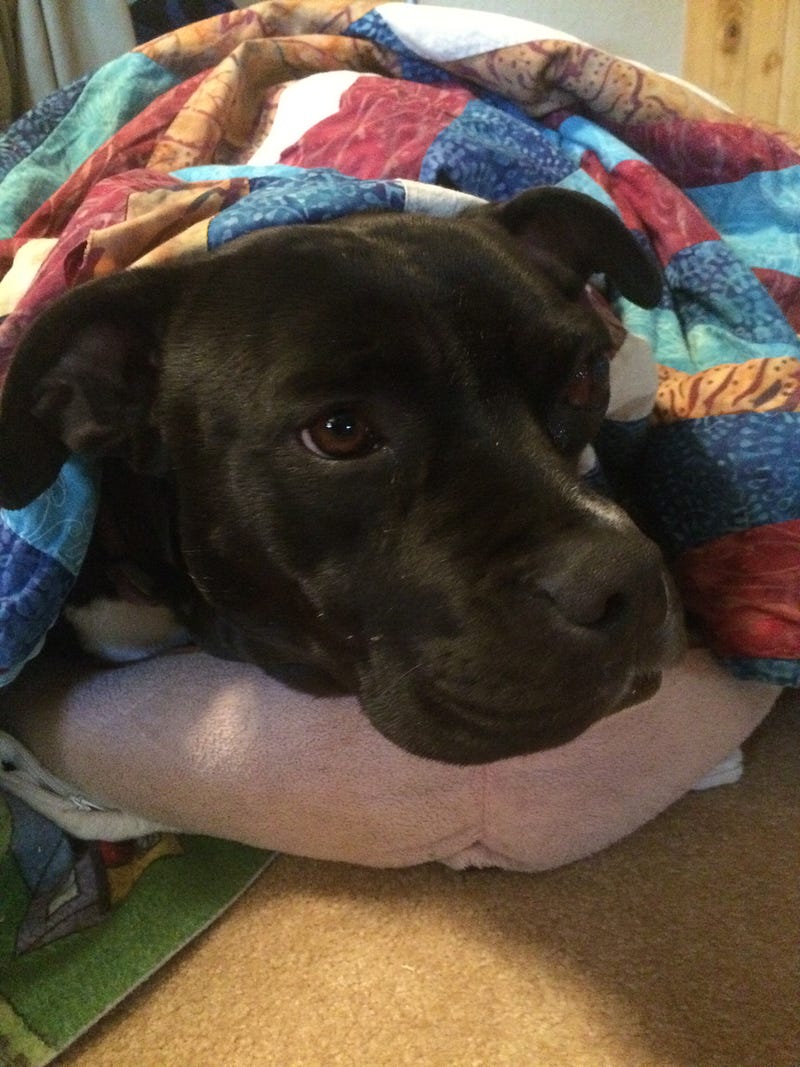
We rescued Raffie from an out-of-state shelter eight months ago. He was transported for several days before arriving at a local sanctuary where we picked him up.
I was raised on a farm-turned-sanctuary, so I’m no stranger to rehabilitating animals, but Raffie pulled at my heart more than any other animal that I’ve ever rescued.
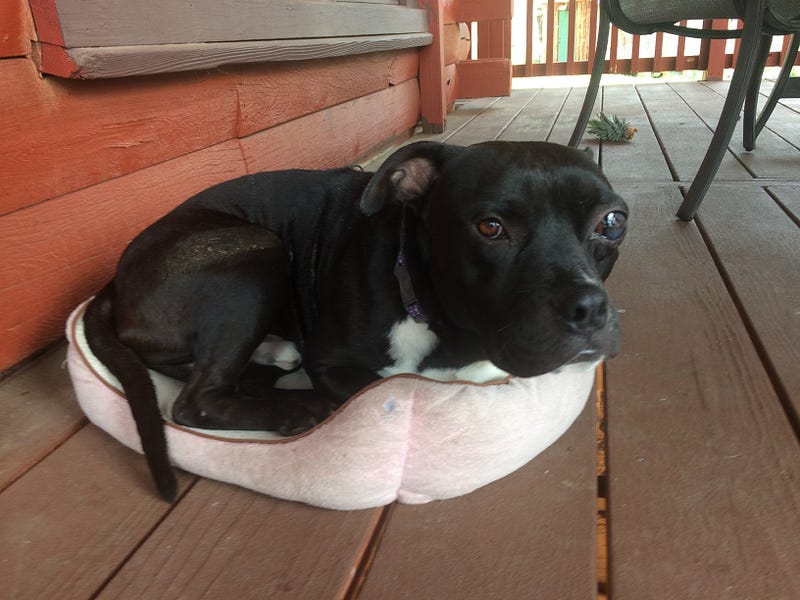
He arrived mangy, dirty, scared for his life, and yet full of love. There was also one other detail, and one reason that I quickly put in an adoption request before his scheduled euthanasia: his enlarged eye. To be honest, it was heartbreaking to see. He had sustained some sort of blow to the head which had resulted in Ocular Proptosis.
At first, I thought that he would need emergency surgery, but after consulting with multiple vets, the prevailing suggestion was that he should keep the eye since it was a very old injury, caused him no pain, and could be covered by his eyelid when he closed his eye. Eye removal would have been only for cosmetic reasons.
I was relieved to not subject Raffie to the additional trauma of eye removal. Through his frequent vet visits, we also discovered that his back was out of alignment — possibly even broken years before. The rest of his history is a mystery.
We speculate that he may have been bred or bought as a guard dog, but that his owner beat him up and discarded him. He was found on the streets — after how long, we don’t know.
But he acclimated to family life immediately.
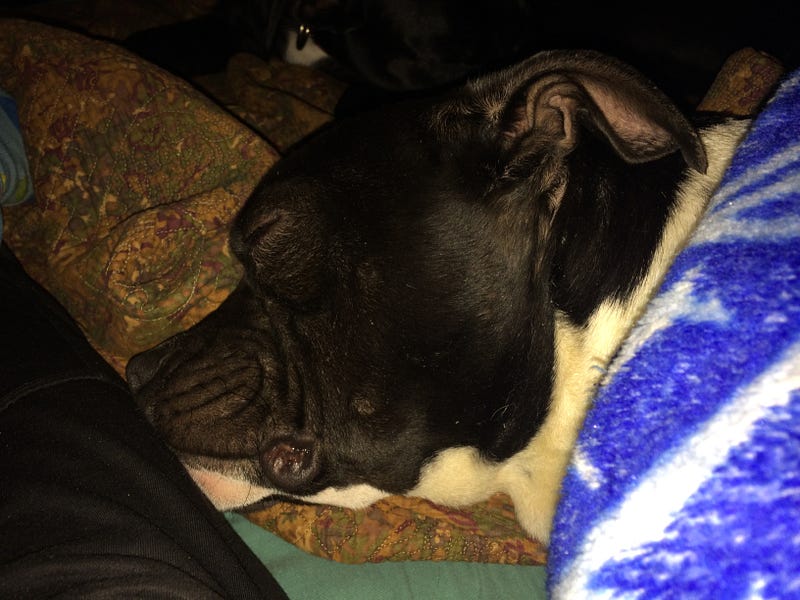
Here is the first day when we got him:
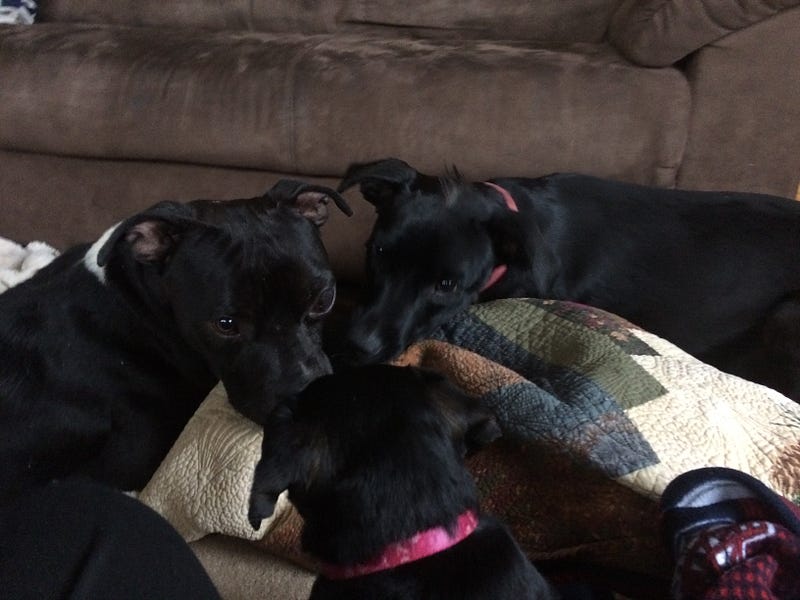
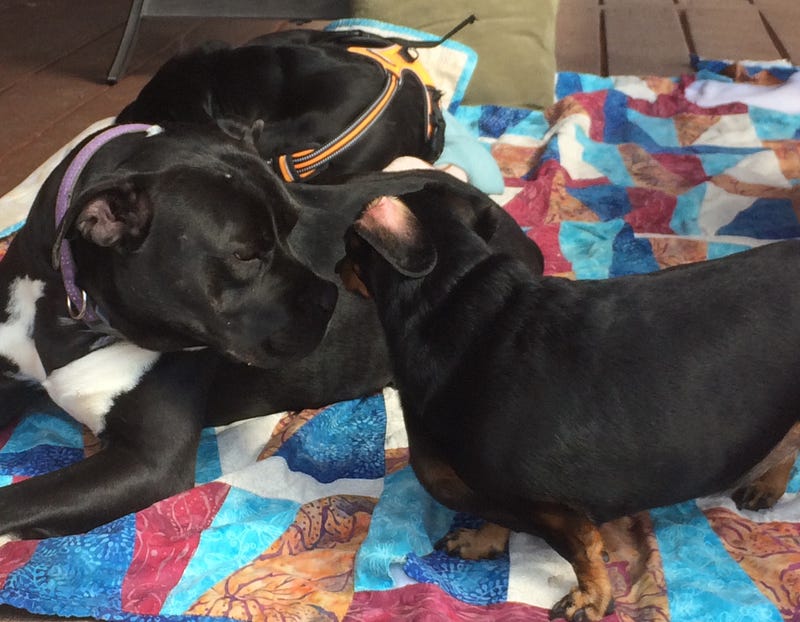
His introduction to some of our other rescues:
And one month later:
A day in the life
In an effort to help demystify Raffie’s breed for potential adopters, I recently spent eight hours just observing Raffie and keeping an hourly “journal” on his behalf. To be honest, it was an enjoyable mission. Following around a 70-pound cuddly baby bull-bull (as we call him)? Sign me up! The only hazards are too many kisses and hug exhaustion.
5 a.m.
It’s dark out. Chortle. Chirp. Sigh. Chortle. Chirp. Sigh. “What’s that sound?” my son asks. “It’s Raffie,” I reply. He’s sleeping on my legs, curled up and softly sighing, his head on his favorite pillow, content to be part of the pack. He likes to sleep in and will happily doze until he is woken by the hustle and bustle of the household.
6 a.m.
My son gets us out of bed, and Raffie follows. I hear his uhh uhh meeehhh noise from the door. He’s around two years old (we think), but still manages to sound like a 12-week old puppy when he wants something. I let him out on the porch, and as I fill up his water dish, I can hear Raffie joining the cacophony of neighborhood dogs exuberantly greeting the day. He lets out his own hoarse bark and it echoes across the valley.
7 a.m.
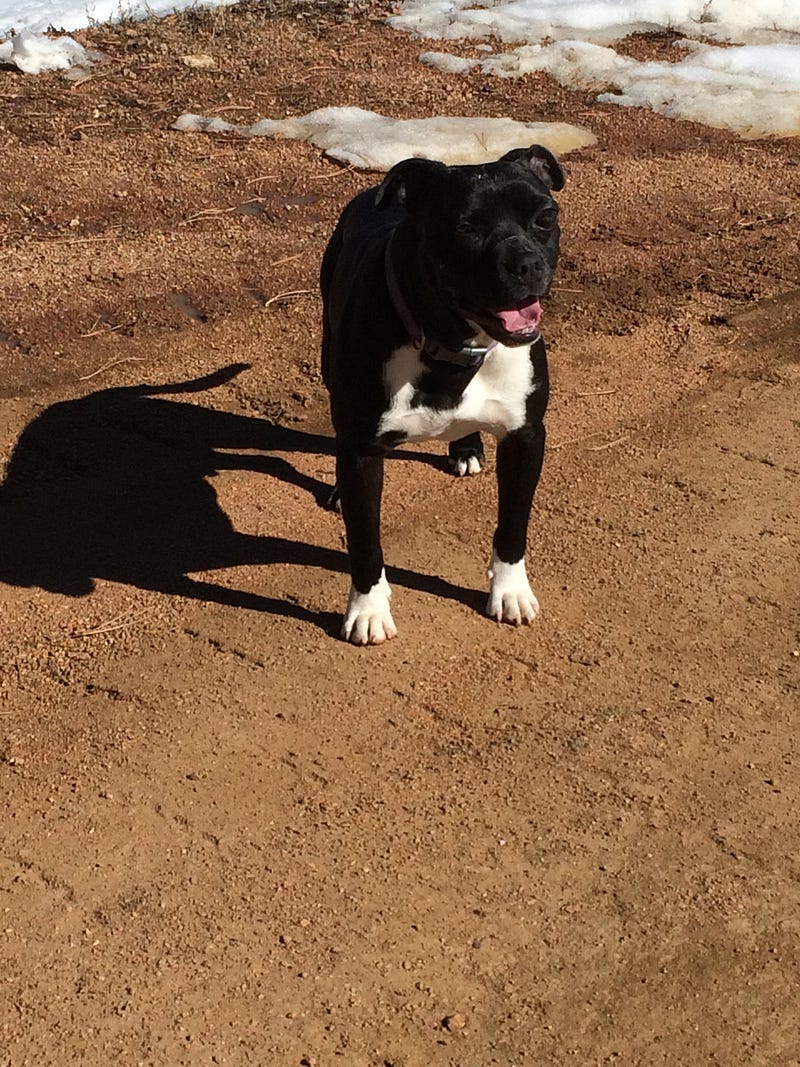
A shot rings out in the distance. Raffie runs back inside shaking and hides under the table. I coax him out with his morning warm blankets from the dryer. The blankets were very instrumental in building his trust in me; he probably figures that anyone who would put blankets in the dryer every morning and then wrap him up in them can’t be too bad. I gently wrap the warm quilt around him, leaving his face visible, and he stops shaking. Now it’s time for a pittie-boo-boo hug and scratch. I wrap my arms around his compact body and he nuzzles his head under my arm, giving a sweet sigh of contentment and safety. The other dogs are not pleased at missing out on some affection, but I can’t help but hug Raffie whenever I can. He’s such a lovebug, and physical touch is his love language.
8 a.m.
It’s breakfast time! Raffie is nowhere to be seen, but I can guess where he is: downstairs in the dark, curled up in our dachshund’s pink bed. His eyes, pools of love, beg me to stay, so I do. He lays his heavy head in the crook of my arm. “Whatcha doing”? my son asks, before exclaiming, “Ohh, it’s Raffie. He’s so cute.” He comes over, gives his brother a scratch, and Raffie gives him the same pleading look, followed by his goofball snort when he realizes that we’re heading back upstairs.
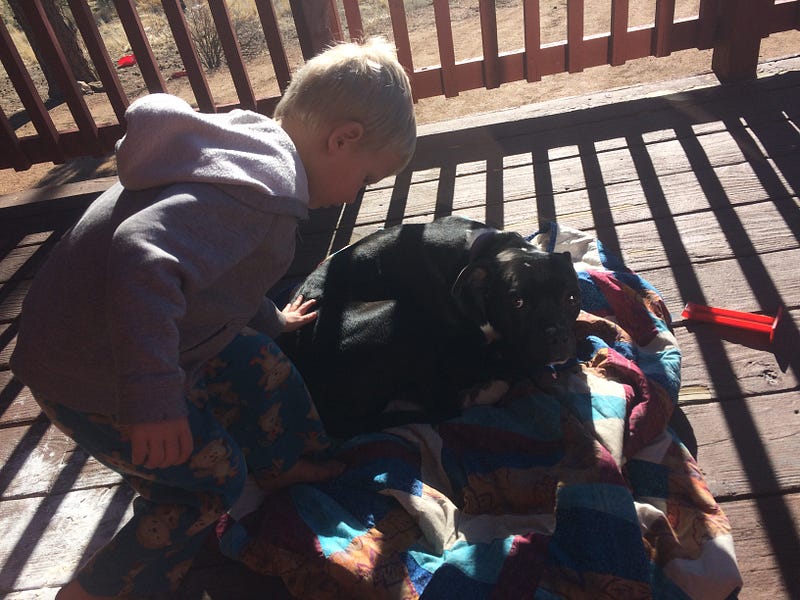
Out of all of our rescues, Raffi is the one that I would trust the most with our preschooler. He’s protective yet very loving and is never violent or snappy. And did you know that pit bulls (or Staffordshire terriers) served as nanny dogs in the early 1900s because they were tolerant and gentle with children?
Helen Keller’s dog, “Sir Thomas,” was a pit bull, and so was Petey, the canine mascot of the Little Rascals. Clearly they have become a very misunderstood breed.
9 a.m.
Since today is all about Raffie, I sneak a cracker downstairs to him, away from the watchful eyes of the other rescues (but I think that they’re onto me). Persuaded by the treat, Raffie gingerly walks up the stairs and looks at me with his good eye, before he slowly climbs up on the couch, one leg at a time. I help him up, but I think this may be a ploy for more hugs.
That’s OK. I’m just glad that I can be his safe place.
It’s been painful at times to rehabilitate a dog that has been abused to this extent, but I know how much more painful life has been for him. Even though he is adjusting well, the sound of a chip bag opening, or the sight of anything metal sends him running for the hills.
Fortunately, he is ours now, never to be used or abused again, and it’s heartwarming to gain his trust and watch him blossom into a fun-loving puppy.
10 a.m.
Roo Roo Roo. Raffie’s hoarse bark echoes through the den. He’s circling the door. In fact, all of the dogs are. OK, guys, it’s time to go outside. Raffie nuzzles my hand, gives it a pittie-boo-boo kiss, and bursts happily through the door with the other rescues out into the morning sun.
11 a.m.
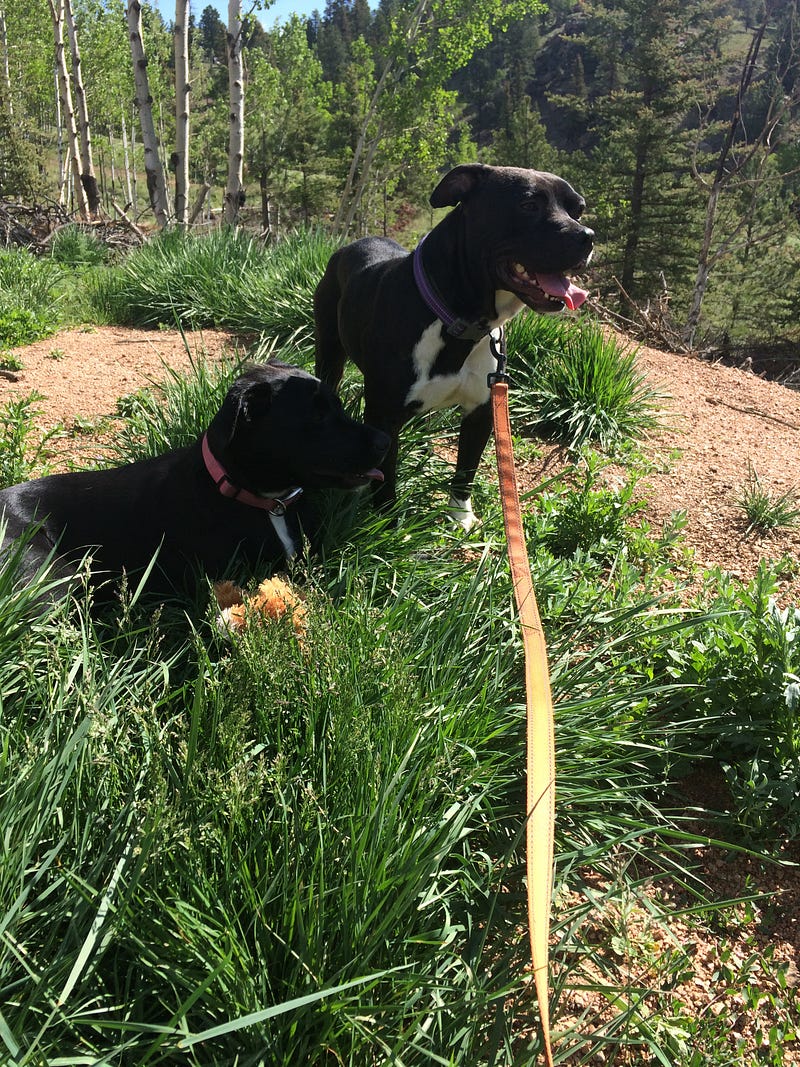
Here they come, Raffie and Rose (our pit-mix) up the bank from the creek. Dripping wet, tongues hanging out, tails waving. I take a few photos of Raffie and marvel at how he was terrified of the camera just two months ago, but now wags his tail when he sees me coming with the phone. I’m so glad that we’ve got to this place.
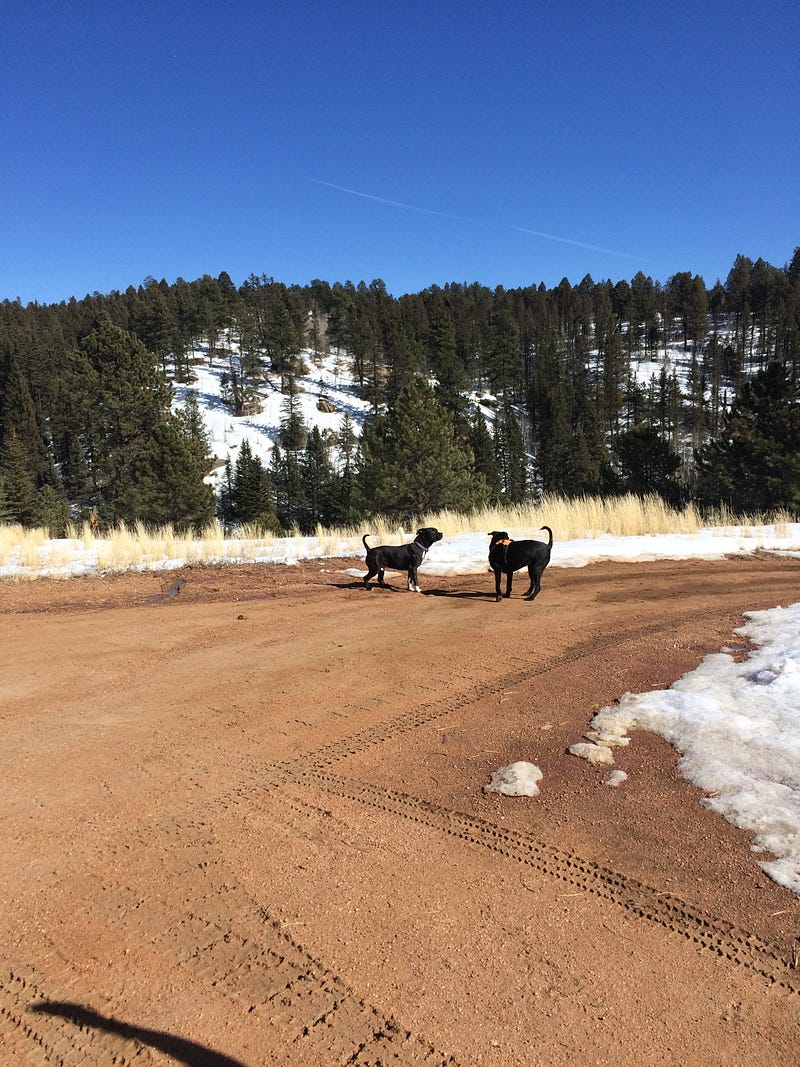
Four dainty paws, two white and two black, trot by the porch as I get everything set up to work outside. Raffie sits to watch birds and nap, his soft jowls moving rhythmically … wheeze … chirp … wheeze … chirp.
My other dogs are so full of energy that I thought perhaps Raffie had an undiagnosed health problem due to the fact that he napped for much of the day. What I learned instead was surprising: while some pit bulls are more active than others, many are referred to as “couch hippos” and prefer to nap for much of the day with their humans close by.
12 p.m.
I hear a faint crying, soft and sweet from around the deck. It sounds like a 12-week old puppy. Arooo, Arooo. It’s Raffie crying because the gate is halfway ajar and he doesn’t want to push it himself. He has a thing about doors, and will only enter a room if the door is all the way open, and unobscured, often with gentle coaxing and possibly the boo-boo dance (which is when the whole family dances back and forth softly saying, “Come on boo boo, boo boo, boo”).
He gingerly walks over to the food dish and waits patiently as our dachshund finishes her food before starting his own lunch. Crunch, crunch, crunch. he walks as he eats, keeping a close eye out for threats. I reassure him that it’s safe to eat and he continues. It’s OK, sweet boy. This is a safe place and your forever home.
Raffie’s experience makes me eager to help more pitties in need.
Reasons to rescue a pit bull
- Pit bulls are sweethearts. Like any other breed, they require socialization, but I’ve found this to be true for every animal that I’ve rescued.
- They weren’t bred to fight each other, but they are terriers, which means that they like to dig and hunt for rodents or other small creatures.
- They are smarter than people give them credit for. Raffie came into our home completely house-trained, despite having lived on the street for quite some time.
- They are incredibly loyal, and will do anything to be loved and given attention.
- Some have limitless energy, and others are couch potatoes, but generally they’re just happy to be doing whatever you’re doing, preferably with physical contact.
- Pit bulls break stereotypes every day. Many people who have only seen horrific news articles are afraid of pit bulls, believing that they are all ticking time bombs. People who get to know pit bulls are often surprised to find that those raised in loving homes are very friendly and gentle, just like any other animal.
- Pit bulls are referred to as couch hippos. Enough said.
- Two of their favorite activities are hugging and kissing.
- Many pit bulls are bladder camels, and prefer to stay cozy in bed rather than go outside at 6 am. Raffie rarely goes out at night, but he never has accidents indoors.
- Family pit bulls are always happy to make a new friend.
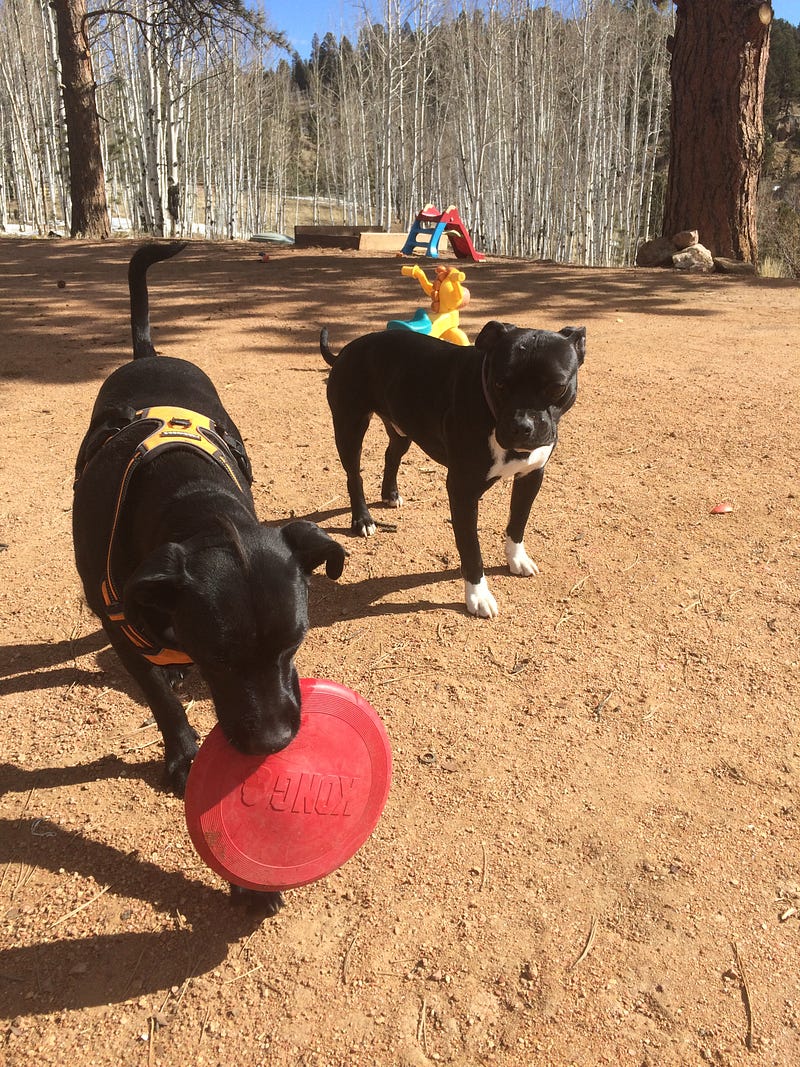
- They can coexist peacefully with other pets. Our dachshund is the alpha in a house of pit bulls.
- They are great with kids. In fact, Raffie sometimes gets worn out by our son’s exuberant energy.
How to help
If the stigmatization of this wonderful breed has tugged at your heartstrings as it has mine, here are five ways to help end the stigma against pit bulls:
1. Be a responsible owner
If you have a pit bull, make sure that they are loved, trained, and get enough exercise. Provide them with boundaries, and make sure that they are socialized with other dogs, people, and children.
2. Work against breed-specific legislation (BSL)
Many lawmakers are starting to take another look at breed-specific legislation (BSL) and are now working on more sensible laws that focus on the behavior of the owners rather than the type of dog.
3. Educate
The best way to counteract fear is through education. Together we can keep pressing forward until pit bulls are once again seen as the beautiful, lovable best friends that they’ve always been.
4. Support the cause
You can become involved with local pit bull rescue organizations or become a foster for pit bulls looking for their forever homes. And you can always stand up for a misunderstood, mischaracterized breed.
5. Remember the past
Once upon a time, pit bulls were the preferred nanny dog, and they were often left in the care of young children. Only recently did this start to change, and pit bulls didn’t get a bad rap until they became a guard dog of choice at the same time that dogfighting re-emerged in the mid-1980s. They also aren’t the first breed to ever become subject to blanket bans; at various times, German shepherds and Rottweilers were the most likely breeds to be outlawed. History alone should be strong evidence that it’s not the breed that’s the problem, but how they’re treated by the humans who are responsible for them.


