
I Followed James Clear’s Morning Routine For 1 Week. Here’s What I Learned
Spoiler Alert: My productivity massively increased

See that photo up there? That’s what I feel like most days when I wake up.
For most of my life, I’ve been a night owl. So, mornings usually go one of two ways:
- I wake up early but I’m tired throughout the day (sometimes wanting a nap in the afternoon)
- Or, I wake up late (because I stayed up late) and my day starts several hours later than I would like
But, recently I decided that I wanted to alter my habits and take advantage of my mornings.
And I thought, what better way to upgrade my morning routine than by learning from an expert?
Last month, I read Atomic Habits by James Clear and loved it. His book taught me how I could create and maintain life-changing habits by making small changes. So, it was about time I put some of that learning to use.
How does James Clear start his morning?
Mornings are one of the most important parts of the day, according to James. He says that they set the tone for how the rest of the day will be.
“What you do each morning is an indicator of how you approach your entire day. It’s the choices that we repeatedly make that determine the life we live, the health we enjoy, and the work we create” — James Clear
So what is James Clear’s morning routine?
In an interview with My Morning Routine and an article on his website, James shared how takes advantage of mornings and starts his day:
1. Prepare for the next morning the day before
While technically not a part of his morning routine, this is what sets him up for success the next day. The night before, he takes ten minutes to prepare for the next day. This includes making a to-do list and outlining an article.
2. Don’t set a wake-up alarm
James rarely uses an alarm to wake up in the morning unless he has somewhere he needs to be. This way, he can wake up when he is fully rested.
3. After waking up, drink a glass of water
James drinks a cold glass of water to start his day. James says that this is a ‘pre-game’ routine, a ritual that triggers your brain to start working.
4. Write down three things you are grateful for
James is an advocate for using a journal to record his thoughts and habits. I’m not surprised that gratitude is also something he practices every day.
5. Two-minute meditation
In Atomic Habits, James Clear talks about the power of performing habits for two minutes. James’ meditation is quick: just some deep breathing in silence before he gets on with his day.
6. Read 20 pages of a book
Reading 20 pages of a book was not always a part of his routine. But he says this habit has massively increased the number of books he’s been able to read consistently.
7. Do your most important task first
Rather than working on your most urgent task, James Clear says you should work on the task that is most important for you. This way, you will accomplish your goals and prioritize yourself. Save urgent tasks for the afternoon, because you know you’ll get them done when there’s a deadline.
8. Write when your creative energy is high
James says his creative energy is highest in the morning, so that is when he writes.
9. Don’t check your email until noon
James believes that mornings should be for yourself. He says:
“My most productive days are the days when I avoid email until as late as possible. I think it’s pretty much always better to spend your time working on your own agenda rather than responding to someone else’s. I typically don’t open email until noon. Occasionally, I’ll go later than that.”
I extended this rule to include not checking any notifications (such as my stats on Medium) before noon as well.
10. Leave your phone in the other room when you work
Alongside delaying emails, James says that in order to be deeply focused on your work, you need to take your phone outside of the room. This helps avoid distractions and save time.
11. Work in a cool place
James says that working in a warm environment can make it more difficult to work because you feel sluggish and groggy.
12. Sit or stand up while you work
James says that lying down prevents your brain from working effectively. To get your mind to work properly, your brain needs oxygen. This means your lungs need to expand and contract easily.
James recommends standing up or sitting while you work to help your mind work better and concentrate easier. If you do sit, he says to have a cushion or pillow at the small of your back so you sit up straight.
What James Clear leaves for the afternoon and evening:
- exercise (he often does weightlifting)
- responding to emails, calling people
- eating (James practices intermittent fasting, which means he eats between 12 pm-8 pm)
As for the end of the day, James Clear says he typically goes to bed at 10:30–11 pm. But, he isn’t strict on a specific time if he’s feeling motivated.
All in all, James Clear’s morning routine is pretty simple. He says he keeps it this way on purpose:
“I think a morning routine should be simple and repeatable (at some point, if you add too many pieces to the mix, you’re not really doing a morning routine anymore, but simply a daily routine).” — James Clear
One Little Amendment
Before I even started this challenge, I knew there were going to be some parts of his routine that I needed to adjust slightly or change to work for me.
If it wasn’t already obvious, James Clear and I are different people with different goals. If the spirit of the challenge was to push me to use my mornings in a productive and new way, then I needed to set myself up for success.
So, I knew I would be ignoring at least one little part of his routine: James says that you should “eat as a reward for working hard.”
This decision was for a couple of reasons. Firstly, I don’t personally like this mentality, especially if you’re someone who has struggled with healthy eating habits and body image in the past. Secondly, I’m hungry in the morning. And I know my stomach grumbling would distract me from my work. Not to mention, food gives me energy and helps me to wake up.
While I understand intermittent fasting works for James Clear, I’m not going to be altering my food schedule. This isn’t a dietary challenge, and I have no interest in doing so anyway. I’m going to eat when I want to, which includes having breakfast in the morning.
Besides this change, I stuck as closely as I could with James Clear’s morning routine for one week to see if my productivity increased as a result.
Here’s how it went:
I started this challenge on Monday, as James Clear writes in his book Atomic Habits that it is easier to commit to new habits when you start at the beginning of a cycle (such as the start of a month, week, year, etc.). It felt like I was starting on a fresh slate, and made me even more motivated to see the challenge through.
Here’s a picture of one of my daily to-do lists:
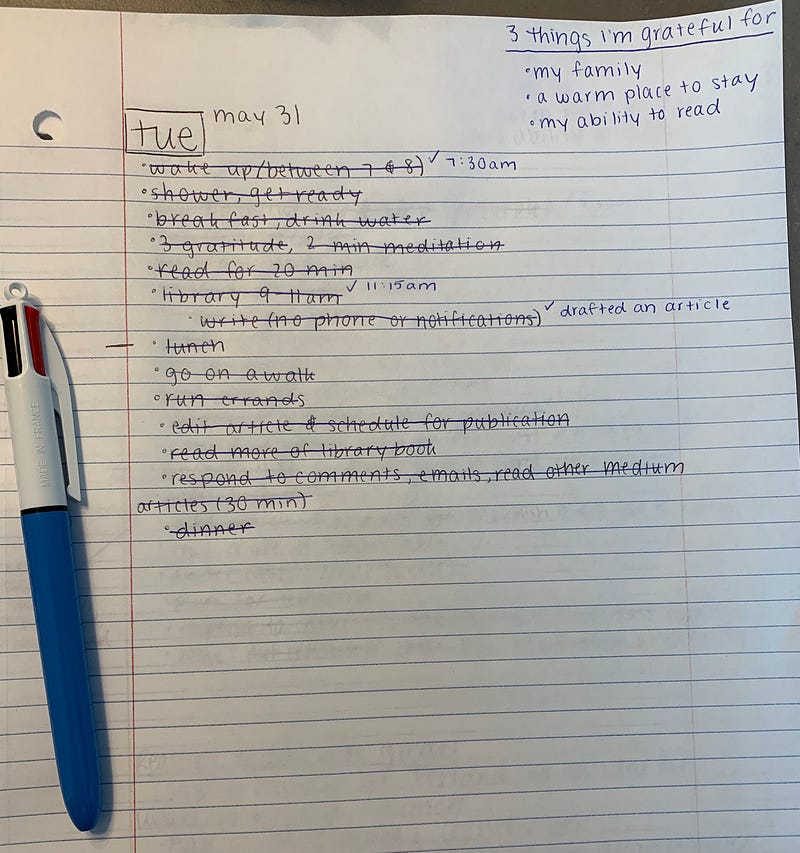
Pictured Above: TUE — - wake up (between 7 and 8am) - shower, get ready - breakfast, drink water - 3 gratitude, 2 min meditation - library 9–11am - write (no phone or notifications) - lunch - go on a walk - run errands - edit article and schedule for publication - read more of library book - respond to comments, emails, read other Medium articles (30 min) - dinner
The day before, I planned what I was going to do the next morning. Then, after lunch, I added anything else I needed to get done for the rest of the day. This way, I knew what I had already accomplished in the morning, and I could set realistic expectations for the afternoon.
If you’re looking for the short answer to whether I would recommend this routine: Yes.
I enjoyed following James Clear’s morning routine, and I found my productivity increased dramatically as a result.
I wrote at least 1,000 words every morning, usually finishing an entire article. I finished most of my work by noon.
When my writing productivity goes up, I usually find that my reading goes down, as it’s hard to balance the two. I was pleasantly surprised this wasn’t the case here. Reading in the morning before I started writing meant that I was making small progress in my book throughout the week. And this reading time still left room for me to maintain my momentum in my writing.
The most surprising part?
I knew that I was going to enjoy a lot of aspects of this routine, such as the time to reflect on my gratitude and read. What I didn’t expect was how much I enjoyed the two-minute meditation. Two minutes is such a short amount of time, I wasn’t expecting it to change much.
But I loved doing it. I found it helped center me before I got on with my day. This is no surprise given that deep breathing helps bring oxygen to the brain, relaxing you and helping you focus.
It’s amazing how a two-minute activity can dramatically change your routine.
Would I do it again?
Yes, I would. It’s especially useful if you’re looking to increase your productivity. Your day starts with your work/writing, and you get it done quickly before you do anything else. Planning out what you will do the next day makes the morning go more seamlessly: because you know exactly what you’re going to do.
There was a day or two that I made an exception for the “no notifications or email before noon” rule when urgent matters came up. I noticed on these days I wasn’t as productive as the days when I followed the routine exactly.
I would also say it was easy to get in the habit of doing work all day when I followed this routine. Admittedly, I can sometimes be a workaholic and get lost in my work, forgetting to take breaks. Starting work immediately in the morning meant that my brain was in “work mode” almost all day. If there was some sort of rule that I had to be off of my device by a certain time at night, I think that would help me.
There were days when I was planning my article for the next day that I ended up just starting to draft it there and then. When I finally did stop, it made it much harder to get to sleep because I had unfinished work and my brain was in “work mode.”
It’s great to be productive, but if you don’t also have downtime, you’re quickly on the road to burnout.
What would I change?
Besides implementing stricter limits on my screen time, one thing I missed doing in the morning was going on a walk. I think it’s great to get your body moving in the morning and breathe in the fresh air.
Getting out of the house also helps you gain perspective of the outside world, and not get so swept up in the words and pictures on a screen.
Here’s what I learned:
James Clear says that we have 25,000 mornings as an adult and that we shouldn’t let a single one of those slip us by.
Here are a few lessons I learned by doing this challenge:
- How you start your morning sets the tone for how the rest of your day will go.
- The less time you spend on your phone (checking notifications and email), the more time you will be productive
- Balancing reading and writing is all about setting daily time limits and incorporating both into your schedule
- A two-minute meditation before you work can help center you
- And a more personal takeaway I learned about myself: If I don’t force myself to stop working, I won’t
Would I recommend this challenge?
It was less overwhelming making these small changes in my morning routine because I only had to do it for one week. I wasn’t committing to a massive reset of all of my habits for the rest of my life. I just had to make small changes in my routine for one week.
Ultimately, because this was a one-week challenge, it was easy to follow through. His routine is simple, and I enjoyed each step.
If you want to make a change in your routine or be more productive in the morning, try a challenge like this one. Reflect on which aspects of this routine (or other habits) you want to implement into your life, and take the steps to create your ideal schedule for one week. Committing to a week of new habits is easier than trying to change habits you’ve had for years.
Have you ever tried a morning routine like this? What does your routine look like?
If you enjoyed this article, check out this one where I read five of James Clear’s favorite books:
Did you like this article? Sign up for free emails whenever I publish something new. And if you want to support my writing, become a Medium member through my referral link for $5/month. I receive a small commission at no extra cost to you — and you can read thousands of stories ad-free on Medium from me and other writers.


