
I Finally Figured Out The Actual Difference Between A View & A Read
Sharing what I learned for anyone that’s been confused too

I don’t know about anyone else here on Medium but I have never fully understood the difference between what exactly counts as a view and what exactly counts as a read. I’ve guestimated in my mind, figuring a view is probably someone who only reads the first paragraph or two and a read is someone who scrolled down and read most or all of the article. I was never really sure. I just made that up to make myself feel better.
This whole time I’ve been waiting to stumble across an article that would finally explain it, but any article that does mention views and reads seems to be guessing and is more so focused on explaining earnings. I never found anything that definitively explained the difference between a view vs. a read.
Coming Across False Information
I recently read an article in which the writer explained views as the number of times your story pops up on someone’s feed. That didn’t seem quite right to me. As a very small YouTuber who has watched a ridiculous amount of videos about getting monetized on YouTube, the word for when your content shows up on someone’s feed is referred to as an impression (in YouTube lingo). This means the person was scrolling, your story pops up as they’re scrolling and they see it. From there they can choose to click on it or keep it moving. If they see it and keep it moving that is just an impression and couldn’t possibly count as a view without it being clicked on.
So I decided to finally stop being lazy and do the research once and for all. I went to my stats page and low and behold the answer to this question has been there all along in the form of a clickable link that probably often gets ignored. In my three months on Medium, I’ve barely even noticed this little link. And my guess is there are probably quite a few people who didn’t notice it either. Either that or they were completely ignoring it, not knowing the knowledge they’d be missing out on. Right above your stats chart, on the upper right side, there’s a small link that says learn more about using stats.
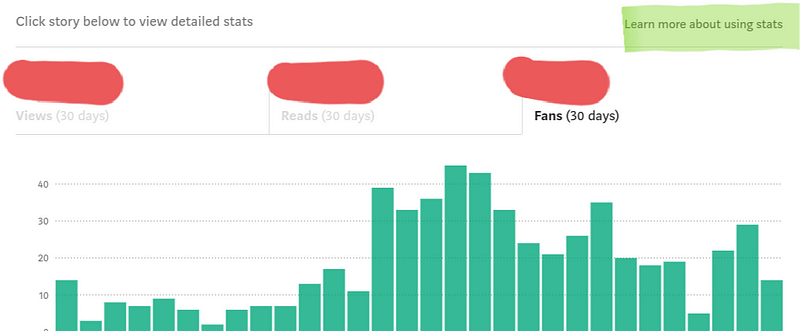
According to the information in that article:
A view = someone who clicks on your article but doesn’t read it fully.
Reads = the approximate number of people who have read your article from beginning to end.
Fans = the total number of people who have clapped for your work (not the total number of claps).
Read Ratio= For any given article the read ratio is the percentage of views that became reads.
Honestly, my mind was a little blown. Knowing this information really gives new light to my stats. I’m now completely blown away at the number of people that have read my articles from beginning to end. I’ll discuss my own stats for the month of October in a separate article.
More importantly, this information clarifies something important. I had assumed that if a person reads 3/4 of an article that’s most likely considered a read, but I was wrong. If a person reads about 3/4 of your article and they don’t scroll down to the bottom, that is still considered a view.
Below are two examples showing the stats for my article with the highest read ratio and my article with the most views.
Vocal Media Got Me In My Feelings is a short-form article that garnered 32 views and of those 32 views, 24 of them became reads. This equates to a 75% read ratio. Even though my total views are not that high, it shows that most of the people that clicked on this article read the whole thing. I’ve learned that the read ratio is usually higher with short-form articles (150 words or less).

Then looking at one of my more popular articles, Before You Rush To Get 100 Followers Consider This, it has 104 views and 51 reads. This equates to a 49% read ratio. The thing is for all I know the 53 views that didn’t turn into reads could’ve read 70, 80, 90 percent of it. There’s no way for me to know exactly. And maybe it doesn’t matter. What I do know is this is a full-length article (6-minute read), meaning both viewers and readers were spending more time on it than my 1-minute article, therefore earning me more money.

Knowing this information is going to be key in helping me to better understand and analyze my stats. Something that YouTube does is show you exactly at what point viewers clicked off your video, so you can try to figure out what was it about that 3-minute mark that made people click off and try to improve your future videos. Though Medium doesn’t tell us exactly at what point viewers moved on, the read ratio can be a great tool in analyzing those articles with high views but low read ratio. I’m not planning to drive myself crazy over-analyzing my past articles, but I do find this information incredibly interesting.
There’s so much more helpful information in that article that will really help break down your stats. I urge you to check it out.
Follow my adventures:I am Positively Healthy Vibes on both my YouTube & Instagram in which I promote positivity and document my weight loss journey.On Twitter I am Nathalie_Clair1 (can y’all believe someone else has that so I had to add the 1) and that’s where I promote myself as a writer.If you are not yet a Medium Member you can Sign Up Here to get unlimited access to all Medium content for $5 a month. I will receive a referral bonus when you sign-up using my link.You can also support me by buying me a Ko-fi Here.


