
I Faked It in the World’s (Almost) Happiest Country, Till I Made It
By trying to fit in I actually became happier
They say fake it till you make it.
When I arrived in Denmark, ranked the second happiest country in the world, I was lost, tense, neurotic, and hard as a rock. A normal state of mind for a New Yorker, but for a Danish person — almost unheard of.
In Copenhagen, people seemed calmer, quieter, less addicted to electronics, and more present with one another. They seemed to be at peace. In the land of such contentment, I was almost embarrassed by how anxious and restless I was.
Sure, I was coming from a complicated city in a complicated country but excuses or complaints weren’t gonna help me to feel, or fit in, better in the new place. And fitting in was all-so-important in the country where being “too different” is frowned upon.
I had no choice but to fake it and copy the Danish behavior until I figured out the next steps. Little did I know, by doing so I actually became happier.
Here’s how.
I biked in bad weather and didn’t complain
If there was one thing I could do to improve my happiness levels instantly, it was to get a bike. Nobody sticks out more like a sore thumb in Copenhagen than a healthy person without a bicycle. The city runs on them, and without one, you will forever be a foreigner there.
With some hesitation, I bought a used bike and, knees trembling, cycled as far as I could in a day. As soon as I got over the fear of car and bike traffic, I felt happier, even if only for the duration of the ride.
I started biking to my coworking space every day which was fun… until it started to rain.
Almost every day. “Should I just take a bus?” I thought one rainy morning at 8 AM. I gave up and did just that — a failure that cost me almost ten dollars for a round-trip.
When I arrived in the office I realized that no one else chose public transportation just because of the rain. It turned out Danes biked every day in any weather.
My office friend lectured me on the importance of proper gear and suggested a few essentials: a rain jacket with a hood and a visor, waterproof pants to go over your regular pants, waterproof shoes (waterproof sneakers turned out to be a hot item in Copenhagen where so many people love to run), and a waterproof backpack. She even loaned me her raincoat to get me started.
Finally, I was loaded and ready to bike in Danish winter. I arrived in the office wet but happy, feeling like a superhero. Only to discover that no one cared.
Danes don’t see biking in bad weather as a challenge but as a part of life in Scandinavia. They don’t complain about it or talk about it at all. Amazing, I thought.
Eventually, my amusement faded but the calm sense of achievement remained. I was now just one of the many no-nonsense winter bike commuters in Copenhagen, and I wouldn’t have it any other way. It was impossible not to feel a little happier.
I lit candles
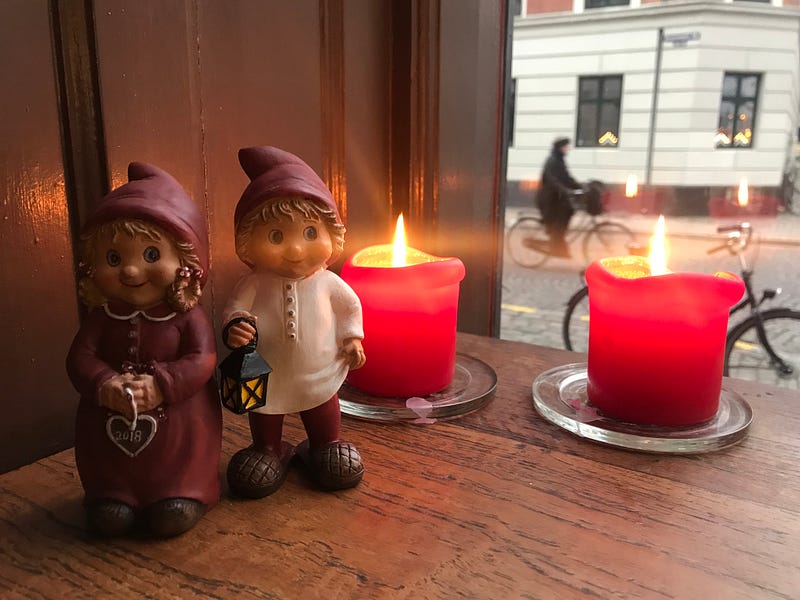
Danish people are the world’s biggest consumers of candles. They’re everywhere: in cafes, stores, offices, homes, and next to sausage rolls in the supermarket. It’s because Denmark leads the world in the “cozy” department, also known as “hygge.” It seems that everyone there lives with dimmed lights, a woolen blanket, and a fur rug.
Since the art of “coziness” doesn’t exist in America, the land of bright lights, big cars, and loud everything, I had to do my research on “hygge” ahead of time. In Copenhagen, I headed straight for the supermarket to stock up on candles and fuzzy socks.
Every night, I turned down the lights, lit a candle or two, made a cup of warm tea, and pulled a soft blanket over my knees. I felt instantly relaxed.
This, I knew, was a big piece in this Danish happiness puzzle.
I followed the rules
Denmark has been named one of the world’s most honest nations, and the honor system is a big part of the Danish national identity.
A Dane will never cross the road at a red light, even if there’s no car in sight. He’ll dutifully wait for the signal to change because that’s what a Dane does. This behavior seemed odd to me at first but, as with everything else, I accepted it as my new reality, and did the same.
Coming from New York, where crossing on the green light is saved for tourists, it was a challenge but I stuck with it.
Surprisingly, I found myself relaxing more and more every day. After all, never having an option to cross at a red light means never having to worry about when to cross the road. Always signaling during your bike commute means never having to think about whether to signal or not. And knowing that everyone around you will do the same, means never having to mistrust people.
Without a lapse, I did the honest thing every day and it did, inevitably, make me trust others, and myself, more. And that was a big step in the right direction.
I ate with other people
In a small coworking space in Copenhagen, I learned the value of communal eating, so beloved in Denmark.
Danes naturally place spending quality time with other people above personal possessions or achievements.
From day one in the office, I noticed that the majority of members ate their lunches at large wooden tables in a dedicated kitchen at noon every day. Food was delivered each morning by a catering company. It wasn’t cheap (around $15 per meal) but it was homemade, delicious, and Danish-themed.
I was terrified to join them but I gave it a try, faking my willingness at first. I signed up for lunch and arrived in the kitchen when instructed.
At noon, the candles were burning next to steaming bowls of hot food. There was no music, just the muted hum of conversations in both Danish and English. No one talked loudly or demanded attention. People weren’t there to make a fuzz but to enjoy their food and company.
Awkward as hell, I took a plate from the fully-stocked kitchen and picked up the simplest things — potatoes, salad, pre-sliced pieces of pork. It was hard to go wrong, I thought.
Yet I still did, as I learned sitting at the table with four Danes who were sweet enough to switch to English for me. Here I was, telling strangers my life story and receiving a gentle lecture on Danish food customs.
I ended up learning a lot about Denmark from these lunches, surprised at easy it was to talk to Danes (in some settings!). They didn’t rush to their desks for all their unfinished tasks They didn’t boast. And they almost never talked about work.
What started out as a painful experience, ended up creating some of the warmest memories of my life. No doubt that taking this daily time to build and strengthen a community, even in your workspace, is a big part of why Danes are just more relaxed about life.
And by forcing myself to eat with others every day, I started to feel like I belonged more, and I was happier for that.
At the end of my one-year journey, I wasn’t exactly happy-go-lucky but I was a more relaxed and grounded person, with changing priorities in life.
Sometimes, you just need to act like a better version of yourself. Until, eventually, you become one.