
I Earned 18.5K Backlinks To a New Website — This Is How
No, I didn’t buy them
I don’t actively focus on building backlinks to my websites.
Let me be clear upfront: There is nothing wrong with backlinks. I actually really like and want them. Backlinks tell Google that a website is valuable, credible, and trustworthy. Backlinks give you more authority and boost your rankings.
That results in more website traffic, more display ad earnings, and more affiliate marketing commissions.
In short, websites with more backlinks earn more money.
Even though I don’t seek out backlinks, I still got 18.5K on a new website in 24 months.
This is how I did it.
The Proof
Here is a screenshot from my Ahref dashboard showing some of the stats on my website:
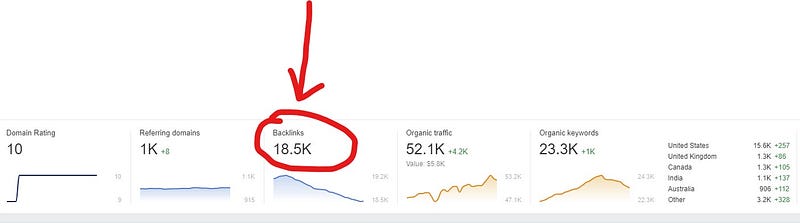
I know you can’t see the name of my website in this image. Since running websites is how I earn my living, I don’t feel comfortable sharing the exact domain name.
As you can see, I have reduced how often and how much I publish on this website. I’m still publishing new content, just at a reduced rate.
That’s the main reason for the downward slope of my backlink profile.
I expect that chart to reverse in the next 12 months as I add new articles that rank high in search.
Some stats:
- I have about 130 articles on this website so far
- There are approximately 260,000+ words of content on this site
- My top-ranking pages get the most backlinks (this will be important later)
I Didn’t Buy All My Backlinks
You can throw money at backlinks.
You can pay scrupulous and unscrupulous marketers to build backlinks for you and your website. On Fiverr, you can get backlinks from $20 up to $1,000 (and more).
Typically, the more you pay, the better (and fewer) backlinks you get.
It may seem strange to pay more money for fewer backlinks, but those backlinks get built with “white hat” methods that don’t get you in trouble with Google.
That’s the big risk with backlinks.
Do it wrong and Google can shut down traffic to your site. And, I probably don’t need to tell you that you don’t make any money with a closed business.
Things you don’t want:
- You don’t want your backlinks all at once.
- You don’t want backlinks from PBNs (private blog networks) that exist only for backlinks
- You don’t want backlinks from websites that have nothing do to with your site or topic.
- You don’t want a ton of backlinks from spammy websites (Google might see you as guilty by association).
Things you do want:
- Backlinks that slowly accumulate or drip-feed over time
- Organic backlinks
- Backlinks from high domain authority sites with original content
- Backlinks from authority sites in your niche
Some SEO experts and niche website owners swear by buying backlinks. Especially to new websites that slog along in the first year.
Again, there is nothing wrong with buying backlinks. I’ve bought backlinks before to experiment with them. I might write about the results when I have collected enough data.
If you have the money and find a trusted source, go for it.
But I didn’t buy these 18.5K backlinks.
My Butt-Naked Backlink Formula
Ok, then how did I do it? I’m going to metaphorically strip down and show you my butt-naked backlink formula.
The best part of this formula is that it is passive, free, and works all year round. It’s also backed by solid data.
Oh, and Google is here for it.
Google loves this “ish”. Why? Because the whole process is built on organic backlink growth by offering real value to real people.
This is not a “pay to play” approach.
Here is my butt-naked backlink formula: I earn backlinks naturally by ranking articles in the top #1 position for keywords with zero competition.
That’s right.
My entire process is finding untapped keywords with super low or no competition, writing the best articles on those topics, and then ranking them in the #1 spot in search.
“Sadly, much of the content being published is simply not worth linking to. 75% of it is getting zero inbound links. So forget the ‘more is better’ approach to content if you want links. Go with quality instead. Your content will generate links only if it is truly exceptional — ’remarkable,’ as Seth Godin would say.”— Brian Sutter, Forbes.com
According to a study conducted by Ahrefs — an internationally recognized SEO, keyword, and backlink authority — top pages in the top spots get the top number of backlinks.
They even gave it an oddly ominous name: “the vicious circle of SEO.”
Here is how Ahrefs explained it:
It’s the theory that people are most likely to link to top-ranking pages. As a result, those pages get links at a faster pace than all other pages on a given topic. Thus, they are almost impossible to beat in the SERPs.
They call it a theory but it’s been proven over and over again by bloggers.
If you have time, check out the entire study. It’s pretty eye-opening about acquiring backlinks.
However, there is one juicy secret buried in the data.
Butt-Naked Backlink Formula 2.0
The secret is that one of the best ways to build organic backlinks to websites (even new ones) is to rank number one for low-competition keywords.
In the experiment, pages in the top spot earned an average of 24 backlinks every single year.
That’s proven true in the data from my website as well. The top pages get more exposure, so they get more backlinks. I also like to think that my content is valuable enough to earn a backlink here and there throughout the year.
The key for new websites is to mine for low-competition keywords that are easy to rank for on Google.
The less competition, the better.
As your articles rank #1 for multiple keywords, you’ll start to get backlinks. In a way, every top article on a low-competition keyword is like a mini missionary constantly promoting your content 24/7/365.
Imagine a small army of backlink ambassadors working tirelessly for you all year round.
That’s about as “passive” as passive income gets.
“Focusing on quality [backlinks] over quantity is what can help to protect your site as Google updates.”— Adam Riemer
Final Thoughts: Building Your Backlink Funnel
You don’t need any special tools to build a backlink funnel of low-competition keywords. I mostly use Google search to find good topics for my websites.
However, I also use paid tools like Ahrefs, Shine Ranker, and LowFruits.io (not affiliate links).
Whatever you use, start building your organic backlink funnel straightaway.
Browse my “playlist” of articles about building money-making websites


