I Dream of Electric Squirrels
An evolution of childhood reactions to the ebb and flow of life
My very earliest memory has no words. Just scenes. Sounds. Sensations. I see a window out to the bright blue world, most of which I cannot see from the vantage of my crib. The sill is above me, so the window is like a rigid eye pointed up at the sky, while the fun and action are down below. Perhaps that is why I escaped with an instinctive and irrepressible urge, like a born inmate I’m told.
Freedoooom!!! cried Braveheart in diapers.
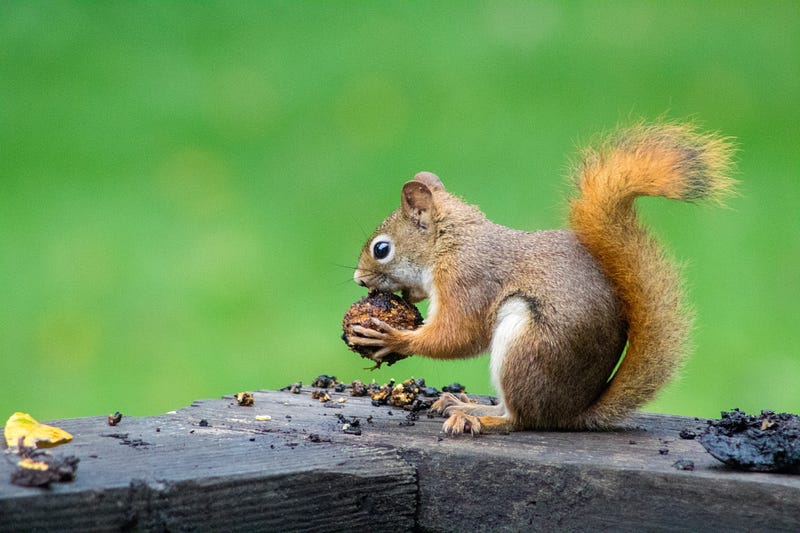
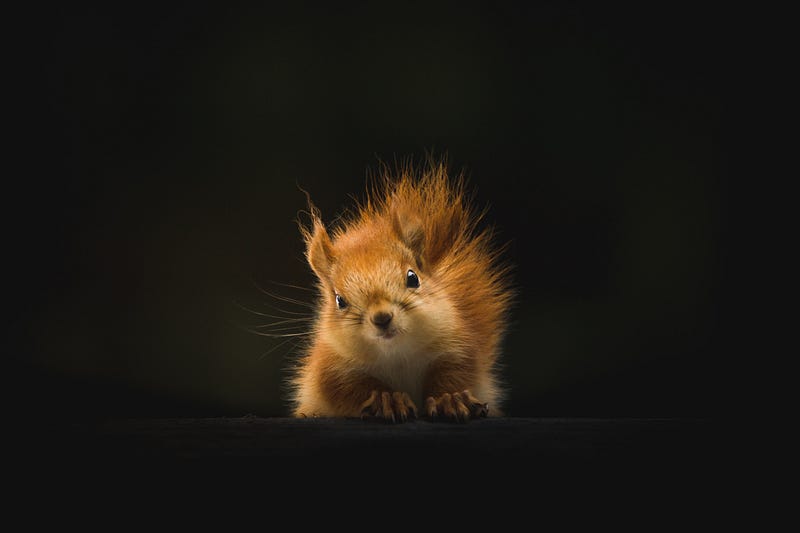
Then, I see a squirrel hopping along the sill. More than half a century later I can still feel the electricity surging through my limbs and chest upon seeing the bushy S of its tail, the obsidian orbs of its eyes, the hop-pause gait. The charge of excitement sent me into a mania, jumping, squealing octaves only dogs and mothers can hear.
And, like a reflex, my mother ran in to see what trouble I was in. Slowly her DEFCON-level blood pressure deflated when she saw my rapt attention on the squirrel scrabbling along the window sill.
She made some motherly sounds, perhaps trying to teach me “squirrel” or “dangerous rabid animal”. It occurs to me now that I only spoke her mother -tongue until I went to school. That language is forever lost now, and perhaps that is why my memories lack words. As far as I cared, whatever she was doing, she’s just talking furniture. The squirrel was my north star, guiding my every intention.
Then the squirrel disappeared past the frame of the window. I recall the electricity draining out of me and spilling through the bars of my crib. Mom’s holding me now, and I’m pointing, commanding, a miniature general, to the window, to the squirrel, to the world outside. I think there were tears on the general’s inconsolable cheeks.
Like an alternating current, my earliest memory contains a full cycle, the peak of excitement and the trough of despair wrought by an electric squirrel.
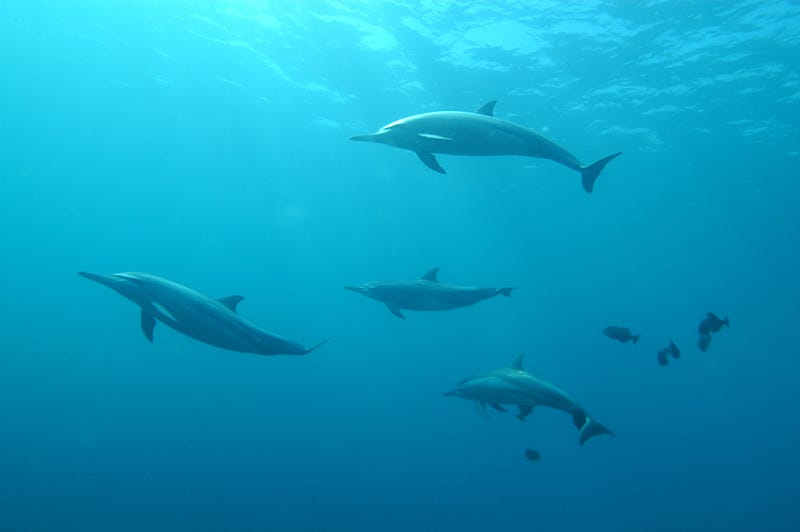
Another very early memory is probably a few years after being abandoned by the squirrel. I had drawn a shark or a dolphin or a whale, something aquatic, graceful, undulating.
Why do I still remember this mundane scene? One reason may be that this was my first attempt to draw freehand, copying a photo or drawing from a book without tracing it. Look at that. Look at my drawing, I’d tell you if you were there.
The same electricity sparked by a squirrel a few years before charged through every cell in my body now. But this was from something I did. Something I made. With my hands. The graceful lines of that hand-drawn dolphin flowed like water through the wooden pencil that I held, down into the graphite and onto the paper. It was magic and powerful.
The resulting electricity needed an outlet as before, and it powered me and my sea creature in eddying circles through the house and out into the yard.
I remember now that Flipper, a dolphin in some long-forgotten television show, was one of my favorite characters about this time, and so I probably ran around trailing a long string of sounds meant for dolphin echolocation rather than human comfort. Mom probably kicked me out of the house rather than me bouncing out by my own undirected Brownian motion.
Out there in the tiny English yard in front of the tiny English house we rented, was a typical English hedge, with me safely within its protective arms, and the Manchester streets on the other side. And just as my dolphin and I made a lap around the hedge-bound yard, a pack of kids on bikes came by.
Perhaps the bright white rectangle of the paper signaled like a flag of surrender and was an irresistible summons. Or perhaps a small, unsupervised, ethnic-looking kid on his own signaled far more than any flag could have done. Who knows.
They were older boys and rolled up friendly-like, and asked what I was doing. I showed them my dolphin or whale or shark or whatever it was, and I told them I had drawn it.
The oldest boy up front asked me to hand him the drawing so he could see it. I handed it to him, smiling.
He said that I traced the picture, didn’t I.
The charge powering through my body and my electric grin suddenly constricted, and focused right in my chest, leaving a numb tingling in the vacated and unpowered limbs.
I was still smiling. I could feel it. But it was as thin as my drawing, a few molecules of graphite scratched across the surface planes of my face.
I didn’t trace it. I drew it on my own.
Did not.
Did too.
Did not.
The boy held up my drawing and slowly tore it to pieces.
These patterns recurred like clockwork, a universal law with its mathematical inevitability. Every electric peak of excitement came hand in hand with a trough of disappointment or despair. Peak and trough. Peak and trough.
I learned early that the pain deep within the troughs hurt far more and lasted far longer than the fleeting highs at the peaks. It was not a fair fight. It was asymmetric warfare. The chronic, dirty guerrilla war of despair and humiliation won the day and won the war.
A little older and back in America I became a hunter, capturing and keeping all manner of creatures, insects, frogs, snakes, anything that could not wriggle, writhe, hop, or scamper fast enough to elude my trundling approach.
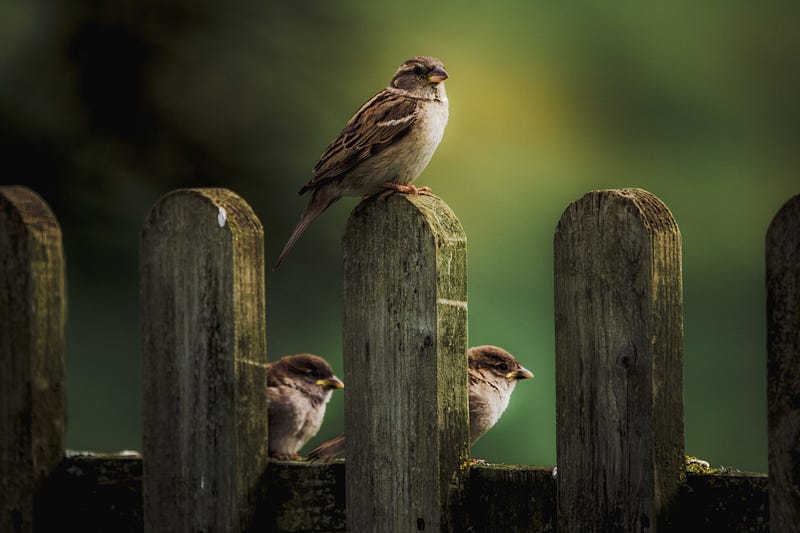
And then a lucky bonanza, a sparrow! A fledgling who could not climb the currents of air and get away from my grasping hands. Back at home, I flapped about in perfect mimicry of the bird I had captured, galvanized by my luck and my prize. I eventually settled into the routine my mother set for me, feeding the bird and cleaning its cage, and keeping it company. We called it onomatopoeically, Chibbie.
But as night follows day, the trough of despair arrived and I learned I had to let the bird go.
We followed an unscientific but gently progressive schedule, setting the cage near the sliding door to the deck, supposedly so Chibbie could learn to yearn for blue skies rather than spackled drywalled ceilings. Then we set the cage outside, pleased when neighborhood sparrows came to visit, probably for the seeds scattered by Chibbie, rather than for Chibbie himself.
Then came the day I dreaded. Mom had me open the cage door, wisely letting me drive destiny and take responsibility. Chibbie fluttered away without a backward glance.
The mathematics of symmetry dictated that grief and despair mirror the pure joy of capturing and holding a small feathered heart beating in my hands.
But something happened. The next day Chibbie returned, perhaps answering the morse code tapped out by my own feathered heart. He came with the neighborhood sparrows. Dozens of them congregated on the railings of the deck where had we set his cage for a week before his release. That summer and fall, we set seeds out for Chibbie and his friends. Even though the apartment neighbors below and beside us complained mightily about the mess they left.
A calmer and slower joy, of feeding a wild Chibbie and his wild friends replaced the fiercer youthful joy of capturing and controlling, of possessing and domesticating.
And with it, an acceptance of the risks, the disappointments, the despairs wrought by the unknowns out there in the suburbs of Pittsburgh, Pennsylvania.
When, eventually, that winter, Chibbie no longer returned, there was sadness, but a dawning wordless realization, like my earliest memories of childhood. And just as the joy was, the sadness was also tempered. More resilient, less brittle.