
I don’t want to wait another 100 years for gender equality.
It’s time to change the script and make everyday International Women’s Day.
At the current rate of progress, we will achieve global gender equality in 2120. For the next 100 years our International Women’s Day themes and slogans will continue to celebrate achievements and remind us of the gaps yet to be filled. There is another way. We can change the script by addressing the two fundamental reasons why gender inequality still exists. Every day can be International Women’s Day.
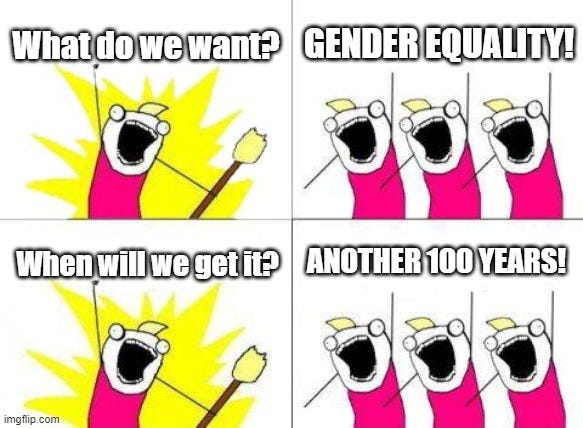
Despite knowing the benefits of gender equality, and what needs to be done to reach parity, change is still painfully slow. At the current rate of progress, the WEF predicts we will achieve global gender equality in 2120. This will be long after the predicted singularity, space colonies and cyborgs which are often held as aspirations for civilised society.
[Which already raises two side questions: 1. Without equality, who will benefit most from the advances in the next century? 2. Will humans reach their full potential if half the population isn’t completely engaged?]
On the other hand, the United Nations is more ambitious — gender equality and empowerment of all women and girls is an SDG target in the 2030 Agenda for Sustainable Development. Furthermore, the United Nations theme for International Women’s Day 2020 is ‘I am Generation Equality: Realizing Women’s Rights’ which signals the push to make women’s rights a reality today rather than a dream for the future. Equality by 2030 sounds good to me, but how do we get there?
Why haven’t we reached gender equality yet? The path to equality seems rather straightforward: i) acknowledge that inequality exists using evidence of the extent and effects; ii) articulate goals; iii) create and implement plans and accountability; iv) track the progress and iterate accordingly; v) monitor for and rectify roadblocks; vi) then realise the goals for gender equality.
However, there are challenges faced at each of these steps. Some of the obstacles preventing gender equality today are:
- Gender-specific data isn’t universally nor automatically collected and analysed. Without definitive data it is easier to ignore inequality.
- Women continue to do most of the world’s unpaid and unrecorded care work, this impinges on how a woman can contribute.
- Laws exist which support inequality.
- Cultural practices exist which support inequality.
- People and groups aren’t cognizant of the negative impacts their decisions have on gender equality.
- Competing social or economic goals are prioritised.
- Equality is not a goal for some people.
- A lack of accountability by individuals, groups and countries to articulate and realise goals.
- Design of our physical world hasn’t fully accommodated the female body. As eloquently stated by Caroline Criado Perez in her 2019 book Invisible Women, this “has led to a world where women just don’t fit very well.”
All of these obstacles and the others not listed here are rooted in two fundamental reasons which explain why we don’t have gender equality today.
We haven’t reached gender equality yet because:
1) There are people who don’t care about gender equality.
2) People who do care about equality don’t always have power to act.
When we care about something, we prioritise it. Whether it’s a lack of data on violence against women, or social traditions which limit girls, or products not designed for women’s bodies, the bottom line is that we, humans, have constructed barriers that prevent parity. Fortunately, we have the tools to remove the barriers. When people who care about gender equality have the power and influence to act, then we accelerate towards realising equality.
I’ve created this Gender Equality Care and Power Model to illustrate the intersectionality of caring and power in making a difference to gender parity.
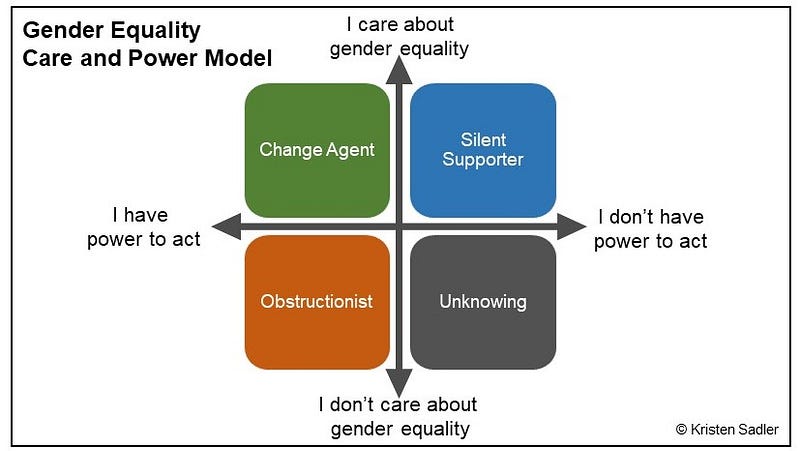
We each have a place in this model and where we sit depends on whether we care about gender equality or not, and whether we have the power to influence or not. People sitting in the upper half all care about equality (green and blue). Similarly, people sitting in the left half all have the power to act (green and orange).
This creates four general categories. Those in the upper left (green) care about equality and have the power to act — our change agents. Those in the upper right (blue) also care, but they don’t have the power to act — our silent supporters.
People in the lower left (orange) are perhaps the most damaging because they don’t care about equality and have the power to act — the obstructionists. People in the lower right (grey) don’t care and don’t have power — the unknowing.
This isn’t a binary scheme though; caring and power are both relative and each exists on a continuum. Hence the axes don’t have absolute values, rather cater to different levels of caring and power. I sit in the upper left because I care and have power, yet others who care more and/or have more power would be a little further to the left and higher than me. This allows everyone room to improve, even the change agents.
To move faster towards gender equality, it would be ideal to have everyone in the whole world caring about equality and empowered — everyone would sit in the upper left section. In reality though, due to human nature and our heterogeneity, it’s unlikely that everyone will care about equality and have power. So instead, we just need to tip the balance: to have enough people who care and with influence to negate detrimental actors and activities.
How can the balance be tipped? There are three ways. We can:
- Nudge people who don’t care about equality to care (shift the lower half into the upper half).
- Empower those who care so they can have influence (shift the upper right into the upper left).
- Support and encourage the people who already care and have power. We need our champion change agents to carry on their excellent work and continue to raise the bar.
These shifts require collective and individual action, communal and personal responsibility. So it’s time to move from “we” to “me” and embrace the UN IWD 2020 theme — I am Generation Equality.
How can I nudge people to care about gender equality and empower those who care? Whilst preparing the Gender Equality Care and Power Model I reflected on where I sit, where I aspire to be, and how I can tip the balance. I do care and I use my power. But if I just continue with my current efforts, and we all do the same, then we wait 100 years for equality. I need to do things differently to change the script.
For IWD2020 I’ve decided to commit to my own IWD Resolutions. I’m aiming to increase my own impact and help nudge other people to care about equality and be empowered. Every day. Not once a year.
Here are my IWD 2020 Resolutions. I plan to:
- Fully embrace an empowered mindset. I will remind myself that one person can create change and that we each make a difference because of our unique skills and experiences.
- Share gender equality success stories with anyone and everyone. By communicating the great outcomes achieved through gender equality, I will show others what’s possible and nudge people to plan and realise their own goals.
- Include gender categories when collecting and analysing data and information sets. This will identify gaps and the progress being made towards equality. It will raise awareness of the Gender Data Gap and help others see the gap and the effects and hopefully nudge them to care.
- Increase women’s representation using my professional power. I will utilise my standing to increase the ratio of women with influence. This can be as simple as amplifying women’s voices on social media or advocating for women as they vie for formal appointments.
- Increase women’s representation using my consumer power. I will pay more attention to the gender equality policies and practices of service and product providers. I will use my purchasing power.
- Raise my own bar. I will work out how to best use my skills and experience to advance gender equality directly, indirectly, proactively and passively.
- Empower others. I will help more people recognise their power and how they can use their influence in the workplace, in community and social groups, as a consumer and as a voter.
- Be better informed about current and projected gender equality. Please share your recommendations for books, articles, reports, podcasts, talks, writers and anything else!
Will you join me by setting some everyday IWD Resolutions of your own? The first step may be to consider where you are and wish to be in the Gender Equality Care and Power Model. If you aren’t where you want to be, think about what you need to do to get there and start planning. Also, reflect on how you can help other people to care about gender equality and/or support them to find their power.
“The most common way people give up their power is by thinking they don’t have any.”
Alice Walker, novelist, poet, social activist
Changing how I act will move us all towards gender equality faster. If we stick with our current plans and mindsets, gender equality will take 3 or 4 more generations. More people being proactive now and having more women in positions of influence will help speed things up. So too will questioning and disrupting the old ways of thinking and doing. Fortunately, Millennials and Gen Z’ers seem particularly talented in these areas.
We can also harness emerging technologies and digital transformation as resources for accelerating towards equality. Technology, and particularly connectivity and communication are developing at exponential rates. This means that the collection and analysis of data are no longer reliant on human-scale capabilities or linear progress.
Sophisticated algorithms could be designed to analyse more complex and larger data sets than any human could manage. There are caveats though about the use of new technologies and big data; we must avoid unintended consequences, and remove harmful biases in data, software and programming. We must ensure the right people are involved at the right time for useful data collection and analysis.
I want to reach gender equality before 2120. Can we do it in the next ten years and meet the UN SDG target? We can, when we care and act. I can, when I care and act. Are you with me?
Kristen Sadler is an independent advisor, speaker and author. She combines a scientific approach with leadership experience and a multi-local perspective to explore the interfaces of emerging tech, exponential thinking, knowledge, truth and potential futures. kristensadler.com