I Don’t Want More Kids
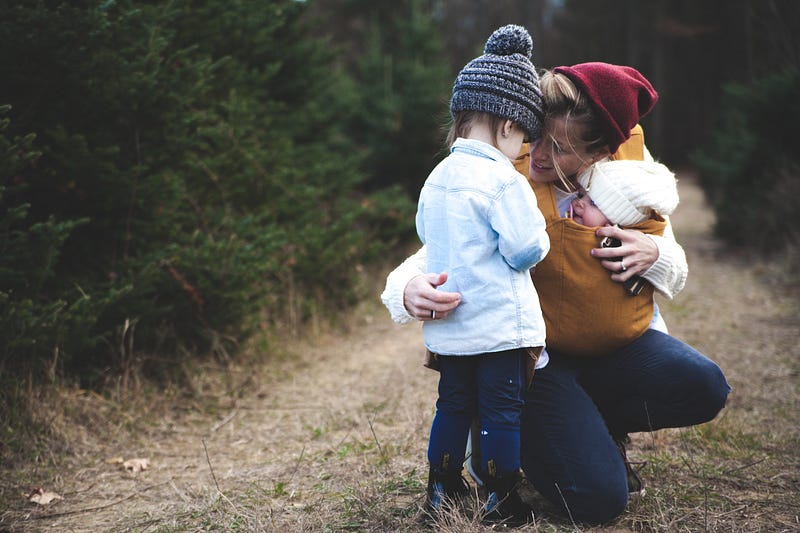
Even in our supposedly evolved times, if a couple makes the decision to have children, three seems to be the magical number that they’re expected to bear. When I’m with my two children, I often get asked if my husband and I plan to have another. It’s not a question that ever gets asked of my friends who have three kids; everyone seems to assume they’re done.
It certainly doesn’t help that my children are both girls. “Now you’ve gotta try for that boy!” joked a stranger (I didn’t laugh). “Would you try for a third if you knew it would be a boy?” asked a friend. (Pretty sure that’s not how it works.) Friends who have one of each sex, it seems, don’t get asked about their plans for a third quite as often. They’ve checked both boxes, and it seems logical for them to be satisfied- but not me.
My official reason for stopping at two, the one that I trot out most often, is that my husband and I are both cystic fibrosis carriers. CF requires both parents to be carriers, and any child of ours has a 1-in-4 chance of being born with the disease. In my case, I am a carrier of what’s called a “nonsense mutation,” meaning that it does not respond to the usual forms of treatment and sufferers’ life expectancy tends to be lower. While my husband carries a more common mutation with a better prognosis, there is no predicting where our children could fall on that spectrum. “There’s only so many times I’m putting you through this,” my husband told me after the invasive genetic testing session that would reveal whether our ten-week-old fetus would be born with the disease. Describing the hellish wait time for the results- two times over- is generally accepted by anyone who asks as reason enough not to roll the dice a third time.
The truth, however, is far simpler, more brutal, and generally not what anyone wants to hear: we’re not having a third child because, quite simply, we don’t want one. Despite that still-unchecked “boy” box, after going through two pregnancies (both healthy), two births (both uncomplicated), and two newborn stages (both hard, but in normal ways), we just don’t feel like doing it again.
Want to read this story later? Save it in Journal.
It’s a truth that sparks reactions. The most common is incredulity that I don’t want to re-experience the newness of a baby. While I can gaze back on the baby days with the lens of time filtering out the sleepless nights and helpless crying moments (theirs and mine), it’s not as though I’ve forgotten them. Yes, I do get nostalgic for the milk-drunk babies sleeping on my chest, but that nostalgia is tinged with the memories of the crushing anxiety, exhaustion, and isolation that I experienced in tandem.
The other reaction, less common, concerns my husband. Doesn’t he want a boy? The underlying sexism of the question makes it seem easy to dismiss at first, but the uncertainty ate at me nonetheless. I had to ask him- was he really okay with two girls? Was he, as a man, incomplete without a son?
His answer- “What am I gonna do with a boy that I can’t do with the girls?”- gave me clarity. And as time has marched on, with our youngest now nearly two years old and baby clothes being given away by the boxful, we remain grounded in our decision.
The fullness of my experience as a mom, it turns out, does not depend on the sex of my children, nor meeting some arbitrary quota. The depth of love that moms feel for their kids can (and does) motivate some of them to have more. The depth of love I feel for mine, though, only makes me want to experience their lives with them, to see where they go and who they decide to become.
📝 Save this story in Journal.