
I Don’t Think Y’all Realize How Much More a Billion is Than a Million
It’s not just a “little more”

Jeff Bezos has a ton of money. Numerically, it is estimated that he is worth over $200 billion — the most money ever made by anyone in the history of people. And, he might eventually become a trillionaire, not for a while though.
American Lawyer, Bob Lord, estimates that if the growth rate of wealth over the past 30 years continues, a trillion dollar fortune will show up before the year 2040. That is insane. For now, we only have billionaires and millionaires.
Did you catch that? I said “we ONLY have billionaires AND millionaires.” The two often get lumped together. Heck — before a few years ago I saw billionaires as a little richer than millionaires. That is so far from the case. Here’s the breakdown and what it means.
The Numbers
In numerals, a million is: 1,000,000.
A billion on the other hand is: 1,000,000,000.
To someone, like myself, who is about to start paying back his college loans both of those just look like immeasurably large numbers. A million is 1,000 a thousand times. On the other hand, a billion is 1,000,000 (that is a million) a thousand times.
(And just for fun: if you were to multiply a billion by another thousand, you get a trillion!)
Why We Can’t Visualize These Numbers
We have never had to, that’s why.
“Prior to the advent of a formal numbering system, early humans only really needed to get a basic sense of small batches of quantities, like the number of people in the clan, or how many animals might occupy a certain area.
These days, however, we’re surrounded by large numbers. Like, stupid large numbers. We’re told that there are 7-billion humans on Earth, that there are 300-billion stars in the Milky Way, and that there may be upwards of 70-sextillion stars in the Universe (that’s 1021, or a 1 with 21 zeros behind it). Good luck trying to wrap your head around what such a quantity actually means or signifies.”
— George Dvorsky, How to Comprehend Incomprehensibly Large Numbers
You see, even these days, the largest quantities of things that we are conscious of are probably regarding money. How much this is, how much the car payment is, how much money we have in the bank. Beyond that, people are generally working with some pretty small numbers. Three kids. Two cars. Four Cats. And — what — maybe 200 likes on your latest instagram post.
We are not totally lost with numbers though, just really, really big ones. You probably have a strong intuition that 20 dogs is a lot more to handle than 2 dogs. Can you even visualize 200 dogs? What about 2,000? Keep in mind this article is about numbers with at least this many — 000,000 — zeros.
It gets really tough. Our brains just go blank. Let’s try anyway.
Looking at Those Numbers Differently
As time —
Let’s start with this tweet that went viral a few years ago:
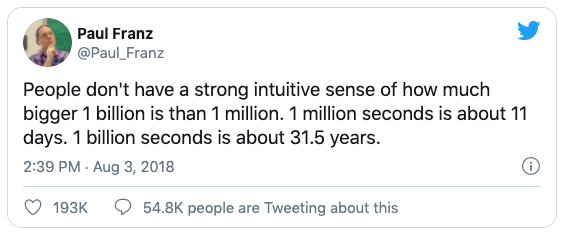
We humans are obsessed with the concept of time so it makes sense that Paul’s analogy above works. We all know what 11 days feel like, but what about 31.5 years? I have not even lived that long yet!
As weight —
A million grams is the equivalent of roughly 1.1 tons. A walrus it turns out weighs that much. So do many Chevrolet Corvettes, grown male polar bears, and the second largest pumpkin ever recorded.
A billion grams is 1102 tons. That is the equivalent to 5.5 adult blue whales, 275 H1 Alpha Hummers, or 7 Statue of Liberty’s.
As counting —
Here’s is something more interactive. Get the whole family involved!
If you counted to 1000 every day, you will have collectively counted to a million in 1000 days (142 weeks, 2.7 years). Counting to a billion this way is worse. Keeping our same scheme here, it would take you 1,000,000 (a million) days to count to a billion. That is 142,857 weeks and 2,740 years.
When I said get the whole family involved, I meant generations and generations of family members. The person to count the last set of 1000 (if each generation covered 100 years of counting) would be the 28th generation past the one that started the family counting tradition.
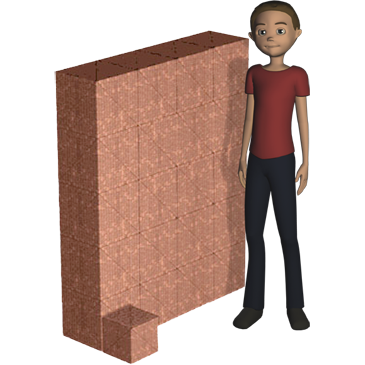
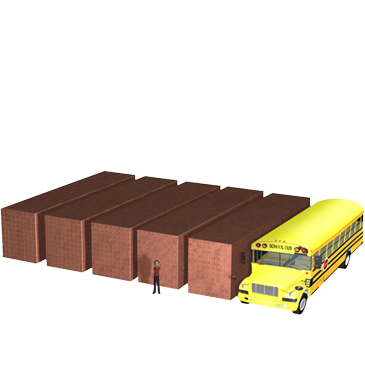
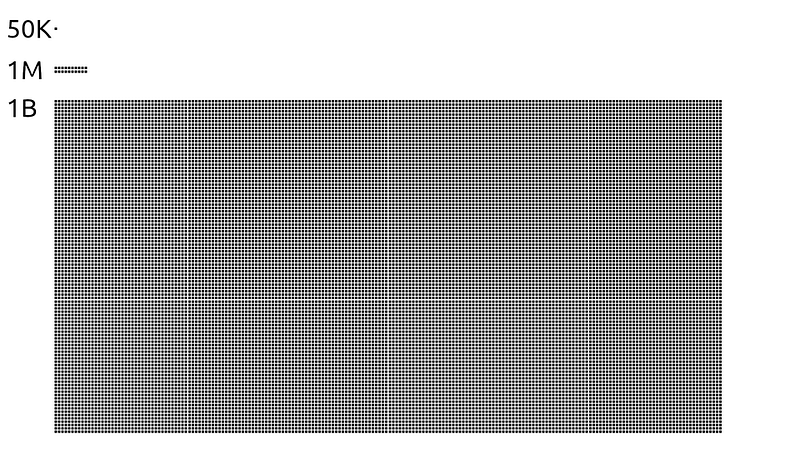
Visually —
I hope that last one was not too hard to follow. If it was my apologies — to make up for it here’s something nice to look at to illustrate the same point.
These are from a neat site I found called the The MegaPenny Project:
This one is from Reddit:
Then there is this beloved tiktok where someone represents how much Jeff Bezos was worth (at the time). Each grain of rice is $100,000.
What’s the Point?
The target we should be setting for ourselves is not halving the proportion of people living in extreme poverty, and without enough to eat, but ensuring that no one, or virtually no one, needs to live in such degrading conditions. That is a worthy goal, and it is well within our reach.
— Peter Singer
We can’t comprehend well how much bigger a billion is than a million but we can start to ask questions about how so many people are becoming billionaires in the first place. In 2019, there were 2,825 billionaires. A record high.
A year later, 9.2 % of the world’s population live on or below the Extreme Poverty Line which is $1.90 (US dollars) a day. That is 717,600,000 people — over twice the population of the United States. [Note: the COVID-19 pandemic is estimated to add up to 115 million people to this total.]
The point is that the wealth distribution of the world is obscene (or whatever 1000 times obscene might be — grotesque?). Some people really do have more money than they could use in several life times. While the extreme poor live on less than $2 a day, many people are getting daily coffees that are three times that, at least.
I am a broke, college graduate and even this morning I went to Starbucks and spent $5 on an iced coffee. My first hope is that you can now see how much more a billion is than a million. My second, and more important hope, is that you start interrogating why and how the number of billionaires keep rising while there are still hundreds of millions of people living on less than $694 a year.


