
I Don't See Color
My grandmother's double life

I remember my Italian grandmother, who would have been 96 this year, constantly saying, "I don't see color." She was feisty, opinionated, and didn't take crap from anyone.
She lived in a predominantly Black neighborhood for most of her life. Her childhood friends, Aunt Martha, Mrs. Dobs, and Aunt Julie, were all Black.
She married my grandfather, a Black police sergeant, and they raised three bi-racial, energetic kids on the south side of Chicago. Today, it's no big deal, but in the 1950s, it was a major faux pos.
As a child, every Saturday, I was my grandmother's road dog. Weekends were a scavenger hunt; we went from store to store, looking for the best price on items like ketchup and toilet paper. I could have been a contestant on the Price Is Right.
We were driving on a congested expressway, semi-trucks speeding past, when she said, "Oh shit," and slammed my head down into the dashboard. A few seconds later, I popped up, startled and confused, asking, "What was that for?" She profusely apologized, holding the steering wheel with her left hand while stroking my head with her right hand. "I thought that trucker was someone from my job." Still confused, I said, "They don't know you have a granddaughter?" She uncomfortably laughed and changed the subject, asking if I wanted to get my Barbie an outfit at the next store. I was around six, so the mention of Barbie was like crack for me.
Fast forward ten years. I drove my grandmother to the store for one of our Saturday scavenger hunts. We were reminiscing when I brought up her, slamming my head into the dashboard. It was definitely a core memory. I mean, the woman had never laid a hand on me. We laughed. She laughed harder than me as she reenacted my head bouncing off the dashboard.
Then she paused and asked, "You know why I did that, don't you?" To which I responded, "I have no clue."
And that's when I discovered my grandmother was living a double life.
She had worked at the same company for over 25 years, and no one knew her family, and many friends were black. Although she lived in Chicago, the small trucking company she worked for was on the border of Indiana. According to her, they were KKK racist.
My grandmother panicked, thinking one of the truck drivers saw me. "How was I going to explain this Black child in my car," she laughed. I wasn't mad; I was just surprised. After all, most of her friends were Black. So, "no one knows about us?" I asked.
"They know I'm a widow and have a family; the color of your skin never came up." I guess that made sense. Why would they assume that her son, who graduated from military school, wasn't white? Or that her precious granddaughter, me, whom she took to church every Sunday, didn't have rosy colored cheeks with blonde hair and blue eyes.
Seriously, my mom was a gifted pianist. A debutante, and my grandmother's coworkers would have spit on her because she was born with the natural tan they tried to achieve every summer.
She explained you do what you must for your family. "I take their white racist money and put it back into the black community."
Gram said that she and my grandfather decided when she started working she would play whatever role people needed her to play. Gram's paranoia about the make-up of her family secret ran deep, though. The Chicago Tribune ran a story with a photo of my grandfather detailing his exemplary work in an undercover investigation. My grandmother walked on eggshells at work for weeks, scared that people would put two and two together. Her coworkers knew her husband was a cop, and his last name was Noel.
I got it. My grandparents made the best of a shitty situation.
It dawned on me that Mrs. Fiker, her work best friend, a woman she spent 40 hours a week with for over 30 years, had never seen a picture of her family. Would this woman have stopped sending me birthday cards? Would our quick chats on the phone when she called my grandmother have ceased all because of my caramel complexion and curly hair? Would they have fired my grandmother from a job she was great at? Based on my grandmother's life experiences, her answer would have been yes.
It was a different time.
Still driving, I busted Gram's chops a bit more and threatened to push her head down if I saw a Black friend. "How would I explain this White woman in my car," I laughed.
Then, I got serious for a minute. I explained that she does see color. And that's okay. It's perfect.
Respecting individuals based on action and intention, not skin tone, is almost impossible in America. "If you don't see color, then the world's just Black and White, which is how the people at your job view life," I told her. She nodded in agreement, stating that she was a trailblazer. And the truth was, most of the women in my family were.
Seeing the beauty in color cost my grandmother most of her Italian family when she married my grandfather. My grandmother's brother was so racist that when their mother, who also married a Black man, passed away, he didn't attend her funeral.
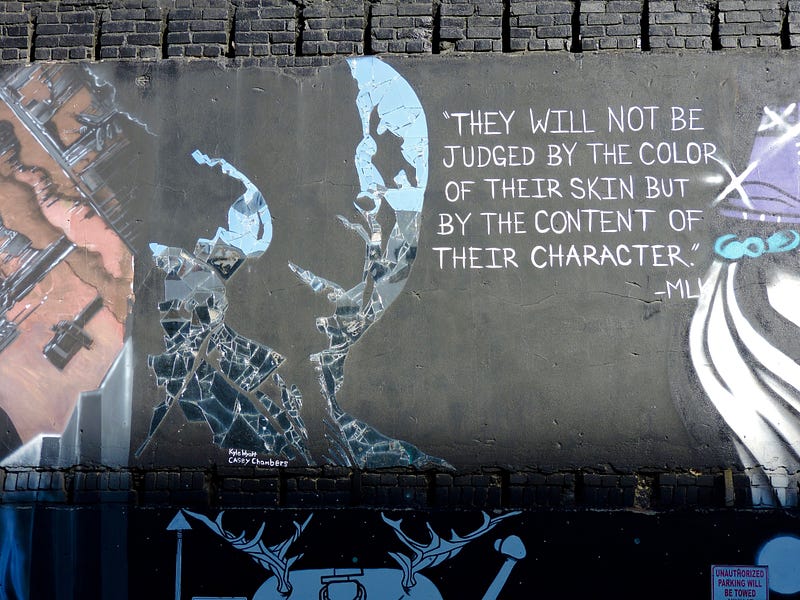
I later learned the concept of “not seeing color” came from Martin Luther King’s 1963, ‘I Have a Dream’ speech. The phrase is wrought with good intentions of showing how we are all one was meant to unify Whites and Blacks.
Today, though, if someone says they "don't see color," it is often seen as racist. Not seeing color equates to not acknowledging racial problems in America.
Although I know it's a problematic phrase, it still brings a smile to my face. I think of my grandmother living Martin Luther King Jr.'s speech and attempting to see people for who they were, valuing integrity, not skin color. That's one of the many lessons that stuck with me and helped me find my multiracial tribe.