
I Don’t Have a Higher Power
On trying to navigate spirituality, sobriety, and recovery without god.
“A bird recognizes that every life that surpasses a first breath is a miracle.” — Kira Jane Buxton, Hollow Kingdom
Once, I disappeared from life. It was during the six months following the death of my daughter. Ana had cancer. Diagnosed at 11, she endured various forms of treatment that worked until they didn’t anymore. It’s a story I’ve told often.
When she died, I was unable to participate in the world — at least for a while. Author Katherine May calls this “wintering.” In her book, Wintering: The Power of Rest and Retreat in Difficult Times, May writes:
“There are gaps in the mesh of the everyday world, and sometimes they open up and you fall through them into somewhere else. Somewhere Else runs at a different pace to the here and now, where everyone else carries on. Somewhere Else is where ghosts live, concealed from view and only glimpsed by people in the real world. Somewhere Else exists at a delay, so that you can’t quite keep pace.”
That’s what happened to me. I fell through a gap in the everyday world and found myself searching for Ana, trying to wrap my head around the fact that she was really gone.
I looked for signs. I spoke to her each night, imploring her to visit me in dreams. I peered up at the moon, the clouds and the mountains, hoping for a glimmer of evidence that she was out there.
It might seem crazy, but I miss that first year. It was the year I was closest to the threshold between life and what comes next. I was open to any and all possibilities. I visited psychics. I met with a Rabbi. I left all the doors of possibility open because I wanted — I needed — to see Ana again.
It was the only time in my life that I truly believed our souls continue to survive after our bodies die. Maybe that’s how religious people feel. I don’t know. I’m not religious. I don’t have a higher power.
As hard as it was to lose Ana, living without her over weeks, then months, then years is equally hard. At first, I couldn’t wait for the agony of early grief to subside. Missing her was so painful. Everything was so damn painful. The rolling despair, the barrage of memories, the whole-body ache, the unfathomable trauma of losing a child — it breaks people.
It sends them over the edge. It steals their will to live and I’m not just talking about adult people. My younger daughter has been fighting her own brand of bleak despair since the funeral home workers carried her sister’s body out of the house six years ago.
I didn’t come here to dwell on that moment. But I want you to understand why I’ve been searching for Ana — why I need to hear or feel or see a sign that her soul lives on. I want you to glimpse how hard it’s been to return to my life after everything fell apart — and why alcohol and weed initially gave me a small measure of solace.
Ana was never okay after she got cancer. Ana got sicker and sicker. Then, after everything she endured, Ana died. Emily grew up in the shadow of her sister’s illness. She has survived the wreckage of her sister’s death.
For these reasons — and many more — I recently found myself in my first 12-step program, an environment where I am constantly compelled to have faith in a god I don’t believe in.
The thing is, I watched my daughter die in her own bed. I’m watching her sister try to manage the trauma and devastation of this loss. Emily was 8 when Ana got cancer. She was 12 when Ana died. She’s now 19, and she is struggling to find her way forward.
It’s not that I blame anyone’s god, but it’s kind of hard to have faith in anything — god or otherwise — after witnessing both my kids suffer so much.
In the addiction support group, they use unfamiliar language like “qualifier” and “moral inventory” and the pervasive and reverential term “higher power.”
That last one is the driving force behind recovery. I keep trying to go back to this group and I keep leaving, feeling frustrated and disconnected from people who, like me, are suffering and scared and discouraged. But at least they have a higher power. At least they are connected by the promise of god — something tangible that can guide them back into the light.
At the start of each meeting, someone reads a list of 12 rules written nearly a century ago. These rules were created to map out a spiritual solution to a very human problem — alcohol addiction. The 12 steps of AA and other recovery programs rely on the idea of higher power to be effective.
They use language like “turn our will and our lives over to the care of God” and “We are ready to have God remove our defects of character.”
This god stuff — it’s hard for me. The talk of god, of a higher power, of surrender, of self-care and tough love — it makes me feel worse than I did before dialing into the Zoom meeting (my camera off, my sound muted). I want the camaraderie and support of others who need help not with their own recovery, but with someone they love and care about. But I can’t get past this language and these tenets that were written for men by men in 1935.
I am doing (much) better than I was in those first couple of years of early grief. I stopped drinking 18 months ago. I’ll be two years sober from weed next month. I did it on my own, with no higher power or rules involved at all. I did it because I wanted to model a healthier way of dealing with grief for my kid, one that didn’t involve having 2 or 3 glasses of wine every Friday and Saturday night and popping an edible before bed to help me sleep.
I can only (try to) control my own demons. But addiction can be much harder to live with when it’s not your own dragon to slay. That’s why I searched for support because I don’t know what to do for someone I love. That’s how I found myself in an anonymous support group filled with struggling people invoking their higher power.
I’ve been sporadically attending a 12-step program because there’s not much else I can do to try to find support as I grapple with the addiction of someone I love.
This isn’t like cancer — it’s not something I can write about as freely. It feels like there’s nowhere to turn, like so much is riding on my ability to get this right.
There’s not much help for addiction, mental health, and all the ways these things are intertwined beyond programs like these. At least, not in the U.S. Hearing other people’s stories gives me hope. But it also scares the crap out of me.
I log into the support group once a month or so. I sit through the tenets and the daily prayer (they don’t call it a prayer, but that’s what it is) and try my best to visualize what my higher power would look like if one existed for me.
If I had a higher power, what would it look like? Ana is not my higher power, but I do speak to her. I do look for her. I do ask her to watch over the people I love, especially Emily.
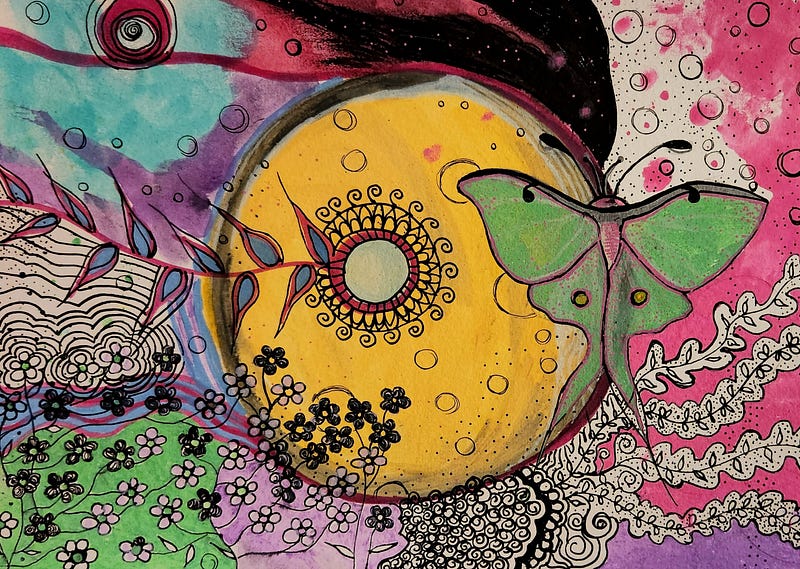
And, in truth, the things that keep me sober and interested in my own recovery could be considered spiritual. Walking on forest trails looking at the way the light filters through the trees, watching a hummingbird at one of my feeders, creating bright and useless drawings of mushrooms and trees and butterflies—is the stuff that makes me feel connected to something larger than myself. Is that what it means to have a higher power? I don’t know.
It’s been important for my recovery to believe in something bigger than myself — a larger force that connects the world and everything in it, an afterlife where souls and consciousness continue to exist, and the possibility of rebirth (and second chances). This all feels much more like hope than like any kind of god, but maybe there’s not much of a difference.
I haven’t written off the 12-step program completely. I still check in on their Facebook page and scroll past the “god is good” and “god is listening” and “trust your higher power” memes. I look for posts from real people who need real connection. This helps sometimes, but it’s hard not to feel like I don’t belong because the pervasive messaging about god, faith, and prayer are so foreign to me.
I haven’t been to a meeting in over a month though. Instead, I’m seeing a therapist who specializes in addiction, trauma, and PTSD. I’m walking more than ever. I’ve started a self-care campaign that involves hormone replacement therapy, weight loss, time spent with friends, and lots of hours drawing, writing, and walking.
Maybe I’ll never find my higher power, but as long as there are signs from Ana, hummingbirds, mushrooms, tiny dogs, and shadowy forest trails, I’m okay with that.