
I Didn’t Think I Needed “Representation.” Then I Watched Always Be My Maybe.
For a long time, I thought I was basically white.
I was young and had a limited but reasonable understanding of privilege. Though I was neither white nor male, I looked around my life and saw the effects of my other privileges: an upper-middle class upbringing in the safe suburbs, two parents who loved me deeply in their own flawed ways, a sense of material security and an assurance that I could do whatever I wanted. What were these things, I reasoned, if not the privileges of most of the white Americans I knew?
Plus, being raised in Missouri, most of my friends were white. There was a surprisingly large Asian community in my St. Louis suburb, but I felt a distance from them from a young age. I wasn’t like the other kids at my Chinese church and my Chinese language school. After the quiet awkwardness of my early teens, I became… oh, it’s laughable, but they considered me to be wild and unruly, prone to trouble. I was not perfectly obedient. There’s a term for it in Chinese that’s a little hard to translate, but literally it’s something like “full of designs.” My mother uses this term on me to this day, as if at 36 I am still a rebellious teen. It describes any action I take that is outside what she considers to be “normal” for a good Asian Christian woman — so, essentially, every single thing I do. I had (have) a lot of opinions. An indomitable will.
Also, honestly, most of the Asian kids were nerds, you know? That’s a narrative I bought. And churchy, which was a huge turn-off for me after a certain age.
So, through college and into adulthood, I developed the feeling that I was white. I was more comfortable around white people, they understood my sense of humor, they didn’t find me to be wild and unruly and full of too many designs. In college, a white friend and I went to a lecture that turned out to be attended by mostly Asian students; at it, I leaned over and whispered with only the tiniest sense of irony: “Wow, we’re the only white people here.”
I didn’t hate being Asian. Yes, as a kid it meant I was always doing extra homework, and the academic pressure was exhausting and probably damaging, in some sense. But what’s not damaging about our childhoods? I resented my lack of freedom, which felt like it had a lot to do with being Asian. (I had to take the SATs three times before receiving the score my father was happy with — a 1570, 30 points below perfect. But I’m pretty sure that the first time I got a 1510, and the second time, something only marginally better than that and marginally worse than 1570.) What, I wondered, was I trying to prove? And to whom? Even back then, there was the beginning of a realization that I was working for somebody else’s sense of worth, and that in the end, it wasn’t really going to matter. But I loved being bilingual. I loved the food (the most important part of any culture, let’s not lie). I loved, even if I thought I hated, being different.
Following college, I moved to Taipei for a year. I absolutely adored it, but also found myself mostly hanging out with white ex-pats. If Asians in Missouri thought I was unruly, lord, guess what actual Taiwanese people thought! In their eyes I was large and loud and more full of designs than ever. There, I started to truly understand the gap I existed in — I wasn’t really Asian in Asia, but I wasn’t white in America either. Still, to me there was a positive spin on this “not one thing, not the other” situation, and it’s the one I have believed most of my life, including in the present day: that I experience many of the privileges of being white while also having the benefits of being not white. That in the States, my particular minority is stereotyped and sometimes mocked, but on the whole treated much differently from every other minority. It’s fucked up, but it gives me a perspective for which I’m grateful. And as I have grown to understand systemic racism, I have been extra careful of identifying myself as a “person of color” in America, because though I technically am, I see the ways in which I have not suffered. I am stereotyped and fetishized; I am not threatened or attacked. Exoticized but not traditionally degraded.
And within this specific experience, I developed the belief that absolutely REPRESENTATION MATTERS… but not so much for me.
There was a lot of talk of Asian representation when Crazy Rich Asians came out last year. I watched many Instagram stories where my Asian friends talked about how nice it was to see a movie comprised entirely of people who looked like them. But I didn’t watch Crazy Rich Asians, because I tried to read the book when it came out and it was so badly written that I didn’t get past the first chapter. I’m being snobby, for sure, but I did not get the sense that Crazy Rich Asians would make me feel like I was being represented in modern media. It was just another thing that made me kinda feel white.
So I was happy for my friends who felt seen. But I continued to feel that I, personally, was fine. I was seen enough. In many characters of many races who I felt were “basically me”; in the same way that I was “basically white”.
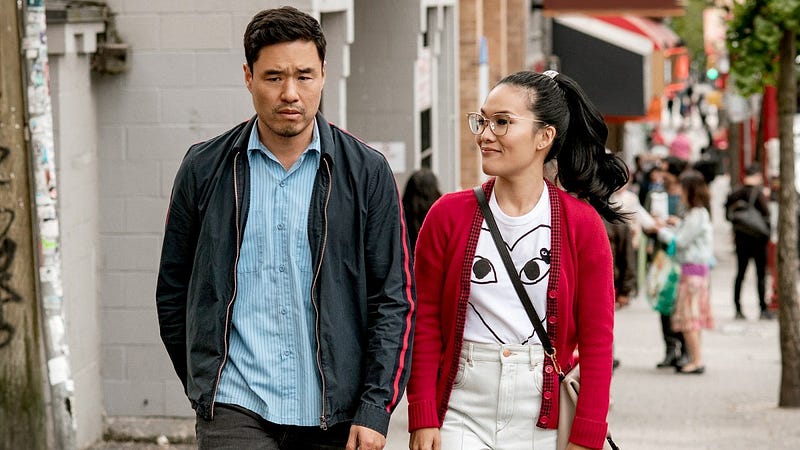
Then, two nights ago, I watched Ali Wong and Randall Park’s new movie, Always Be My Maybe.
I made a point of watching it, because I saw the trailer and thought, “Oh wow. This looks like a movie with Asian people that isn’t about them being Asian.”
(That’s a sign, you know, of lack of representation — when the only things created containing people of your race are explicitly about your race. Yeah, I had Joy Luck Club or whatever growing up. But I didn’t give a shit about Joy Luck Club, or even a show like Fresh Off the Boat, because being Asian is ONLY ONE PART OF MY IDENTITY. It didn’t feel real to me to just watch these Asian people doing Asian things, because I am an Asian person who does a lot of things that have nothing to do with being Asian, to the extent that I would prefer my Asian-ness not be the first or even second thing mentioned about me.)
Even anticipating ABMM as I did, I was unprepared for the actual experience of watching it.
It felt like I gained something I had no idea I was missing.
I felt seen.
I felt represented.
I felt — okay, stay with me because this metaphor is going to be long and potentially shitty. Earlier this year Dan and I went to a restaurant that does a shabu shabu omakase. They only seat eight people at a time and the chef individually cooks each piece of food for you, in front of you, shabu shabu style (briefly cooking it in a boiling water/broth). Everything we had at that meal was exquisite, like the finest form of that food. Honestly, one bite was A PIECE OF BOILED CABBAGE that she told us to dip in olive oil, and it was genuinely a GOURMET EXPERIENCE. BOILED CABBAGE!! Anyway, part of the meal were these pieces of wagyu. And when I put this wagyu into my mouth, I thought, “WHOA, if this is beef, what the fuck have I been eating my whole life?” Like it was so rich in its pureness and simplicity. Like it was the real thing, not some bullshit.
That’s how watching Always Be My Maybe felt. Like I just discovered something I thought was real was actually a pale and shitty shadow. And the real thing, when I saw it, when I felt it, was like lightning. No — wait. Lightning is too fast, sudden, dangerous. The real thing, the real effect of feeling represented; it felt like being bathed in sunlight.
I thought I didn’t need representation because what I had was enough. But that’s a stealth weapon that the privileged hold over the under-represented — that some of us accept our status and are even grateful for it. A weird representation Stockholm syndrome. I thought I was fine, because at least I wasn’t one of the minorities that was really suffering. I didn’t want to take up any extra space. I didn’t want to demand any extra attention. I was good.
I am good. But I could be better.
Representation is not turning on the TV and seeing someone who “looks like you”. It is not the showcasing of one part of your identity (in this case, race) but, conversely, the lessening of the importance of that one part of your identity. To see your race become only one facet of you, to see your race become so normalized that there is room for you to be something else. To be everything else. I read an interview with Ali Wong and Randall Park after seeing the film in which they summed it up perfectly: that by populating a film with a bunch of Asians, they made it so no one was “the Asian one,” which is all most of them had ever been in American movies and TV shows. They got to be the jerk, and the artist, and the lost one and the insecure one and the funny one. They got to be human.
That is what I had been missing, my whole life, in terms of media representation. Because I have this rich, wild experience that is only partially connected to the fact that I am Asian. But I could never, in white American media, not be Asian. Always Be My Maybe showed me a world that felt like my world — the one that sometimes exists in pockets of places like San Francisco and New York, where you are more than your race. Where you have dimension. Where you are whole, and you take up space because there is space for you take up.
We have to see our stories told. When we see ourselves in a story, we are encouraged to tell our own story; we believe that our own story matters. And when we do that, someone hears our story and feels there is room to tell their story, which might be similar but also so, so, vitally different. And someone else sees that story, and they clear their own throat to share. And — here’s the beautiful thing — when all of our stories are out there, none of us will feel, ever again, like we can only be one thing.