I Didn’t Know The World Would Think Our Love Was Wrong.
A tale of an Interracial Love
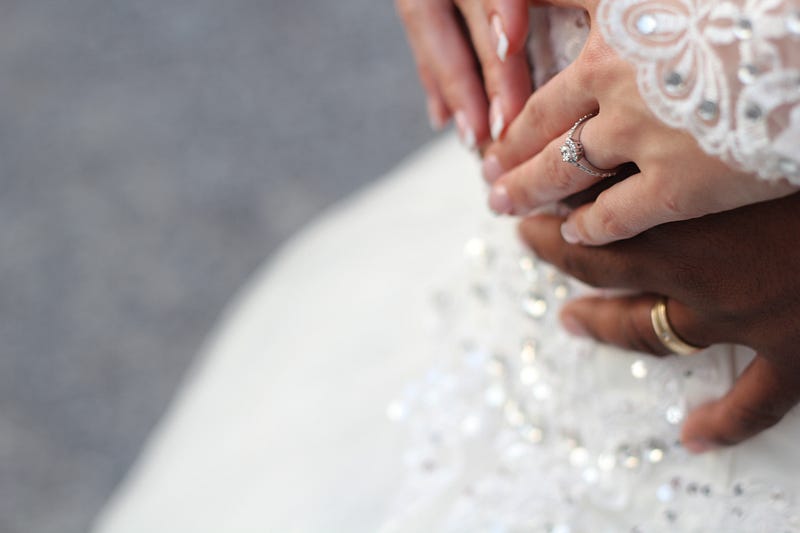
We met in High School in 1984, and I had decided that I would go to a different high school than all of my friends for a new start. My parents didn’t like my boyfriend and wouldn’t allow me to go to the same school as him. I didn’t see the correlation as I do now. My boyfriend in Junior high was Philipino, the fact that that was a problem never occurred to me. It took meeting my first husband, who happened to be black, to realize that the world frowned upon interracial relationships.
I grew up in the liberal Petree dish of Santa Cruz, California. I grew up open-minded, and I thought the whole world was as idealistic as I was. It never occurred to me that me dating a black guy would be an issue. I honestly thought my parents hadn’t liked my jr. High boyfriend because they thought we were getting too serious.
In junior high, there had only been one black student in our school, her name was Olivia, and my heart had ached for her. She wasn’t picked on, but she wasn’t embraced either. My naivety assumed it was because she was new to the school, and she would make friends soon enough. When I arrived at Santa Cruz High, it was a different world. Our school was very culturally diverse, and I loved it.
To clarify, my parents divorced, and both remarried, my mom and stepdad were conservative and were the parents that didn’t like my choice in the fellas I dated; My dad and stepmom were very supportive, always.
“Love is blind despite the world’s attempt to give it eyes.” ―Matshona Dhliwayo
When Jacob and I started dating, he had warned me that my parents might have an issue with us dating. I disregarded his comments as utter non-sense; they would love him. He was popular, athletic, a good dancer, school-focused (unlike me), he didn’t party like a lot of my friends, and I felt like he was a good influence on me. Freshman year, he asked me to prom, and my parents said, I was not allowed to go with him. My dad and stepmom helped me sneak to the dance with him. I made my dress, and I was beyond excited.
I ended up having a heart to heart with my mom and stepdad, asking them to try to get to know him, and Jacob asked them to dinner to talk to them face to face to plead our case. Their reason for not wanting me to date him was fear of us getting married and our children being mixed raced and not being accepted by either race.
Jacob and I dated all of high school, and we did end up getting married, and we had two daughters. My parents did end up accepting Jacob, and his family welcomed me, and both families accepted our children.
What I didn’t realize is this: My parents not approving of my choice made me want that choice more, to spite them on some level. There was no reason in the world that Jacob and I didn’t belong together just because of the color of our skin. However, what I didn’t take into account is that we weren’t a good match. We ended up divorced. He was all of the things I mentioned before, but when he hit the age of 26, things started to change, and he was diagnosed bi-polar.
Where did this leave me? Jacob couldn’t process our divorce with his new diagnosis and self-medication with alcohol, so I was raising our children alone. I was responsible for teaching my children what it meant to be bi-racial. I stayed close to my ex-husband’s family even when he did not. I knew how to take care of my girl’s hair because I never wanted to be that white woman who’s bi-racial kids had wild hair. After all, white women didn’t know how to care for black hair (I was told this by many of Jacob’s family members)I would not fit into that stereotype, I did my best.
I remarried, a white man, and we combined our families, I was now the mother of five children. Looking back because I felt that the color of skin was a non-issue, I didn’t see how hard this must have been for my daughters. I was always conscientious of how society perceived my children, and we didn’t shy away from race topics. If we saw anything even close to discrimination happening with our girls at school, my husband and I addressed it. None of this matters, however, my girls still felt different and curious about the black side of their culture. I couldn’t provide enough information for them, I wasn’t black, and you always want what you don’t have.
Some of my first husband’s mental illness was passed onto my oldest daughter, and she struggles every day. She gave me a beautiful granddaughter who looks exactly like me, with a mixed texture hair that I know exactly how to care for.
Jacob and I stayed friends for many years, but his lack of help and interest in our children, drove a wedge in our friendship, and it ended when our children became adults.
My daughters are close to Jacob now and are close to his family, which I am still as well. My husband is also close to some of Jacob’s family members alike, which I am sure Jacob finds very annoying.
Being in love and thinking the world doesn’t see color was beyond naive on my part. It didn’t matter how much love was in our home when my daughters left my house; they were treated differently. I was treated differently at times also, but I didn’t care, my daughters did care. It hurt when people said to them, she can’t be your mom, or why is your dad white too? How are you, black? Why do you listen to that music, your white-washed. Even today, 36 years later, when someone learns that my first husband is black and my children are bi-racial, there is a perception of who I am, a stereotype.
When Barak Obama was elected President in 2009, I thought finally we were getting somewhere; I was beyond happy that my daughters were alive to see the first black President. Unfortunately, society hasn’t changed near enough; we may even be worse off today then we were in 1984. I wish I could have stayed in my ideological bubble my whole life, but life has changed me and tarnished my views, and nothing I see in the world is giving me the promise of getting it back.
I am fully aware of my white privilege, and I am aware that my daughters, though they are bi-racial, are seen as black. I worry about my daughter’s safety, I am high-endly aware, sometimes more than they are that they are at risk. I understand now why they seek out their black family because their black family knows and understands what it is to be black in America. I will never understand at the same level, and I will always be an outsider looking in because I am white. I will never stop trying to advocate for equality, and I will never stop supporting people from all walks of life. It is my duty.


