
I Did A DNA Test To Trace My Ancestry And Got Three Big Shocks
And why I would still recommend doing a test
I did it during the very first lockdown. Perhaps it was boredom that made me take that chance and order up the spit tube for the bargain price of £80. You’re thinking this isn’t a bargain? Well, I had nothing else to spend my money on during those months. None of us did. All I had was time on my hands and money I couldn’t spend so I decided to attempt to pick up the genealogical research I had been undertaking since 1996 and take my family history a little further back.
It was a blogger friend who inadvertently convinced me that it was a good idea. She lives in Florida and has a varied ancestry profile with Spanish, Native American, Irish DNA in her profile and other smaller percentages from different European countries too. It seemed exciting, to find out by scientific methods who I really am. I have dark hair and dark eyes and imagined that there had to be something exotic out there in my family tree that I simply hadn’t found yet. I never felt Scottish. I felt displaced, and I had very little in common with my parents, sister, aunts, uncles and cousins. Somewhere, deep down, hyperbole took over my thoughts and I suspected I was switched at birth.
So, I ordered up the test, harvested my spit and sent it off to find out who I am.
It turns out I am exactly who my family said I am
I am not exotic at all. I was not switched at birth. My parents are my parents. My family are my family. In fact, my DNA test showed that I have 99.1% ancestry from the British Isles, and from the west of Scotland and Northern Ireland in particular. My ancestors never moved far. They never colonised anything. The family tree research I had done was all correct. Everyone’s father was their father. We were farm labourers, miners, domestic servants and manual workers. I came from a long line of hardworking, underappreciated people who lived and died in this small part of the world. A couple of my direct ancestors had siblings who moved abroad to America, Canada, Australia, and quite randomly, Venezuela, but most of them came back within ten years and settled in Scotland again, the majority of them within a ten mile radius of where I was born. Only one did not and I’ll leave his story for another post since he did something quite incredible.
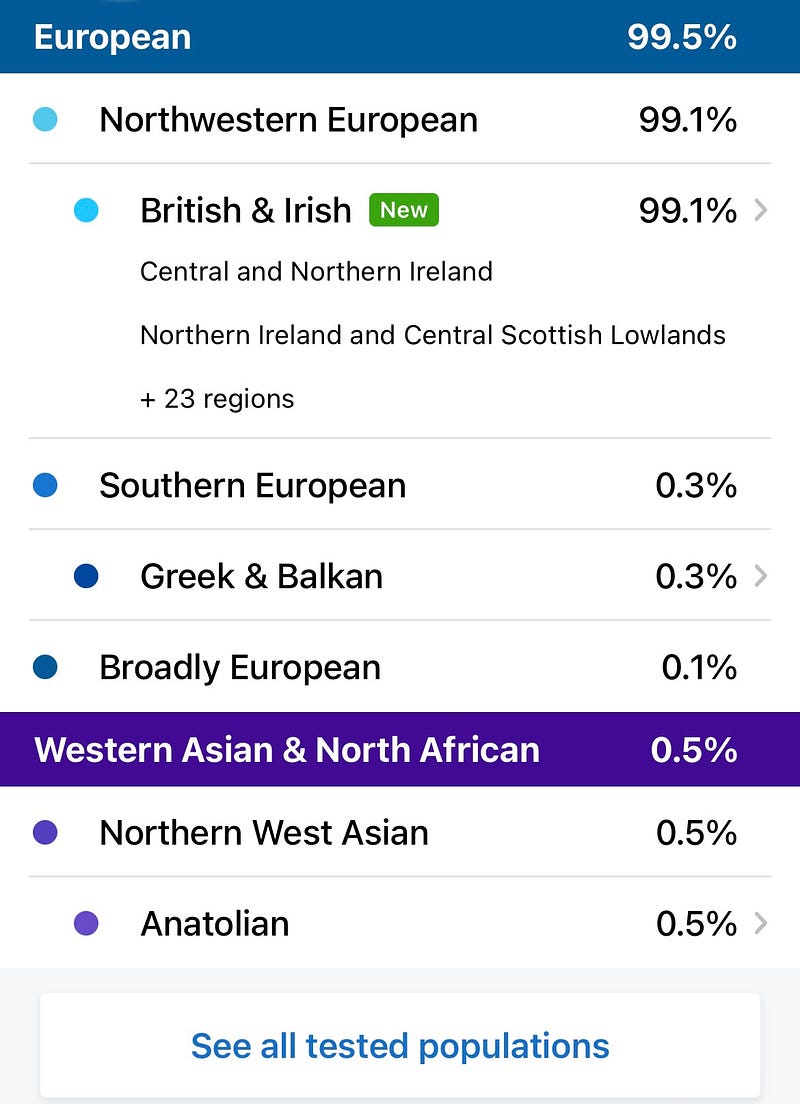
I also had a little thrill when I saw that I had 0.3% DNA from the Balkan area and 0.5% from Anatolia. I always suspected the Balkan thread existed because my sister and I used to joke about my grandfather’s seven brothers all looking like Dracula but the Anatolian DNA was a complete shock. The percentage is really small, so I’m thinking it must be many generations ago and possibly from the same ancestor as the Balkan DNA.

But then I navigated around the app and I found the first thing that shocked me about my results…
Predicted half-brother with 18% shared DNA
I couldn’t believe it. I dropped my phone, my hands shaking and my blood pressure rising until I heard my pulse thrumming in my ears. I couldn’t possibly have a half-brother. My parents met when they were really young and have both maintained, all my life, that the only children each of them have are me and my sister. They’re both quite proud of their boring, uneventful love lives.
It took me about an hour to work up the courage to look at my predicted half-brother’s profile. As soon as I saw the name, I relaxed.
He was my cousin. He was born in 1994 and we have nothing in common, but he and I share a high amount of DNA.
When I checked online, I found research that said a first cousin could show a DNA match of between 4% and 23%.
So, why give me a heart attack by telling me that I had a possible half-sibling? It’s good to remember that these tests are scientific and show a lot of data, but the interpretation of that data can’t be reliably done by AI, or it will end up telling you that your cousin is your brother.
Then I noticed another match…
While I was comforting myself with the knowledge that my cousin is not my brother, I saw another match of around 9% DNA. I had no idea who that might be because I didn’t recognise the name, but he had to be a cousin with such a high match. Let’s call him AM.
I sent AM a message, introducing myself and rattling off some of the surnames of people in my family. It made sense to him immediately and he told me who he was.
He was a first cousin I hadn’t seen since 1988, when he was a baby. I remembered him well. We had played together on Easter Sunday and he had been so taken with my Jack-in-the-box, my favourite toy, that I gave it to him. Then I never saw him again because my uncle and his mother divorced. Being a child, I never knew much about the situation and I never asked questions because they were always unanswered.
I never forgot him though, and his birth name, which had been changed over the years to take his mother’s maiden name, was still listed on my family tree. I was thrilled and removed his old name from the records and updated the tree with all the new information.
The only drawback was that I had to keep our discussion a secret. He didn’t want his father to know that we had been talking. He wanted any contact he had with his father to come from him, not from anyone else in the family pushing that connection. So, for four years, I kept it to myself. I only shared that AM and I had been in touch two months ago, after my uncle, AM’s father, passed away. AM has since connected with other people in the family and they are all delighted to have him back in their lives.
It wasn’t all good
I was never sure whether I wanted to read the health information since I truly believe that sometimes too much information is a bad thing. On the one hand, I found out that I am not predisposed for the majority of health conditions they could trace, so that was good news. I am, however, genetically likely to be overweight (I am not, so far) and I am likely to develop type 2 diabetes in the future if I don’t take care of myself. I can work on both of those things.
On the other hand, I am carrying the gene for age related macular degeneration, a condition which affects the eyes. I asked my optician about it and she explained that it is about the jelly inside the eye drying out. Eventually, people with macular degeneration have a dark spot in their vision and peripheral views are all they get. As a writer and voracious reader, this sounds horrific. Apparently you need two genes for them to say you will definitely develop the condition, and I only have one, so it’s a case of maybe rather than definitely. It also means that if my husband also carries the gene, our son is likely to develop the condition. This concerns me more than developing it myself concerns me, because he has enough going on already with his autism, asthma and allergies.
In some ways, I am glad I did this test because I’ve had to learn how to live with this cloud hanging over me and enjoy my life. It has given me a reason to battle my agoraphobia and start travelling again and it has made me want to see everything I dreamed of. I’ve made a bucket list and I’m ticking things off one by one. But it is a cloud nevertheless, and it might have been nice to not know and live in blissful ignorance.
I believe that many people who take these DNA tests through curiosity like I did end up learning more than they bargained for. You’re not simply learning your family history. You’re learning about your present situation too, and potentially unlocking secrets. You could be connecting with people you’ve lost, or realising you’re more like that family member you thought you had nothing in common with. You have to steel yourself for that kind of information and understand the implications. You’re not just learning about your past and other people’s history, you’re also learning about your future.