
I cancelled my Calm membership. Here’s all the emails they sent me
A lesson in what not to do with CRM strategy and monetisation
I used to love Calm. It’s no secret that working in tech can be stressful-as-hell. I’ve had panic attacks, I’ve been in tears, I’ve lost weight from stress.
In those moments, I used to turn to Calm. I’d pick up my phone, open the app and make a beeline to my favourite SOS sessions. I’d listen to bitesized meditations to calm me down.
Now, I’m in a better place. I feel happy and healthy, no more panic attacks or high stress levels. I manage my own time and clients — its bliss.
So, without the need for my painkiller — the Calm app — I cancelled my membership.
In the six months since, Calm proceeded to send me an email series to try and get me back into the app as a paying subscriber. I got discounts, web flows, free content, GIFs. Did it work? Well, let’s see.
We’ll go through the wild rollercoaster of a ride of Calm’s churner CRM series, and how they try and coax users back into the app with big discounts and web monetisation.
Day 0 of my cancellation: the standard confirmation
On the day I cancelled, I received a confirmation email from Calm. Its a basic moment, but some apps just leave it to Apple/Google to confirm you’ve cancelled.
Its 1000X better to send a bespoke email, as you create a lasting relationship with the user. Some users may plan to resubscribe later, so having a solid churn CRM strategy is key. That’s also why the option to pause a membership is also a nice touch.
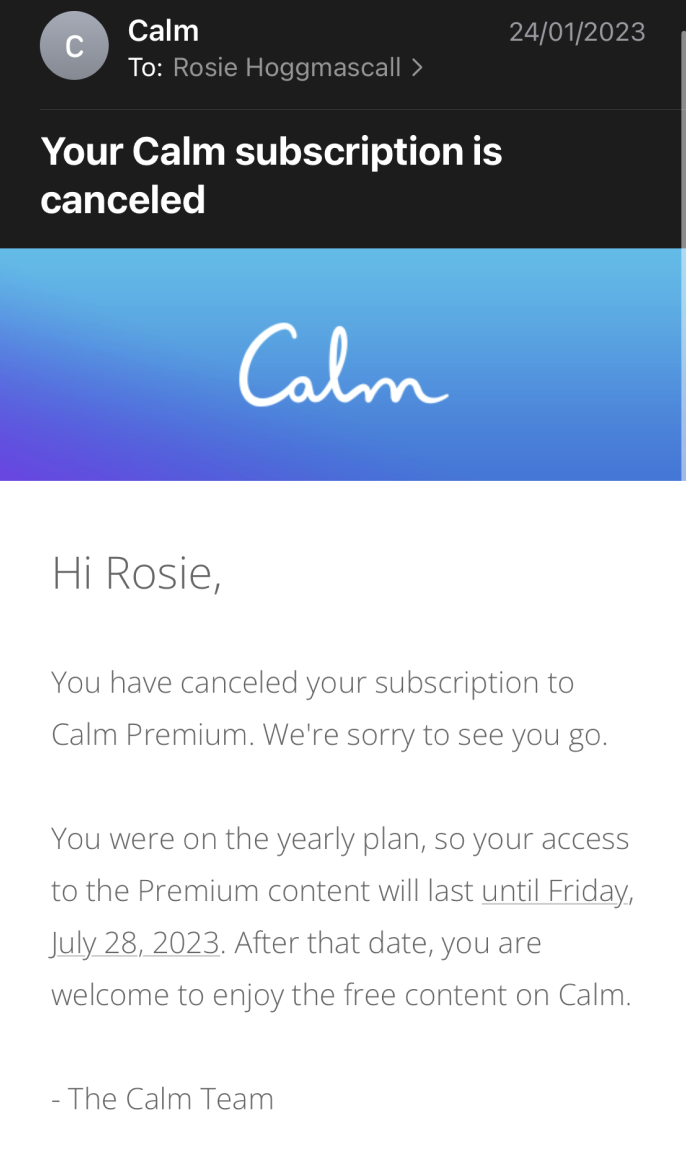
What I don’t like is how generic it is. How many times have I read ‘we’re sorry to see you go’ on an off-boarding flow? Too many.
Calm missed an opportunity here.
I’ve churned in a good way — positive churn. Positive churn is when users reach a level where they don’t need the product anymore. For instance, in dating, if someone finds a partner through a dating app and deletes the app, that’s positive churn.
If Calm had captured the ‘why’, they could have sent me a personalised message, something congratulatory like:
You’ve graduated from Calm, Rosie — nice one. Goodbye to your work-related anxiety. We’re here if you need us, jump back in whenever.
They could have even asked why I left in the email itself, with a frictionless email multiple choice that drives users to a more comprehensive off-boarding survey.
The redeeming feature of their email is that its crystal clear that I’ll have access until July 28, 2023, and that there is free content available. Clear and simple. But boring and impersonal.
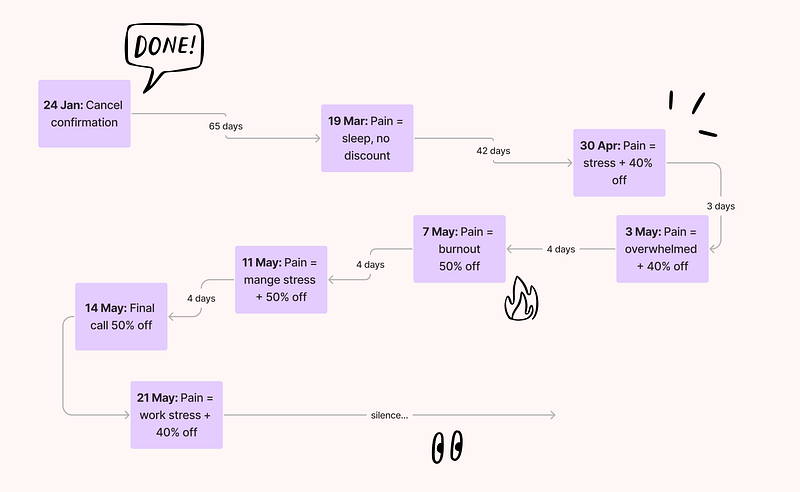
Days 1–65: Nothing. Nada. Zilch.
I was very surprised that I received nothing for over two months from cancellation. Just silence.
I’d completely forgotten about Calm by the time my next email came around 65 days later mid-March. A standard sleep-focused email with 3 modules of free content and no discount or offer.
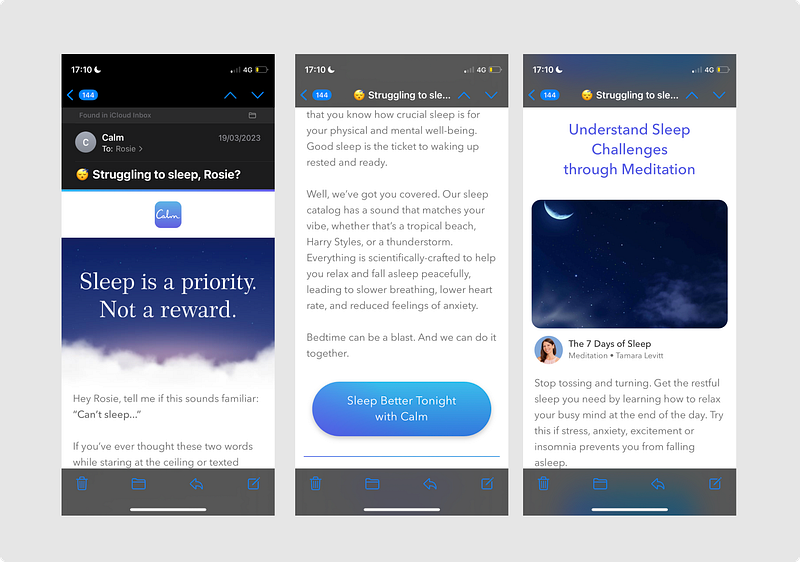
The second thing that disappointed me is that this email is chronically under personalised. My pains were stress and anxiety, not sleep.
What’s worse is the first line of copy re-iterates that: Hey Rosie, tell me if this sounds familiar.
No, Calm. It doesn’t sound familiar. *Deletes email*
I’m lucky enough to take after my dad and grandad in that I can sleep in minutes. I’m grateful for that, and I wish that Calm had put me into a personalised flow based on my preferences from onboarding long, long ago. I gave them that data, so they should use it.
When looking at the emails from Calm, there’s a few other missed opportunities they could improve on:
- Consistent cadence of emails
- Fresh messaging that cuts through
- Calling out the reasons people cancel directly, to make us feel heard
- Noting what’s new in the app to show that it’s worth resubscribing
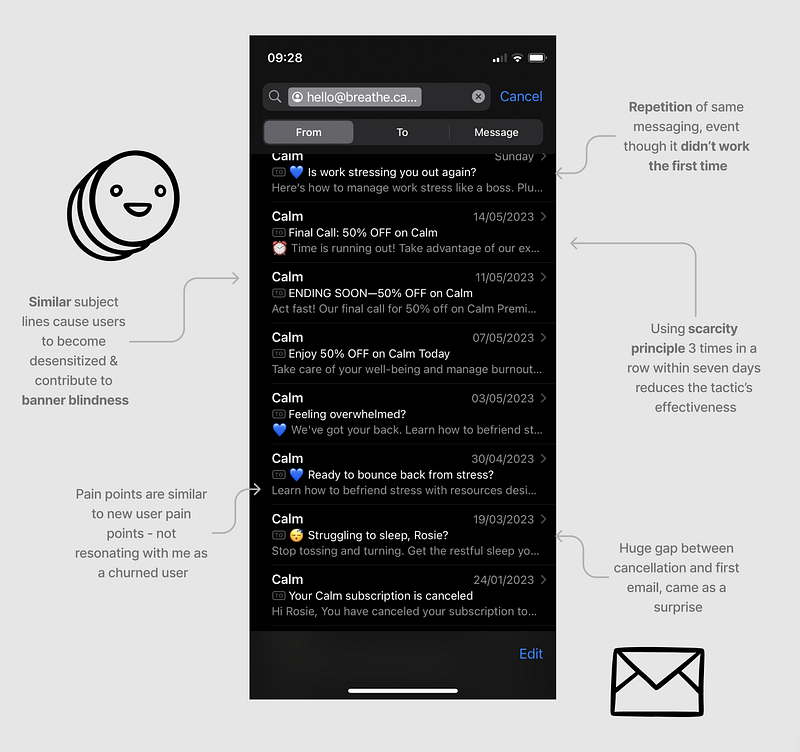
For me the biggest one is copy. I didn’t even open these emails aside from to analyse them as the subject lines didn’t compel me to do so.
My third email arrived a bit sooner at 42 days after the second…
I do wonder the rationale for such lengths between emails. Are two separate people designing the triggers and didn’t talk to each other? Or is it beneficial to let people forget you before saying hello again?
This time though, I got a discount.
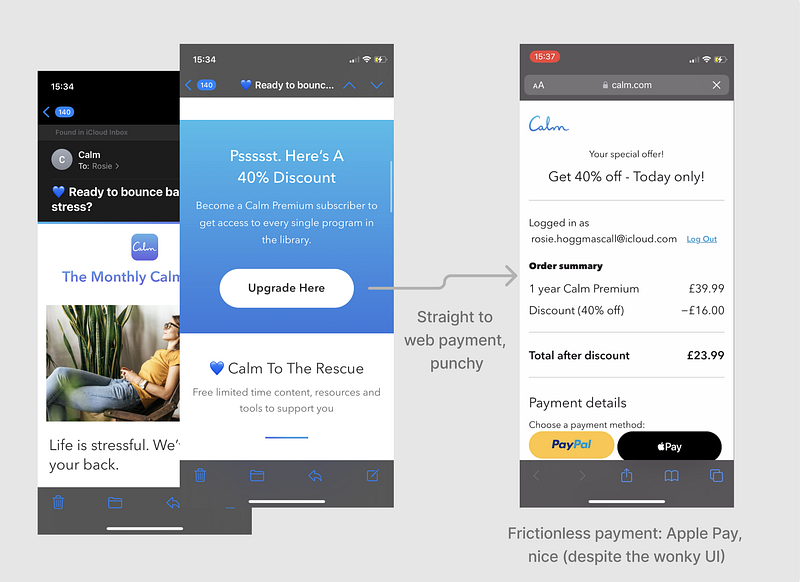
The block with the discount was high up in the email, followed by some free content. Tapping the ‘upgrade here’ email takes us through to a web payment screen with the discount already added.
I like how frictionless it is. Paying on web also avoids the colossal 15-30% fees to Apple for in-app payments.
However, the copy really lets Calm down again here: Become a Calm Premium subscriber to get access to every single program in the library.
I’m aware of how a subscription works thanks, I just had one.
What they need to do is understand why people churn, and what might brings people back.
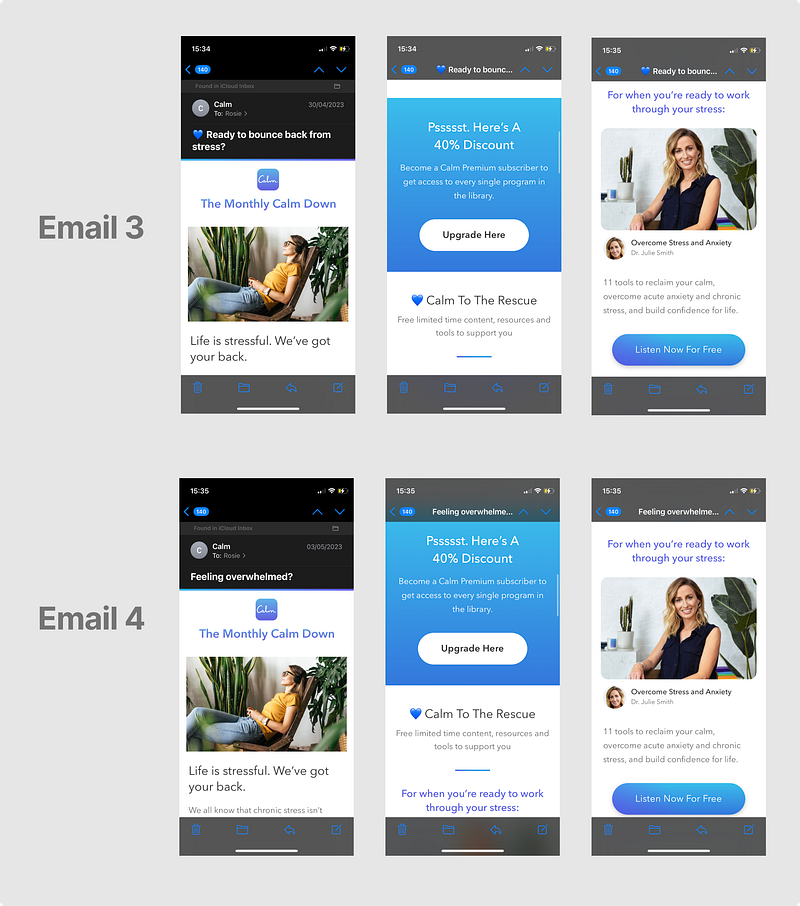
Email number four: exactly the same as email three
Four days later, the next email hit my inbox.
My fourth churn email from Calm was identical to my third, aside from the subject line.
This isn’t a surprise, its common to double send an email. Take all the people who didn’t open your email and re-send it a few days later to increase open rates.
I’ve seen it done even with the same subject line, in case people simply didn’t see it. Here, Calm changed the subject line to one that was as not-so-compelling as the first.
Five, six, seven, eight
My boot scootin’ baby is drivin’ me crazy

To my surprise, four days later I get my 5th, then again 4 days later my 6th. It was like Calm had an internal revenue deadline they needed to hit and completely forgot they’d ghosted me a few months back.
It felt unusual to get a slurry of emails with such urgent messaging after the helpful, caring copy of the first few. ‘Relax, let us help you sleep’ now ‘PAY PAY PAY’.
For me, this was jarring. One reason was the copy, another was the cadence of emails.
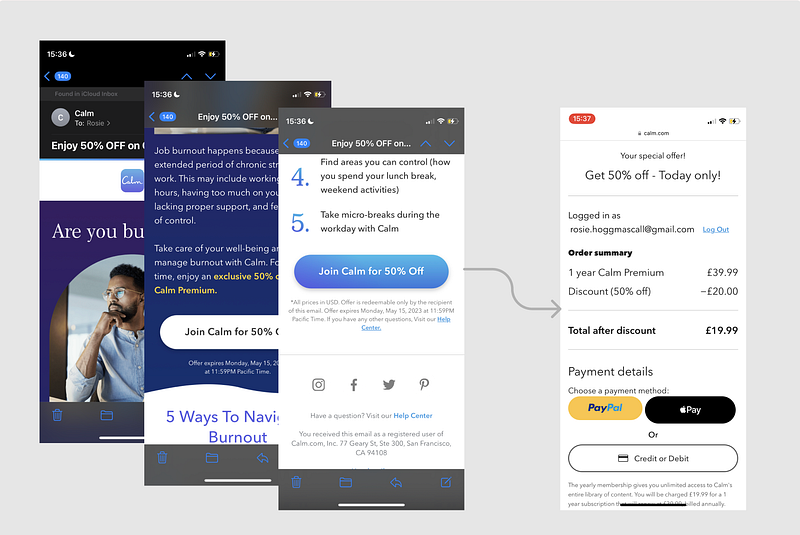
The fifth discount email was themed around burnout. The most compelling email yet in my eyes. Shame I’m not burnt out anymore.
Again, a frictionless journey from the CTA buttons to a web payment screen with the discount pre-filled. The email has not one, but two discount CTAs.
Unlike the 40% off emails, I’m not offered free content or any other distractions in these discount emails.
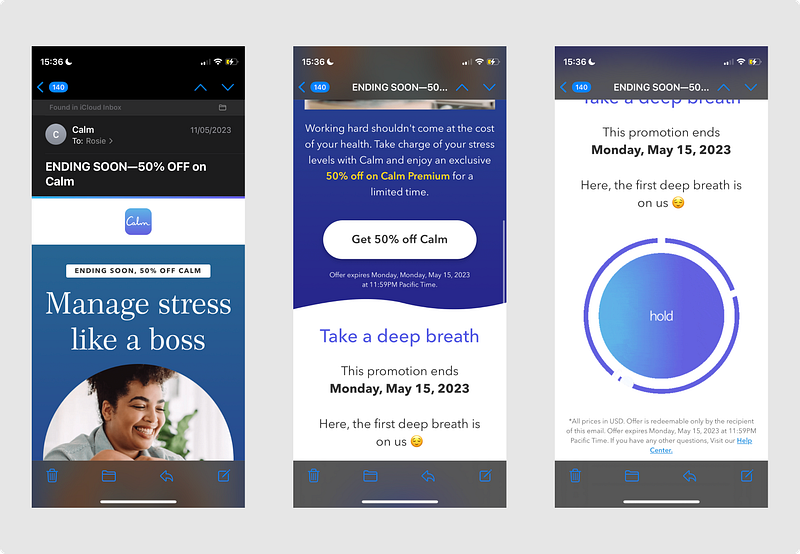
Four days later, number six arrived. Telling me the 50% is ending soon. One CTA this time, and a nice breathing practice GIF re-iterating the magic moment of calm: breath and instantly relax.
Now this cut through for me, it reminded me that I need to meditate even if I’m not at breaking point. It should be a daily vitamin. But not one I’m willing to pay for.
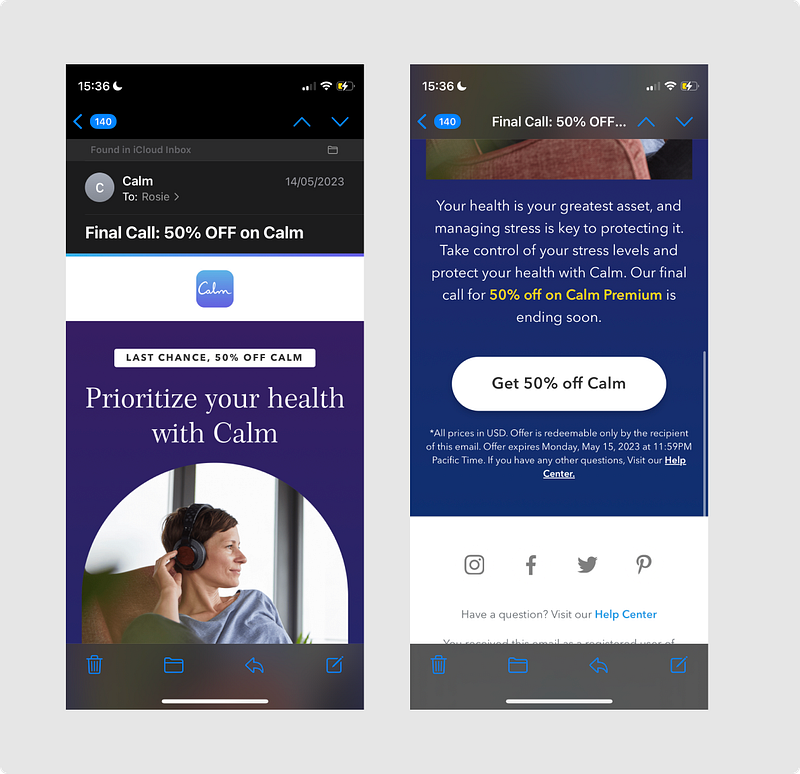
Four days later, the final call. Despite the fact that the first 50% email felt like it was only on for ‘today’ turns out the discount is until 15th May.
What is entertaining, is the fact that I followed through on these CTAs on the 2nd June and the discount was still there.
Final call — just kidding, the discount page is live forever.
For me, the 50% off was too close to the 40% off. I didn’t buy the random urgency, and I didn’t see it as significantly higher, given 40% is already a large chunk.
I also had forgotten that Calm was pretty inexpensive in the first place — I realised both discounts are actually excellent when you see the absolute price.
Calm could try spicing it up to £1.66 per month, or £19.99 per year — that sounds like a great deal and its the same as 50% off, but it may cut through the banner blindness caused by their previous discounts.
After my 3 urgent emails in a week, I was back to their Monthly Calm Down series, which I found ironic as their emails were the only thing stressing me out.
In summary: a jarring CRM flow
What could Calm do differently? A few things:
1) Fresh messaging
Talk to users, find out what’s under the surface of sleep, stress, anxiety. What other pains are in our lives? How can Calm position themselves for positive churners?
There’s so many other use cases for meditation. For me, nice copy could be something like:
Ever get short with your partner?
Feeling forgetful as you age?
Difficulty saying no?
Brain fog in the evenings?
Difficulty being present with your friends/partner/family?
Post-COVID fatigue tiring you out?
Now that is copy I’d act on.
2) Authentic, personalised emails
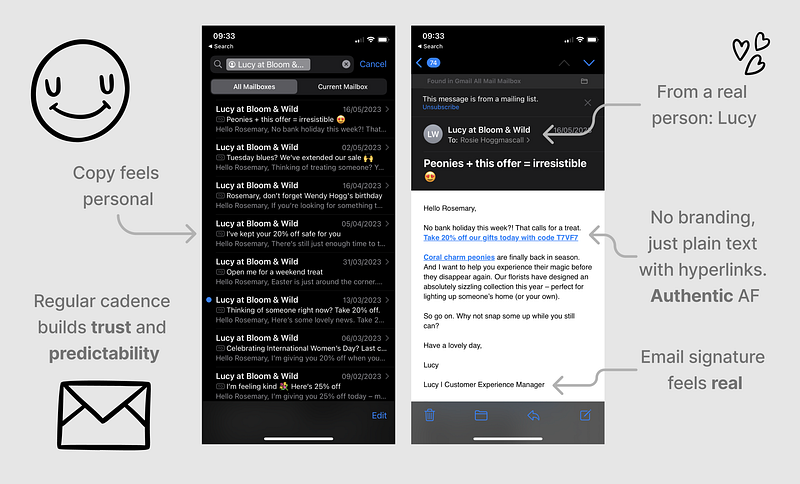
As well as some fresh messaging with new use cases, an un-branded email would cut through. Check out Bloom & Wild’s emails for some excellent CRM, what I love about them:
- They’re from a real person (she’s real, I checked)
- There’s no branded template. I can see the whole message on my tiny iPhone 12 mini screen without scrolling
- They’re relevant and seasonal
3) Consistency
Building trust takes time. A consistent CRM strategy works wonders for your ability to stay out of user’s junk as well as builds trust with your audience.
Frequency is less important than consistency — once a month is fine as long as you stick to it.
Prologue
I’m just about to submit the article when I receive yet another ‘is work stressing you out again?’ Calm email.
That’s it.
I’m done. It’s time.
*Unsubscribes from all emails*
Without customisation, personalisation or truly understanding the churned user cohort, Calm risks burning their CRM channels all together and being unable to retarget. I’d normally say some emails are better than none, but sadly not in this case.


