
I Burned Nearly 1,000 Calories the Other Day, Without Exercise. NEAT, huh?
Disclaimer: Exercise has never made me exhausted quite like this.

My wife and I share so many things in common. We both enjoy staying active with exercise (especially resistance training) and being outdoors (love hiking). We have similar parenting styles (which is great with four kids) and we share the same goals for our blended family. We listen to the same music, watch the same types of shows/movies, have very similar tastes in food, can easily predict what each other is thinking (a quality that doesn’t always serve me well), etc.
That’s why she is my very best friend.
Though having common interests is one of our strengths, at times it’s also one of our weaknesses.
We both tend to procrastinate (admittedly, more so me than her), especially with large projects (again, more me). And we did this past week (ok, that was all me!).
For over a month, a pool party at our house for one of our kid’s soccer teams has been on the schedule. I knew that there was a ton of outside work that needed to be completed. But instead of tackling the projects “little by little” along the way, I waited until the last minute. This gave me no choice but to complete most of the work (like 90%) the day before the party.
Such a Busy Day!
My day started around 6:00 am, and I had a long “honey-do list”.
First up, an unfinished project…a deck built around our pool. I already completed a fair amount of work a few days prior. So, my thought, “Just a few more boards” would easily finish the project in an hour or two.
NOPE!
What I thought would be an easy task turned into 3 separate trips to the local home improvement store and hours of hard work.
At around 4:00 pm, the deck was finished — well, close enough for me to cover multiple flaws with a grill, a couple of chairs, a planter box, and four coolers!
With no time to celebrate, I still had much more work to do. Grass needed cutting. Mulch needed spreading. Pool needed cleaning. The area around the new deck was a total mess from all the excess pieces of wood…etc.
Needless to say, my tasks were completed around 11:50 pm. And I was exhausted.
Out of curiosity, I opened the pedometer app on my smartphone and saw this:
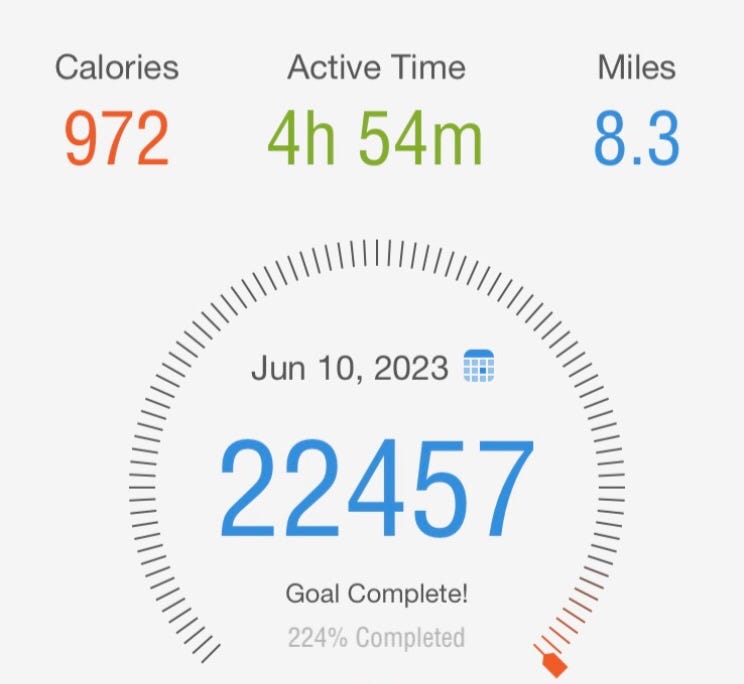
I accumulated over 22,000 steps and had expended (according to the pedometer’s built-in prediction equation) nearly 1,000 calories! And there were times when I did not have my phone on me. So, the step count and estimated number of calories expended were lower than the actual.
I was pretty surprised. I mean, I know I completed a lot of work. But not one time did I walk continuously for an extended period of time. The total number of steps was ACCUMULATED by walking small distances back and forth (mainly locating various tools that I kept misplacing. “Where is that D@MN drill???”).
Wanna Burn Calories? MOVE YOUR BODY!
After reflecting on the day, I was reminded that we do not need to engage in structured exercise routines or perform intense workouts to burn calories and maintain/achieve healthy body weight. We just need to do what our bodies were designed to do…move.
This brings me to the differences and similarities between structured and unstructured physical activity.
Physical activity is defined as any type of bodily movement that increases energy (or calorie) expenditure above rest.
So, when it comes to burning calories, your body doesn’t care what you’re doing, just as long as you're moving.
Exercise is a form of physical activity. It’s structured with the specific intent to improve a component of physical fitness. For example, jogging for 30 minutes per day will increase aerobic fitness. Frequent weightlifting will improve muscle strength. Stretching the body’s major muscle groups several times per week will increase flexibility.
However, other activities of daily living that involve body movement, but aren’t structured into any sort of exercise routine, are also examples of physical activity. Like general walking, cleaning, gardening, and (ugh) doing a long list of outside chores to prepare for a youth soccer party.
Non-exercise physical activity is an often overlooked and underestimated aspect of health and fitness.
Here’s a NEAT Concept.
In the research world, we often refer to this as non-exercise activity thermogenesis (abbreviated as NEAT).
Brief physiology lesson for the day: the term “thermogenesis” combines the Greek words “thermo” (meaning heat) and “genesis” (meaning creation or production).
Thermogenesis refers to the process by which the body produces heat.
It is part of metabolism: the total biochemical reactions that take place in the body to create adenosine triphosphate (ATP — the body’s primary energy molecule for cells) also produce heat as a byproduct.
Calories are units of measurement that represent heat production (specifically, the amount of heat needed to raise the temperature of a certain amount of water by 1 °C).
In other words, our bodies expend calories as we generate heat. This happens all the time, even at rest, but increases with movement. And the more we move, the more calories we expend.
That’s why NEAT is so important.
Wait! No Need for Exercise?
Ah…not quite.
BOTH are important!
My day of taking over 22,000 steps without doing any structured exercise showcased the power of NEAT. By doing so, I expended approximately 1,000 calories.
I am at a healthy weight. But if I needed to lose weight, I’d drop ~2 lbs per week if I kept this level of NEAT every day (1,000 calories per day = 7,000 calories per week. 3,500 calories in 1 lb of fat. 7,000/3,500 = 2 lbs).
Here are some suggestions to increase your NEAT:
- Choose walking whenever possible. Take walks during your lunch break or opt for walking meetings. Set reminders to take short walking breaks throughout the day.
- Perform routine chores like cleaning, laundry, or gardening,
- Whenever possible, take the stairs instead of elevators and escalators.
- Park farther away, take longer routes, or use a bicycle for short trips. Look for chances to move more in your daily life.
- Walk through shopping centers or malls for an enjoyable way to incorporate physical activity while accomplishing your shopping goals.
- Go for hikes to elevate your heart rate, burn calories, and connect with nature.
- Engage in hobbies or activities that require movement, such as dancing, sports, or yoga.
- Most importantly, track your steps with a physical activity tracker (I love the pedometer app on my phone).
With an appropriate amount of NEAT, exercise doesn’t have to take on the burden of being the only method to burn calories.
Instead, working out can be more focused on improving other features related to optimal physical fitness. And it can be done with much less time than you might think.
- Ten to 20 minutes of circuit-style resistance exercise at least 2–3 times per week can drastically improve muscular strength.
- Twenty minutes of moderate-intensity cardio exercise performed every other day will improve aerobic fitness within a few weeks. Or better yet, give high-intensity interval training a go.
- Brief bouts of stretching several times per week will improve flexibility.
The best approach is to achieve at least 10,000 steps through NEAT and perform brief bouts of exercise per day. In this way, NEAT will elevate metabolic rate, allowing calories to be expended throughout the day, while exercise will boost fitness.
NEAT + exercise…a perfect pair.
Important Tip: Too much of either will negatively impact the other.
The trick is to not overdo NEAT or exercise.
I’m not going to lie about what happened the days following my 22,000+ step day. Nothing! Other than resting. I was sore. Because of that, it has taken a couple of days before I was ready to hit the gym again.
While NEAT plays a crucial role in our overall calorie expenditure, aside from lowering body fat, it does very little for improving other components of physical fitness (e.g., cardiovascular fitness, muscle strength, flexibility, power, agility, etc.).
Exercise and NEAT should be viewed as complementary.
For most people, I don’t recommend the habit of 20,000+ steps per day nor do I recommend daily exercise for hours at a time. Sure, occasionally it is fine to push yourself, but chronically doing so will only result in burnout or injury.
Moderation in all things.” — attributed to the Greek philosopher Aristotle.
By achieving 10,000–15,000 steps from accumulating small bouts of NEAT and consistently engaging in brief exercise each day, your health and fitness will skyrocket.
Thank you for reading. If you do not have a Medium subscription but would like one, I invite you to click this link: Join Medium with my referral link — Michael R Esco, PhD, CSCS, CEP. I will receive a little commission, but it will not cost you any extra.


