
I Burned a Book Today
Is this author going to start making sense?
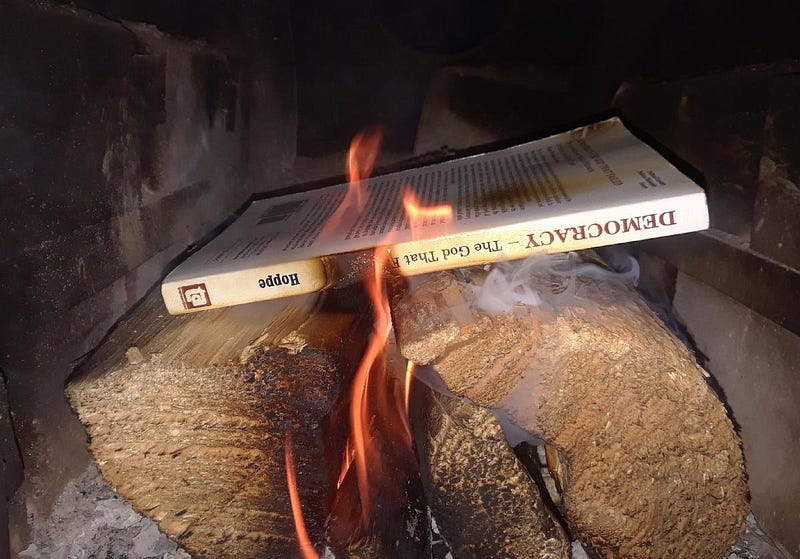
How many times, reading a work of non-fiction, have you found yourself in this position. You’ve just read a paragraph and you stop in abject puzzlement asking yourself this question: “Will the next page be an utter waste of my time or is this author going to start making sense?” I was deep into the Introduction to a book I thought would be a disciplined evaluation of certain values I hold dear, when I encountered this essential quandary.
In Hans-Hermann Hoppe’s libertarian fantasy, Democracy — The God that Failed, I was reading through the fantasmagorical introduction over a delicious Royal We IPA at Very Nice Brewing Company in Nederland, Colorado. Upon reading his thesis that Democracy was bad, Monarchy was bad, Taxes were bad and Socialism was bad leading eventually to the reference to the triumphal term “Pure Capitalism”, I threw up in my throat a little bit and closed the book.
As I sat there staring in disbelief, Susan, the co-owner of the drinking establishment, asked if I was OK. I told her that I was having difficulty going further in this book. She suggested that another ale might help. I agreed and in the fullness of time was able to re-enter this tepid tome. A few pages in, I encountered the telling term “Natural Order” which reveals nothing more than the piteous sentimentality that drives any work by Ayn Rand. It is the notion that these political problems are easily solved as long as we simply use our reason as opposed to our emotions.
Rand’s repeated and hollow trope, that reason will always save us, fails, at every opportunity, to recognize that reason must be based upon premises; and that the premises are, in fact, the actual problem. A child’s view of reason drives the Randian Libertarian fantasy that everything is clear through the colorful crayoned goddess of reason.
Hoppe claims von Meses and his followers as exemplars but his introduction goes so deep into Randian messaging that I was reluctant to waste my time on Chapter one. I did, nonetheless, venture into that chapter. Therein, the sad appeal to a capitalist machine that would close a servo-like loop around perfection, and yield a world of purity and excellence for all deserving humans, left me remembering the pitiful experience of The Virtue of Selfishness and the painfully endured audiobook of Atlas Shrugged. All of these claim that the simple solution is to let the great men drive us forward as the shepherd drives the sheep, accepting that their glory will guide us forward as the will of the people could not.
I could go no further. I closed the book for good and resolved that no one else should be subjected to this drivel. I admit that there is a remote possibility that on the fourth page of chapter one, the author may have explained that this was simply an exercise in expressing the absurdity of such arguments. If that is the case, then I apologize; but, if so, the writing of this book was not well devised. After describing a world of ridiculous sentiment as if it were a simple resolve to the complexities of reality, the reader should be provided with some hint that this is actually irony. Without such an assurance, I do not believe that any reader should be denigrated for choosing to put this book beyond the reach of impressionable budding young Objectivists.
All I know is that as I considered passing this ridiculous vessel of stool water to our local used book store, I concluded that the poor sap who bought it may not have the intellectual vigor to spot the pitiful error fundamental to this intellectual cesspit. My good friend at Blue Owl Books would have taken it and tried to sell it to some unsuspecting sap; but as I considered putting my friend in this occasion of sin, my mind rebelled. At that point I resolved to destroy the book. I thought of this in the same way I think of my gasoline-powered automobiles. I will never sell my Mazda Miata because I want the gasoline-powered automobile to go away for ever. I will not allow the company that replaces my natural gas heater with a new electric heater to take that old heater for recycling because I do not want to risk the natural gas heater being placed back into service. For exactly the same reason, I decided to burn this hideous insult to reason. Were it the last of the copies, I would have felt an obligation to preserve this as a living example of balderdash; but, there are plenty of copies out there and the author is actually a professor who is constantly polluting the pristine minds of students with this childish prattle. Thus, without guilt, I reduced by one the viral load of libertarian clap-trap.
I should not single out this book as a special case. It is very tempting to hope for a magical system that will simply amplify goodness and retard badness. How wonderful it would be if good people were to naturally prosper and bad people would be punished by the very nature of the system by which the community was organized. In my book, Famine in the Bullpen, I too hope for such a system. I describe a mechanism for organizing a worker owned cooperative which I call PROSE. I actually do believe that such a system may work within a company; but for the larger state, I do not claim that such a system will work. It, like Communism, is unlikely to scale. This, then, is the persistent problem: for all of the ways that we humans may organize ourselves, which of them will scale to the larger state?
We all know that Communism works. We have all seen it. The healthy family is a miniature Communist collective. It works well with each member contributing what they can to the common wealth of the family and each dependent taking what they need from that common resource. The Benedictine Monastery is an ancient and successful Communist collective. The Findhorn Foundation is a Communist collective that has functioned effectively since 1972. Communism isn’t the problem. The problem is that we simply don’t know how to scale it to the size of a large state.
The idea that Capitalism, somehow, may magically scale to the size of a nation and assure a just distribution of resources to all is simply delusional. Capitalism is not the free market, as Nancy Pelosi so sadly mistook. They are completely unrelated. In fact, the free market is the enemy of Capitalism which greatly prefers monopoly. My good friend, a brewer, once told me that he was a capitalist. I asked him if he was sitting by his swimming pool waiting for his dividend checks. He responded, correctly, that he was, instead, brewing beer. I said, “Of course! You are a worker. You create value. That is not what the capitalist does.” Capitalism is the mechanism whereby those with capital invest it in systems that process that capital to yield profit. In Capitalism, profit rather than process is key. For my brewer friend, profit is necessary only so that he may continue to prosecute the process he loves: to brew delicious delicious beer. He is not a capitalist, he is a worker.
It is the profit motive, basic to Capitalism, that drives many of modern society’s key problems. There is more profit in selling drugs than in curing disease which leads drug companies to focus simply on turning fatal diseases into chronic diseases. There is more money in renting than selling which is why your cell phone provider is routinely slowing it in order to assure that you must buy a new one even though your old one should be entirely adequate for the foreseeable future. Insurance, which began somewhere around 1690 at Lloyd’s Coffee House as a legitimate enterprise for assessing and sharing shipping risks, has become a scheme for extorting funds from gullible rubes who believe a cheap one-person policy will protect them in the event of a serious medical crisis.
The profit motive is a well-understood phenomenon. While it is the best friend of the amazingly rich, those who work for a living find it distressingly distant. The libertarian fantasy presumes a wide array of incomprehensible assumptions: that people desire immediate gratification, that people are willing to negotiate for what they want, that people are willing to research without limit in order to understand the facts, and other naïve presumptions critical to supporting the libertarian world view. Needless to say, almost no serious research supports those presumptions.
Whenever a libertarian starts explaining the world to you, you should feel free to respond with, “You have no data to back that up.” That should end the uncomfortable conversation quite nicely. I am eager to engage in serious discussion on a number of issues. As a liberal, I look forward to hearing arguments contrary to my basic beliefs. As an engineer, I present controversial ideas all the time and in design reviews, bold engineers object and present better ideas. I would have utterly failed as an engineer if those objections offended me. Instead, I accept those ideas, challenge them as needed and in the end settle on a solution far better than the one I originally proposed.
Crazy new ideas, if they pass the test of premise and reason, are to be taken seriously and incorporated into one’s real definition of the world (the state of affairs as Wittgenstein would write). Any concept that disrupts our lazy understanding of the world brings value. Silly ideas about simple simple solutions like Capitalism is the ideal political and economic system closing a servo loop around everything you care about provide no actual value. Politics is complicated. It is about people with a wide array of ideas working together to accomplish a goal satisfactory to the majority of participants. It is difficult. I have committed myself to providing a solution to this greatest of engineering problems in the book I write after the one I’m working on now. That may be a fool’s errand but, as an engineer, I have thirteen patents that say I may be able to solve the impossible problem. I cannot promise a solution, but I can promise an analysis worthy of belief.
Ayn Rand’s childish view, that Capitalism and bold men resolve all problems, is not a solution I will be taking seriously. Instead, I will be reviewing human nature, the history of governments, sociology and the psychology of the human self. It is an impenetrable problem, but I have a hypothesis. Unlike modern libertarians, though, I am not claiming a miraculous explanation of everything based upon the simplest of simplistic solutions. I am merely hopeful of a solution that is not obvious (like all engineering solutions I have resolved to date). I will review, assess, discuss and strive for a solution. If there is no solution, I will sadly (but not reluctantly) explain how this problem of human governance is simply impossible and we should just give up.
I am hopeful that that will not be; but, as an engineer, I am comfortable with the occasional disappointment. I am not comfortable with conclusions that are not based upon fact. I am not comfortable with wild ideas that are rooted in aspirational bunkum. I am going to look to a solution to the fantastic complication of human interaction that incorporates the actual reality of humanity.
Julian S. Taylor is the author of Famine in the Bullpen a book about bringing innovation back to software engineering. Available at or orderable from your local bookstore. Rediscover real browsing at your local bookstore. Also available in ebook and audio formats at Sockwood Press.