
I Bought $5 in Starbucks Stock Every Day Instead of Buying My Morning Coffee
The money I earned and the lessons I learned — from finally listening to money gurus.
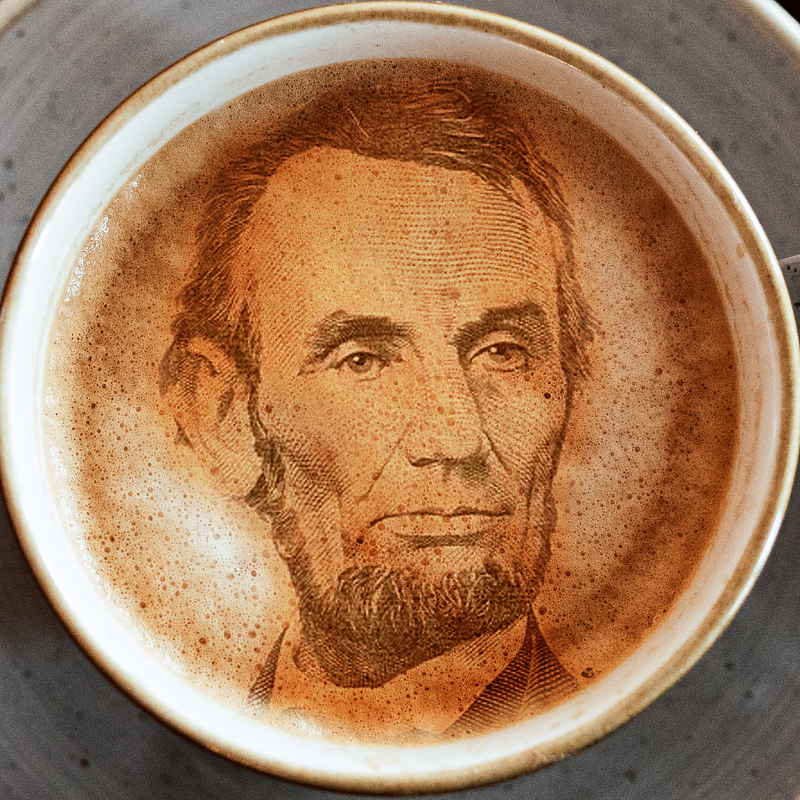
I gave in. I finally listened to all those money gurus on the internet and decided to take better care of myself and my money. There is lots of different financial advice on the internet to listen to, but the advice I’ve seen the most is:
Don’t spend your money on coffee every morning. Invest that money instead.
People give out this advice as if it will save you a fortune, but in reality, it all depends on the perceived opportunity cost of each individual person. I should know; I ran the numbers. But still, this advice gets thrown around from time to time, probably because of the public support from celebrity millionaire, Kevin O’Leary.
“Never do I do that. That is such a waste of money for something that costs 20 cents,” O’Leary says, who is an avid coffee drinker himself. Not buying coffee could be difficult for some though, especially those who are always in a morning rush or those who simply can’t make a good cup of coffee for the life of them.
For me, I love coffee to death. I can’t go one day without my morning coffee, so maybe Kevin O’Leary does have a point after all. Too bad I always make my coffee at home so I can’t really benefit from O’Leary’s advice of not buying morning coffee. Or can I?
Birth of an investor
You see, Kevin O’leary’s advice isn’t just to stop buying your morning coffee. No. It is also to invest that money instead. Which is exactly what I did.
But what stock should I invest in? Should I go safe with an ETF? The answer to this question wasn’t obvious until it was — Starbucks. Instead of buying a $5 coffee every morning, I bought $5 in Starbucks stock every day.

I like to think of this as a little experiment. I wanted to see how much I could actually earn (or even lose) and if O’Leary’s advice had any merit behind it. Yes, I realize returns would be entirely dependent on the stock I chose to invest in, but Starbucks really fits the theme and it also pays a dividend so if I end up losing money, I can at least get some money back.
I bought my first $5 worth of Starbucks stock on November 3, 2020, at $87.97 a share. I am now a proud owner of 5.684% of a single share of Starbucks.
So then I sat there for the rest of my day, checking in on my $5 and waiting for my money to make me money. The stock ended the day at $88.39, and my $5 turned into $5.02. I made two cents in a day from doing absolutely nothing! Maybe Kevin O’Leary is on to something after all.
1. Relax, be resilient, and only invest with what you can
Something that I forgot to mention was that I started this experiment during a pretty big historical event — the 2020 presidential election, which to my understanding and first-hand knowledge, can have a large influence on the stock market.
I woke up the next day to find that the stock of Starbucks rose by 3%! Definitely has something to do with the election, since I woke up to find Joe Biden gaining ground in the battleground states of Wisconsin and Michigan. Stocks are up!
But, then I realized that I didn’t invest five more dollars into Starbucks yet. You see, to make this whole experiment as smooth as possible, I set up recurring investing on the Robinhood app to automatically invest $5 for me, so I didn’t have to think about it.
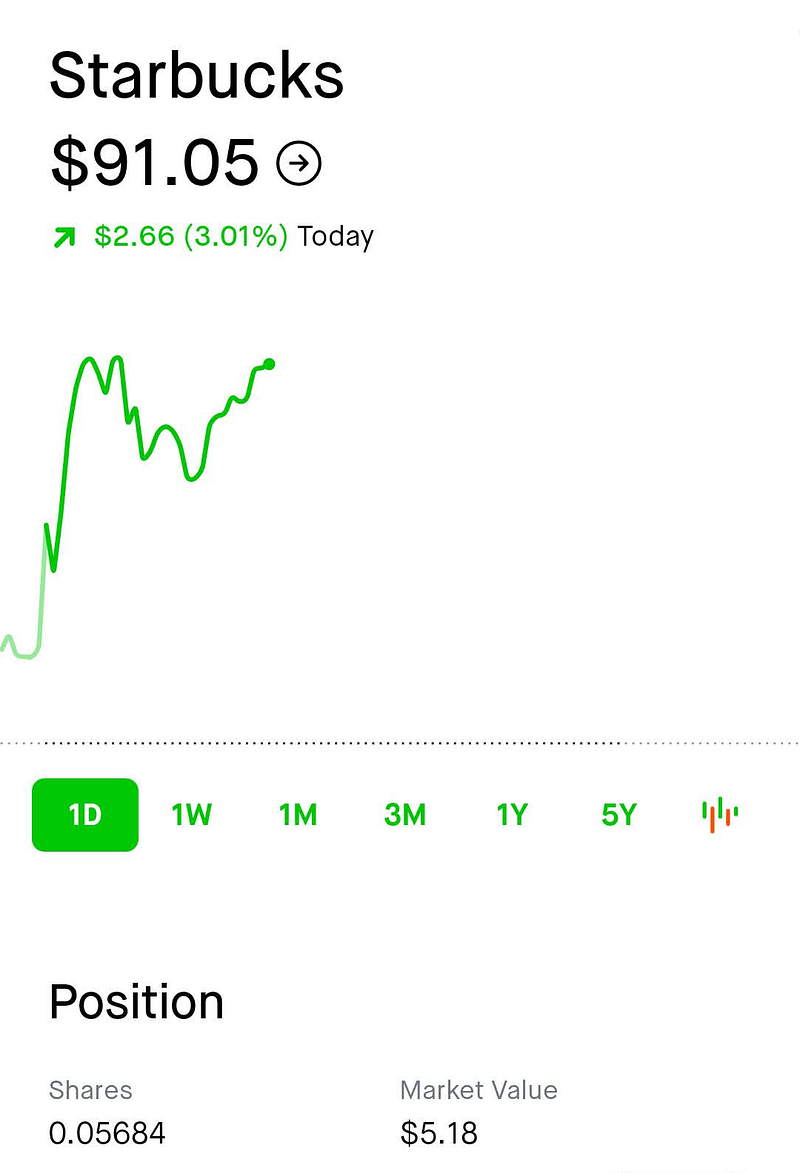
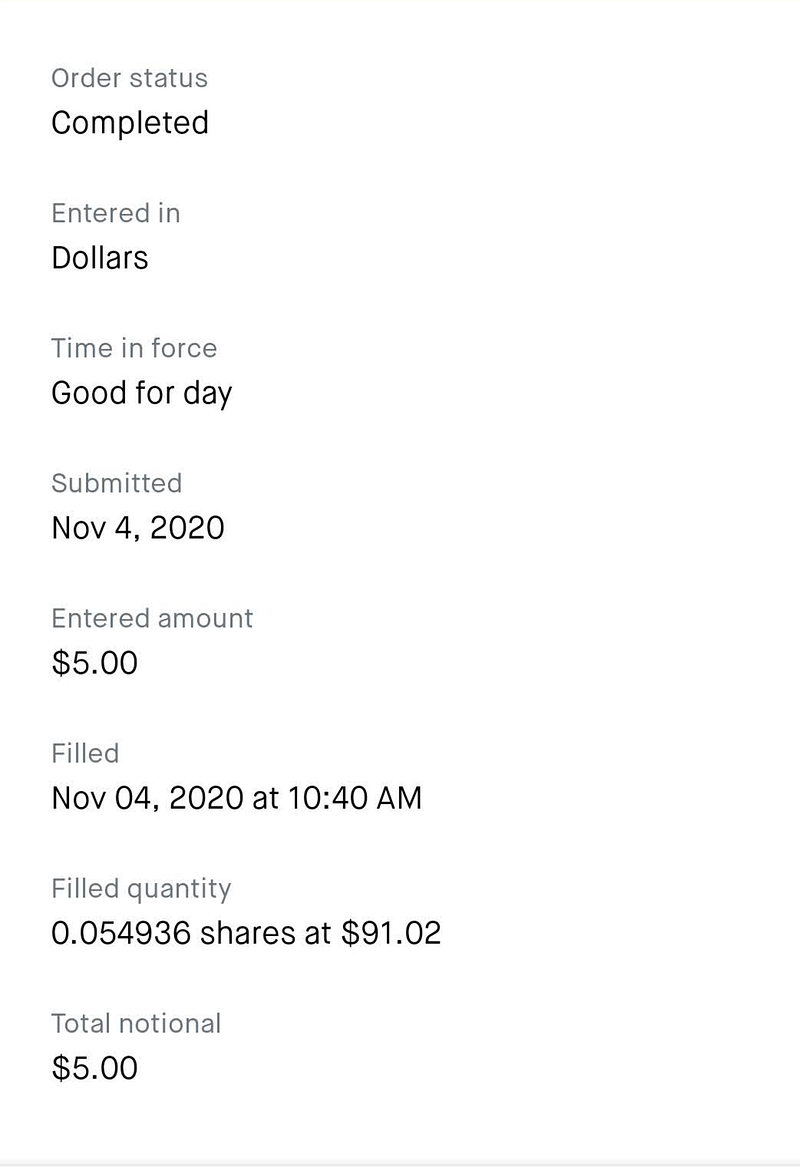
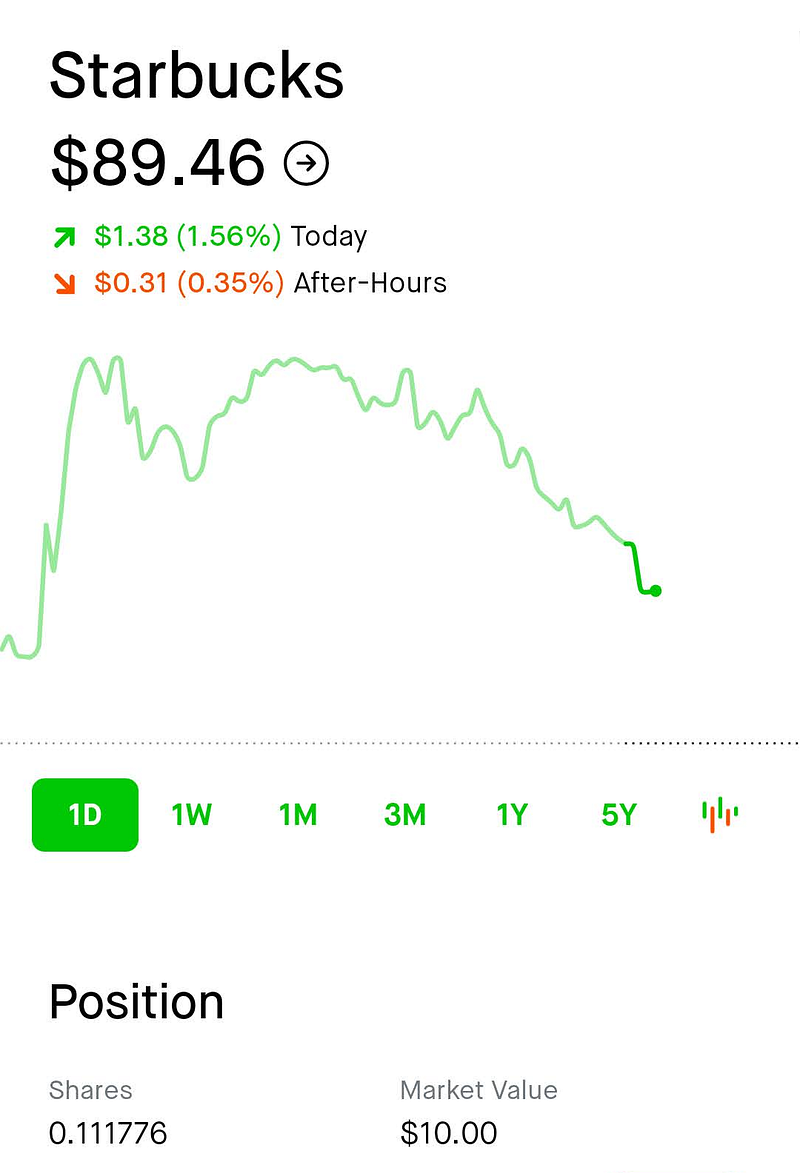
After looking through their help center, I found out that the trade will happen every day at around 12 pm, which I have no idea how they settled on that time. Why not just the beginning of every morning? This little hiccup cost me money because if I invested right in the morning, I would have made more money than if I invested in the middle of that day.
The first loss is always the hardest
At 10:40 pm, Robinhood finally initialized my trade at $91.02 per share, but sadly the stock started to decline and ended around $89.46. If the trade executed at beginning of the day, I still would have made money that day, but instead, I lost money. That day I lost $0.0246 and my total return was -$0.000514. This brings me to my first lesson.
I started to think that this was a bad idea and I shouldn’t have started this experiment. Thoughts started to flood my head like, “What if I lose all of my money doing this? I should pull out now while my losses are low.” But then I put things into perspective. This is money I would have spent otherwise. I still have more money than I would have if I spent it on actually coffee.
Think about the money you invest as money you’ll never get back. You’re mind and bank account will thank you.
This is the mentality I followed throughout this experiment, which really helped me cope with the stress of the stock market. The realization of investing the money I would have spent anyway is core to not only this experiment but to investing in general.
Never invest more money than you can afford to lose. I thought about it as money I already lost, my “throwaway money.” I wasn’t investing my life savings away and so I was less stressed. I still had the money to continue my way of life.
2. Don’t regret but always stay consistent
To be honest, I would have never thought that Starbucks stock would perform as well as it did. The next two days, shares of Starbucks were stable at around $90.50, but on November 9, 2020, Starbucks rose 7%!
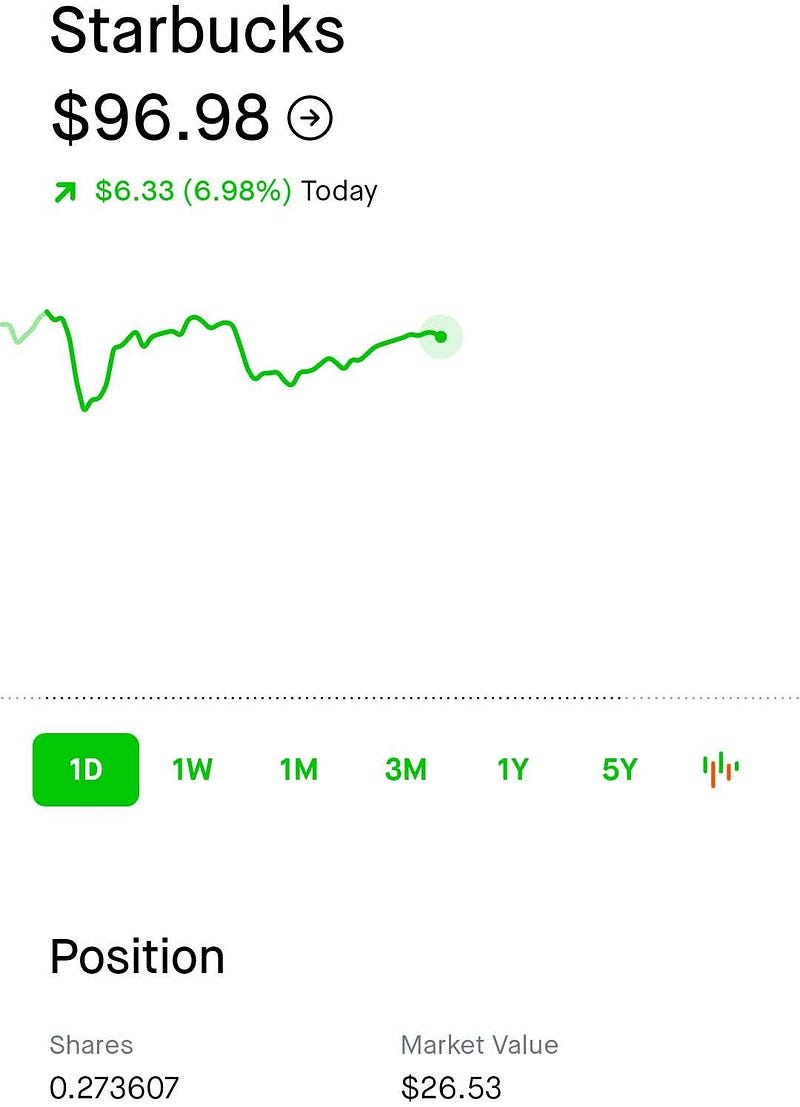
Joe Biden was announced to be the president-elect over the weekend and I guess the stock market has reacted accordingly. The price of a single stock of Starbucks reached $97.65 and in total, I’ve made $1.51, a 6% return. By this time I’ve only invested for five days.
Since the 9th, Starbuck stock has increased steadily, reaching $99 on November 18th. But during this whole period, I could not help but think, “maybe I should have invested more than just $5 a day.” Regret was getting to me as I realized I could have made more money if I invested it all at once instead of every day.
This is a common thought among many investors, but I can assure you it is misguided. People like me can easily be blinded by the ease of getting positive returns that they fail to understand it could have just as easily been the other way around. You could have lost your money.
The sad thing is that you would still feel regret whether you lost or gained money — regret for investing in the first place and regret for not investing enough.
Everyone knows that markets can go up one day and down the next, and I unknowingly made the right choice of investing a little every day. The term for this investment strategy is called dollar-cost averaging.
Dollar-cost averaging reduces the impact of volatility on your investment. By investing a small amount every day, I won’t be losing a ton of money in a single day due to market fluctuations. For example, if I invested $50 dollars in Starbucks on November 18th, I would have lost 2% of my investment the next day because the stock dropped down from $99 to $97.50.
Instead, with dollar-cost averaging, dips like November 19th didn’t phase me because I used it to buy even more stock and ended up making more money in the long term.
3. Patience is a virtue
Not much happened after the rally on the 18th. Starbucks was still on the rise but at a slower pace. This is when I learned that stocks are not a get rich quick scheme. There is a very low chance that you will become rich overnight.
It was frustrating seeing the stock gain so much in one day but then dip the next day and stay at that level for a whole week. This wouldn’t have phased seasoned investors. Many say to invest for the long term. Find a stock that you think will grow in the next ten years and hold it. I haven’t even held my investment for more than a month.
You hear about winners all the time, but you never hear about the losers.
I’ve heard of many online stories of instant millionaires that even I wanted a piece of that action. But you have to realize that there are losers in the stock market as well. For every winner you read about, there is a loser you don’t read about because they didn’t go online to gloat that they just lost all of their money.

Slow and steady wins the race is something I have to constantly remind myself as I see others making enormous returns on their investment. Too bad I’m still addicted to checking my stocks every five minutes. It is a good thing that this experiment automatically forces the slow and steady mentality on to my investment strategy.
Patience finally paid off when on December 3rd, shares of Starbucks finally reached $100.
My 30-day results
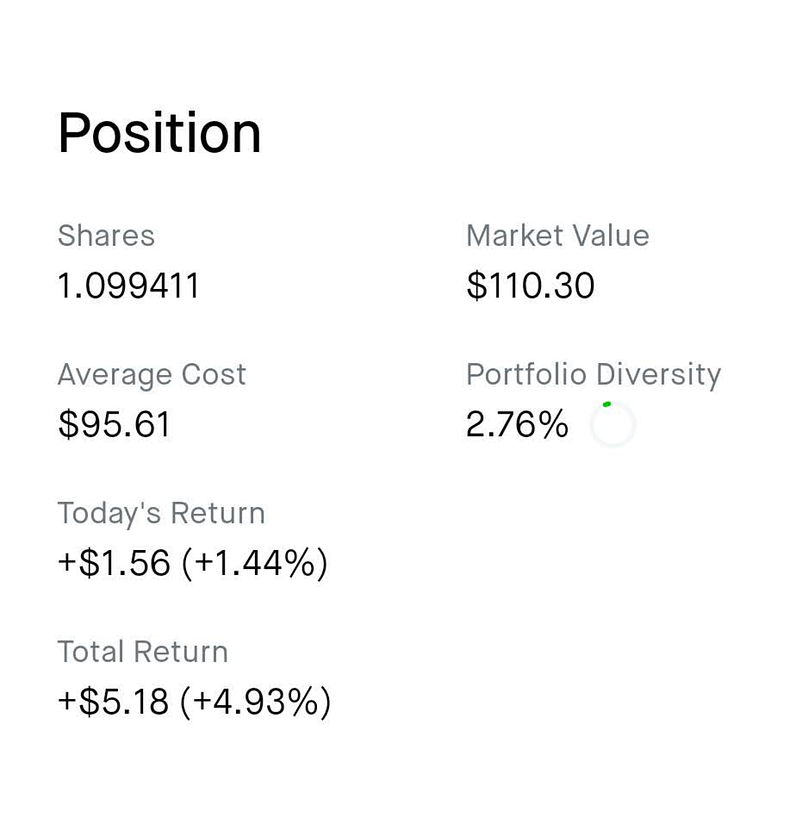
In the end, I came out richer and with a craving for Starbucks. My first purchase was on November 3, 2020, and my last purchase was on December 3, 2020. During this time I’ve invested $110 and gained $5.15, a 4.68% return in a single month!
Making enough to buy a single Starbucks drink, I’ve determined that Kevin O’Leary’s advice isn’t all too wrong. Though $5.15 doesn’t seem like much, over time it all adds up. I should be congratulating myself because I came out of this experiment with more money than I came in, which is a lot more than some people can say. 5% is a great return for just a single month of investing and I’m happy about it.
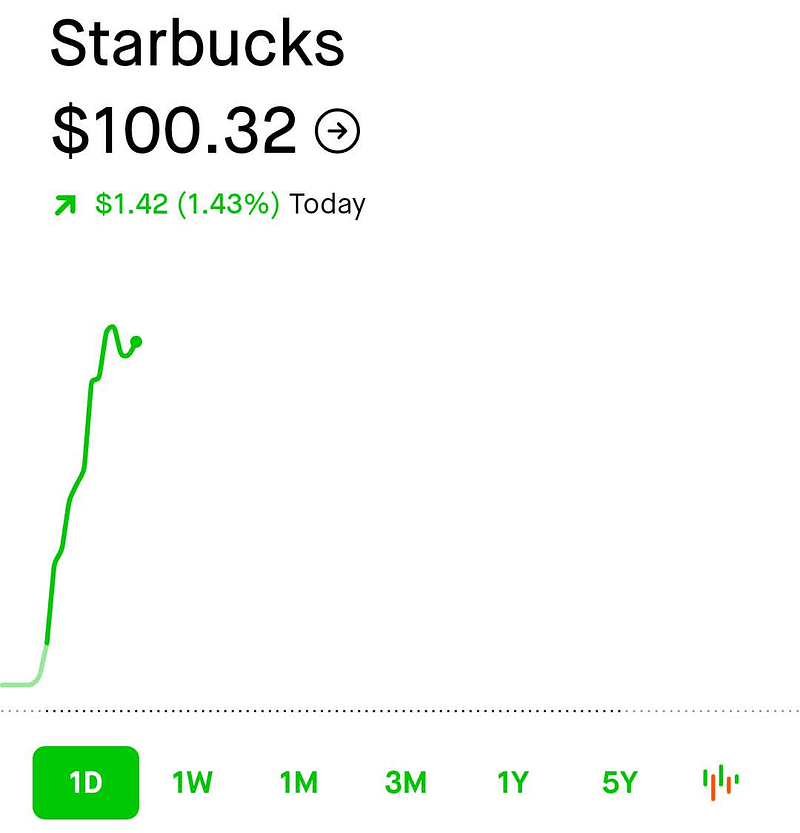
I’ve also saved enough money to make a significant contribution to my monthly loans or splurge on something other than coffee. Because of this reason and also because I really enjoyed this experiment, I’ve decided to continue it indefinitely. It would be a shame if I were to stop it so early.
In addition to making money, I also gained valuable lessons about investing in the stock market that I will use throughout my life. I will definitely report back with updates on my experiment but for now, I hope you learned a little something that you can apply to your own investments.


