
I Believe In Astrology, Here’s Why
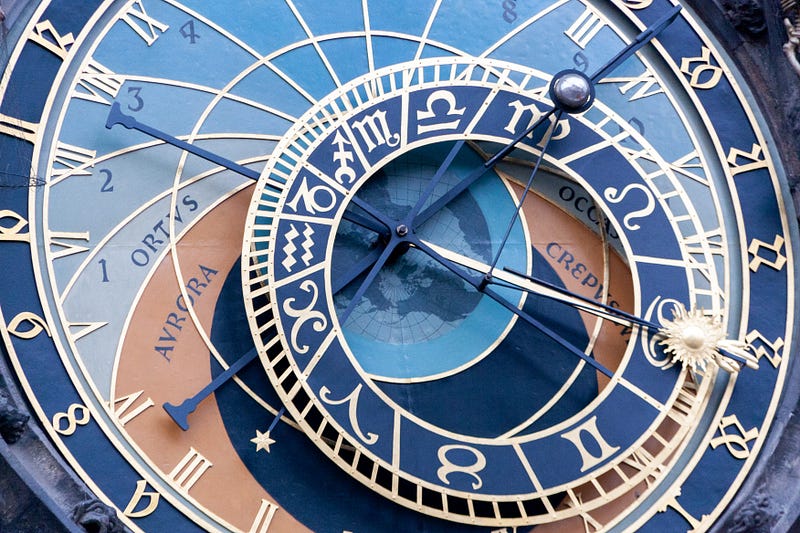
And no, I’m not a New-Age nutter.
Over twenty years ago, when I first introduced my wife to my parents, my dad asked about her birthday. Then he narrowed his eyes. In his most sage, wise-man voice, he peered at my fiance and gave his verdict.
“Ah, an Aquarius. They’re known to be compulsive liars.”
My wife was mortified. Later that night, one of my friends finally let her know that my dad gave that same response to everyone, regardless of their sign. It was his idea of humor. I shrugged. My dad was a Scorpio, and that’s just how they roll.
My dad was an avid amateur astrologer. He delighted in making detailed astrological charts and believed in the science of the stars. Our family communicated and understood the world in part through birth signs. When one brother seemed arrogant and sought leadership, he was “being a Leo again.” Meet a neat freak? Probably a Virgo. If not, the person probably had a Virgo ascendent or moon influencing them.
I’m a lot more skeptical now. I have a hard time believing that my Cancer ascendant or Scorpio moon based on the date, time, and place of my birth have much to do with anything. Would I be a different person if my mom’s C-section had been delayed a couple of hours?
But still, despite natural skepticism and my review of the overwhelmingly negative published academic research, I have both personal anecdotes AND a reasonably scientific working hypothesis that there could be nuggets of truth.
Anecdotes Have Power
As a small child, during a visit from one of my aunts, the family went to Trader’s Village, a mega-giant flea market not too far away. My aunt bought me a plaque with the description of the Gemini. It says, among other things,
“Their keen imagination is active all the time, which keeps them flitting from one project to another. The more intriguing a project, the more captive they are to drop the one they are working on for the newer experience.”
This pattern defines my life. I get fascinated with a project, work furiously and work obsessively. Eventually, the drive wears off, and my effort peters away. I have a large wooden toybox in the garage that I’m building for my daughter. She’s fifteen now and doesn’t really do toys anymore. Maybe it will go to one of the grandkids when I get motivated to finish it. Writing for Medium followed the same pattern; furious production in the first few months, making sure I published something every other day. Then once a week, then once a month.
I could name a dozen more examples. My Ph.D. took a decade. The first half is easy, you just schedule classes like regular college. After that though, I went through several bouts of furious effort and long stretches where I was distracted by other things in life.
Perhaps everyone is like this to some degree. Maybe I just see this in myself because every description of a Gemini contains similar words. Of the academic studies where sun-sign and personality are correlated, the subjects were often aware of the nature of the study, which may have biased their input.
Maybe it’s the same mechanism that allows me to see myself in the results of every personality test I take. I have a good understanding of how personality tests are constructed and how they work, but identifying with my Myers-Briggs results feels a lot like identifying with my sun sign.
It’s hard for me to dismiss personal experience.
Correlation and Causation
A key to scientific inquiry is separating correlation and causation. For example, you might notice that your car battery always seems to die a couple of months after you replace your tires. How did your new tires make the battery fail? They didn’t. Batteries last 3–5 years, and if you drive 15–20k miles per year, so do your tires. For you, tires and battery wear are correlated, but they are caused by time and driving habits.
What if I told you that Aquarians tended to be more physical and athletic, while the Sagittarius tend to be weaker? What if I followed it up saying that Libras tended to be the smartest, while Leos can be a little dimmer?
Malcolm Gladwell did exactly that in Outliers, he just didn’t frame it as astrology. He famously noted that more pro hockey players have birthdays in the first quarter of the year than in the last quarter of the year. He attributes this to the January 1st cutoff for youth sports; kids perceived as more talented are tracked towards more and better coaching. In reality, though, they weren’t more talented, just a year larger and stronger. This means that in certain pro sports there will be more Aquarians born in January and February than Sagittarius born in November and December. If Gladwell’s hypothesis holds, hockey success and sun sign will be correlated because both are caused by date of birth.
Likewise, Gladwell found that school cut-off dates in September favor Libras born in September and October over Leo’s born in July and August. With the advantage of up to a year in age, Libras will track early into accelerated classes and be higher academic achievers throughout their school careers, culminating in being more likely to go to college.
Is There A Social Construct?
Note that in Gladwell’s work the causation lies not the birth month, but the social construct around a birth month. An intelligence test given to a large random sample would not likely show any difference between birth months or sun signs, yet the predominance of early in the school year births among valedictorians and others highlighted as ‘gifted’ is very real.
Perhaps that’s why one of my daughters had to fight so hard to get into the Gifted and Talented (GT) program at her elementary. She was obsessed with being as good as everyone else, but with a September 1st birthday, she was literally A WHOLE YEAR younger than some of her competitors. She was dismissed as being “really bright, but not quite gifted.”
I discount the idea that the position of the sun, stars, and planets cause differences in personality. It seems implausible and borders on superstition. But can correlation be discounted?
Perhaps we have other social constructs in society that we are not aware of. Perhaps personalities differ between spring babies that get more natural vitamin D in their first few months than fall babies that get less natural vitamin D very early in life? Has anyone ever done a study?
Summers are slower; in the fall we go back to school and watch new TV shows. Maybe how much time is spent with babies and toddlers during which months of their lives can influence their development?
There could be dozens of small, subtle effects influenced not by the stars, but correlated with the stars and date of birth. The innate intelligence, athleticism, or other traits would still be randomly distributed. Correlations with fundamental personality measures could show nothing, but behaviors and outcomes could be different due to different socialization.
Finally, even if all behavior attributed to astrology is driven just by people’s awareness of their horoscope and how they think they ought to behave, then astrology might still have predictive power on behavior! It’s just behavior driven by expectations rather than by the planets.
I’ll explore this topic deeper someday, but as a Gemini, I’m already kinda bored with it now and I want to move on to something else shiny and interesting.
You might also like:
Brian E. Wish works as a quality engineer in the aerospace industry. He has spent 29 years active and reserve in the US Air Force, where he holds the rank of Colonel. He has a bachelor’s from the US Air Force Academy, a master’s from Bowie State, and a Ph.D. in Public and Urban Administration from UT Arlington. The opinions expressed here are his own. Learn more at brianewish.com.