
I Attended a $3,000 Tony Robbins Event — Here’s Why I’d Never Do It Again
You don’t need to drink the Kool-Aid.
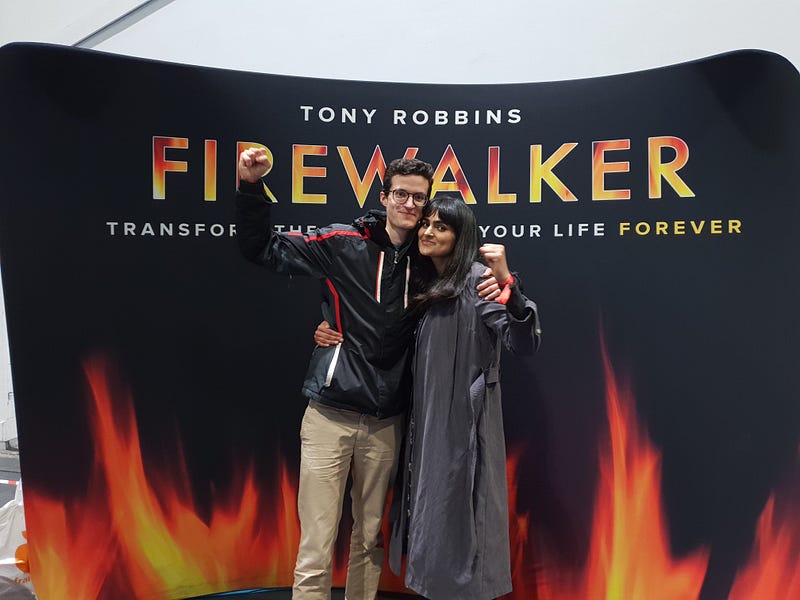
“If you want to take the island, you need to burn the boats.” — Tony Robbins.
Sometimes scams are hidden in plain sight. That goes for the self-help world, too.
A few years back, my fiancée surprised me: she got us both tickets to Tony Robbins’ flagship event, Unleash The Power Within, in London.
I was ecstatic. I’d finally get to see the man I looked up to and admired so much, learn kick-ass techniques to master the mind and transform my life for good. Plus, I was just getting ready to start a new role, so this would give me the boost I needed.
And, best of all, I’d get to do it all with the person who mattered most to me.
Though there were some positive moments, the enthusiasm quickly vanished. In spite of all the hype and ultra-aggressive marketing around these events and their gurus, there's a side to the story you’re not being told. A darker side.
Here’s how it went down.
A Bag of Pseudo-Science and Anecdotal Claims
We were two of the 13,000 people attending the event, packed in a huge arena. The energy and buzz in the lead-up to it was quite something. Everyone I met was raving about Robbins.
The guy next to me, bright-eyed and recovering from his divorce, told me he’d been attending every single year for five years straight.
The event promptly started by Robbins’ charismatic assistant, “Joseph McClendon III”, asking all physicians in the arena to stand up. My fiancée, who works as a doctor, did.
Joseph, who ran most of the event, then made the following disclaimer:
“The statements in this show are not intended to offend the medical profession.”
Who needs science?
It was understood that “old ways” of doing medicine and thinking about the human body and mind were outdated. New ways of approaching these issues would be covered over the next few days.
The audience was asked to keep an “open mind”, particularly for those with a scientific background…Apparently, that might cause your brain to shrink.
The purpose of this was to “enlighten” everyone taking part, not to upset “traditional” health practitioners. I thought it was a funny way to kick things off.
Singling out a handful of folk in a dark room of 13,000 to warn that they may not like what was coming.
Why? Because they represented the “old way” of doing things —a way that relies on scientific evidence, based on facts and controlled experiments as opposed to hearsay and the complete absence thereof.
I understood why this disclaimer had been made the next day, when a bunch of self-proclaimed “healers” took to the stage. And started making claims that were…well…evidently not based on any scientific reasoning whatsoever.
Anecdotal claims — based on the experience of one of two people brought on stage — were repeatedly made to somehow prove that the mind controls matter, amongst other pseudo-scientific ideas.
It was an overly simplistic view of the world, according to which your thoughts directly define your reality.
One story told by Robbins’ right-hand man was that his dying mom had miraculously recovered from cancer, by the sheer power of thoughts. The guy had shielded her from the “negative influence” of the medical staff, who were of the opinion that her days were numbered.
As the story goes, by not letting any negative influence enter her mind and instead filling it with positive associations, cancer disappeared. The doctors, with all their “negative” thinking, couldn’t explain it.
It was a downright miracle…and the particular incident is made out to be this universal truth that governs the entire universe and every single soul in it.
Anecdotes versus facts
The pattern of taking the anecdotal and transforming it into the universal repeats itself over and over to support wild claims.
That’s what researchers call the “anecdotal evidence fallacy”. Here’s a great example:
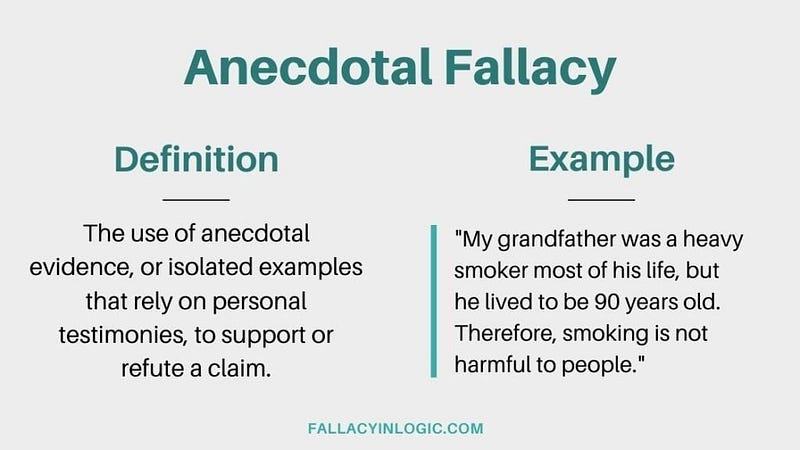
Be it in this event or the wider self-help, Law of Attraction-type pseudo-science movements, gurus resort to this fallacy all the time.
What self-help gurus consistently fail to do is separate causation from causality.
I might decide to stand on one leg and hop around, hoping for rain to fall from the sky. If the rain falls, there’s no causality: no link between a potential cause (me hopping around on one leg) and effect (rain falling from the sky). I’m not going to go around and tell people to jump on one leg to bring more rain so they can cool off in the hot summer.
But here, the audience is led to believe that a one-off event is a sign of how life works — for everyone, everywhere, and in every case.
Next up, this bald guy — conveniently bald so all could see the scars on his scalp, which he proudly showed off whilst the cameras zoomed in on them — told the audience that Robbins had changed his life. And that if he could do it, with a terrible past like his, anyone could.
One anecdote was supposed to convince everyone that they too could achieve the same results, by applying the same vague self-belief techniques.
We were about to break through our mental barriers and step into a better version of ourselves to demonstrate this.
Playing with fire
We were led outside for the highly anticipated “fire walk”.
The point was to walk barefoot on hot coals and prove to ourselves that anything was indeed possible. At least, that was the intent.
The issue? If you don’t walk quick enough, you do get burnt. Heat transfers from coals to feet, and if you’re not fast enough, it’ll hurt. No amount of self-help disillusion will change that.
The dozen attendees who got burnt, some hospitalized, at another U.S event have had a taste of the reality of physics and proven scientific facts over any dreamed-up guru advice.
The walk itself was deflating; the lead-up to it was more exciting, and it was all before we knew it. It felt like the point the experience was trying to prove was nothing new.
Yes — you can make yourself do stuff you might not be comfortable with, when you're doing it with a mob of over 10,000 people all psyched up by some self-help woohoo.
No sexy breakthroughs there.
3 Manipulative Techniques Robbins Used to Keep People Hooked
The event ended with an entire half-day of Robbins’ team shoving aggressive sales messages down our throats. The 30-odd businesses he owns or is invested in had stands lined up at the back of the arena.
Pitch after pitch was made to go out and try the many wonderful health and nutrition products on offer.
Once more, the magical claims for each of those products were largely unsubstantiated. They weren’t backed up by any scientific studies or data.
Quite simply, there was no evidence — apart from a handful of gurus standing on stage urging you to buy this stuff. Social proof I guess?
This didn’t feel convincing to me, but it was enough for many who swarmed around the stands feverishly…probably in a desperate attempt to grab anything that could make them look, feel, be like Robbins in any way, shape or form.
The psychological trick at play here?
Our natural tendency to turn those we admire into mirrors of our own desires.
We want to be and act like them. Show us a path, and we’ll happily pull out our credit card.
The hard-selling phase comes after days of what could be described as a self-help rave party, with music loud enough to make you entirely deaf and emotions running high in all directions.
Once the right emotions have been triggered in the audience, and the carrot at the end of the stick is dangled in front of you in the form of more “life-changing” products and programs, the sky’s the limit.
This is where the true intent behind these events, seminars and courses becomes apparent:
Selling — more — stuff (to more desperate people).
#1. Aggressive sales techniques
The way they induce this frenzy in people is subtle. They “pick” someone from the crowd, who shares a hugely emotional story about themselves and what they’ve gone through. A river of tears rolls down their cheeks.
The camera zooms in and suddenly that swollen, hopeful face is on a huge screen with 26,000 eyes staring at it. A few questions later this person has somehow found their life calling and bursts into more tears — of joy and abundance, this time.
Everybody claps and celebrates. The world’s a better place.
Then you’re told that, of course, such limited insights and changes in behavior are not one-off. They have to be sustained via more (and more expensive) courses, classes, coaching sessions, and so on.
Robbins gets on stage and talks about his “Mastery” University programs, some of which cost several tens of thousands of dollars a year. You’re told to keep “investing in yourself”, whatever the cost may be.
This is where the message becomes toxic. The audience is encouraged to “burn the bridges so you can take the island”, even if that means taking out a loan and getting in debt to pay for one of these life-changing courses.
Looking around and speaking with some of the participants, I could tell this was the case for many desperate, innocent souls out there.
What could possibly go wrong here?
If you believe that by getting in debt you’ll benefit and somehow make a return on your investment, this would be a risky bet, but one that could be worth it.
However, this begs the question: where is the evidence that such programs actually work?
#2. No data, no facts, no evidence
Where are the stats, the data, the facts to back up the claims of lives being transformed? Why are the numbers not shown transparently in the pitch? Surely this would be more convincing than a few anecdotes, right?
- How many have taken the said course?
- What was their starting position (in whatever area of their lives the course is targeting: finance, health, relationship, spirituality, etc.)?
- Where did they end up as a result of taking the course?
Nada. Nothing. No data, no evidence.
Turns out that if you trigger the right emotions in people, the rational part of their brain switches off.
That’s how you get away with having no data to back up your claims or justify the price tag.
A couple of people get up on stage. Tell you how this coaching stuff changed their lives — and boom! — here come the signup sheets.
Close to $700 per month for one coaching call a week by a “qualified” coach. That’s one month’s rent where I live. You better make sure there’s a return on the back of that investment, pretty quickly, unless you fancy swimming in debt.
#3. Preying on vulnerabilities and human emotions
What gurus like Robbins do, is use people’s inner weaknesses to sell them a dream.
Messages and ads are targeted at a particular demographic — often young, struggling financially, single moms, divorced parents, etc.
When people are vulnerable, they’re looking for any way out. They will jump at any opportunity to improve their situation. And when some self-proclaimed guru with a Lambo shows up in their Youtube feeds, or someone with the credibility of Robbins holds an event, they buy the ticket.
When done right, they’ll buy at whatever price.
That’s called psychological manipulation — also known as brainwashing.
Self-help events like “Unleash The Power Within” are a roller coaster of emotions that send participants’ adrenalin levels through the roof. It takes you from crying to laughing hysterically, to shouting out from the top of your lungs.
Once your emotions are all jammed up, you’re easily manipulated. You let your guard down and get hooked on the next bait.
But hold on a second.
If those courses and products sold a dream and didn’t work, surely people would complain and we’d know about it…right?
The issue is those gurus use human psychology to turn your weaknesses into more dollar signs without you batting an eyelid. How?
By selling a product, course or service that cannot be blamed.
Don’t Blame the Guru, Blame Yourself
Self-help gurus selling products that are supposed to transform your life and turn you into a walking god have this in common:
- Outcomes are often too subjective to measure
- If they don’t work, it’s your fault — their claims are “unfalsifiable”
Subjective outcomes
Because the outcomes promised by the gurus are so subjective, they can’t readily be measured.
How do you measure happiness levels? When do you know you’ve become the best version of yourself? How can human growth be measured and a price tag slapped on it?
What can’t be measured can’t be verified. Hence probably the lack of any benchmark or evidence to support any of their claims.
If the desired results of the course or product can’t be measured, then there’s no refund policy. Since the products sold can’t ever be proven or disproven, they can’t be returned nor their creator blamed for not achieving the desired results.
Clever, right?
“80% psychology”
When you buy a course that’s meant to give you happiness or attract wealth at the drop of a hat — and it obviously doesn’t — the answer is: you didn’t try hard enough.
You let “negative thoughts” get into your head. You’ve only attracted what you deserved, really.
So if you’re still lacking money or haven’t lost a single pound months after the course, it’s because your mindset isn’t right. Your thoughts aren’t right.
You aren’t right.
Do you see how dangerous this crafty little trick is?
Arguably, this makes a lot of people feel like crap. No one would want to speak up and claim their failure for the world to see. They’d rather believe in the same message. It’s all down to them; they need to buy the next course and learn to better control their thoughts.
That’s the kind of harmful message repeated over and over by the whole Law of Attraction movement. Most Multi-Level Marketing (MLM) schemes — illegal scams — also use the same tactics to keep their clueless members roped in.
Why? Because,
The best scams are the ones that leave the scammers… blameless.
Oh, and there’s one more thing.
A Very (Very) Bad Sense of Humor
During the event, we sat and watched a super-old video of Robbins. This time, he was telling a joke.
The point was to illustrate the power of human connections, and to give us homework for that day. Our task was to hang out at a nearby café and strike up a conversation with a stranger.
By finding commonalities with someone — anyone — you can quickly build rapport. That was the gist of it.
So here’s the joke Robbins made to prove that point.
“I’m an Iraqi and I walk into a bar. I spot another Iraqi…[starts waving his arms around]…‘Heeeey!! I’m a terrorist too!!’”
And just like that, you made a new friend. Apparently, that’s how you build human rapport.
Bear in mind this “joke” was shown on a giant screen in front of 13,000 people. Judging by how dated the video looked, it may have well been shortly after 9/11, too.
Funny, uh?
So-called gurus follow a simple, 4-step process. Robbins and his crew of devotees are no different.
- Build trust by appearing as if you care
- Manipulate emotions by selling bags of hope and condition your audience for the next step by pressing the right buttons (fear of missing out, anxiety, social comparison, etc.)
- Upsell the audience (by showing them a pathway to that hope, with a price tag that scales for the degree of happiness/ transformation/ wealth promised)
- If somebody complains, point them to more material, resources and courses to cure them of their “negative thinking”. Never accept accountability for the results — it’s all on them, remember?
And there you have it.
Closing Thoughts
This might seem a little harsh on Robbins and his flagship event. There are some positive sides, after all.
It definitely gives you a ton of energy, a sense that you’re all in this together, trying to step into the best version of yourselves. It also gets you to consider your physiology — your posture, how to breathe properly — and the power of the words you use.
Anything new here? No. Absolutely not.
In fact, most of the content was re-hashed and we were often shown video clips from years ago. When on stage, Robbins himself keeps re-using the same examples from decades back…most of which can easily be found on YouTube.
So was it worth spending that much money on? Hell no.
In the end, here’s what we walked away from the experience with:
- A huge buzz that lasted for a few days
- Peanuts (we had to buy some at the local shop since there was barely any time to eat or rest throughout the event)
- A workbook with some notes about how 80% of success is psychology (and ads for some milk-based supplement with dubious promises of ever-lasting youth)
That’s about it.
So if you have a bottomless wallet and want to spend some cash for a quick buzz, then go for it.
But if you actually want change in your life, then surround yourself with the right people, study your own psychology and get an accountability partner. It shouldn’t cost you an arm and a leg.
Self-growth is a noble and worthwhile pursuit — just be aware of the self-proclaimed gurus, no matter how good their story might sound.
Want to stay in touch and receive more useful content? Join my bi-weekly newsletter here.


