
Life, Spirituality
I Aspire To Be a “Guest of the Earth”
Teachings from a Sikh memorial
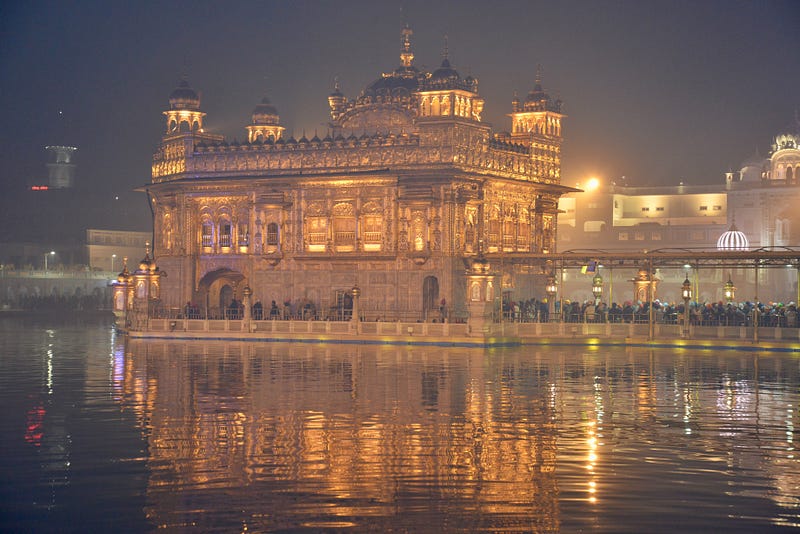
I shifted against the carpeted bench and tugged the red and white pillow up a little higher on my spine. We’d been seated here for an hour and forty-five minutes now, listening to kirtan and watching the translation of the Hindi words from the Guru Granth Sahib, the Sikh holy book, flash across a screen hung from the ceiling.
To be able to pass through this life with the grace of a guest honoring the house of Nature appealed to me so deeply that I felt something profound shift inside my very core that day in the Sikh temple. It left me teary and speechless amidst a swirl of chatter and a kaleidoscope of colorful saris and salwar kameezes.
We were at a Sikh temple to celebrate the life of a dear friend who had passed. And, while we knew from our past experience with the Sikh community that generosity and kindness to others are core values amongst its members, we were awed at the outpouring of love and respect being offered to our friend.
But what really struck me the most that day was a line that kept repeating on the overhead screen: “We are guests of the earth.”
Many religions view their members as being “stewards” of the earth.
But, to me, there is a distinct difference between being a “guest” and being a “steward.”
A steward is someone who has an obligation to care for something. It implies a sense of power or a sense of being in control. It implies a responsibility to alter things as we deem appropriate.
But a guest is something else entirely. A guest is someone who treads lightly. A guest is someone who does not interfere with the workings of the household. A guest respects the natural order of the way the house is run and does not try to change things.
To be able to pass through this life with the grace of a guest honoring the house of Nature appealed to me so deeply that I felt something profound shift inside my very core that day in the Sikh temple. It left me teary and speechless amidst a swirl of chatter and a kaleidoscope of colorful saris and salwar kameezes.
I want to be one who walks softly in the woods, or dances in the rain or imbibes the icy breath of a glacier, without leaving a trace behind me in my wake.
I want to be the guest who does the dishes before they leave and who takes off their shoes at the door. I want to be the guest who departs for the evening knowing that the house we have just left, whether it be the house of a friend, or the “House of the Earth” has not been left in disarray.
The first time that I visited a Sikh temple, it was a serendipitous side-trip. I had come to India with a group of my yoga students. We, and our guide, who was Sikh, and who had been telling us all about his traditions, found ourselves on a lonely stretch of road somewhere between Orchha and Gwalior in the district of Madhya Pradesh. Our guide asked if we could make a spontaneous stop, and we pulled into the empty parking lot of a temple he was familiar with.
The Gurdwara follows the lineage of the ten human Gurus of the Sikhism, but is viewed as far better than a living guru because the words cannot be twisted or altered for anyone’s gain.
Although we arrived unannounced, we were received with utter graciousness. After removing our shoes and walking through a shallow pool of clear water to cleanse our feet, we climbed a set of cool white marble stairs and were greeted by an elderly man with a long gray beard, wearing a purple turban and a tranquil smile.
As the sun was setting over the hazy hills in the distance, we were ushered into the temple or Gurdwara.
Gurdwara literally means “door to the guru,” and it is where the devotees come to gather near their holy book. This scripture, the Guru Granth Sahib, is regarded by Sikhs as the final, sovereign and eternal living Guru.
It follows the lineage of the ten human Gurus of the Sikhism, but is viewed as far better than a living guru because the words cannot be twisted or altered for anyone’s gain.
After being shown the holy book, encased in a golden display and already shrouded (covered up) for the day, we were led down to the basement, where we were seated side-by-side on a long strip of cloth on the ground and were offered tea.
Equality of all people is a central covenant of the Sikh tradition. Those who come to partake in the offering of food are all seated side-by-side on long rows of cloth covering the floor — the destitute seated right next to the well-to-do. All are welcome — Jains, Buddhists, Christians, Hindus. All are viewed as equals and all are offered a meal to share with their neighbors on the mat.
Although the remnants of the caste system still run strong through the fabric of much of India, within the Sikh religion, it is non-existent. Just like in Buddhism, which also rejected the idea of castes, the Sikhs view all humans as equals.
My husband and I have since visited the Bangla Sahib Gurdwara, the main temple in Delhi, and have also traveled to see the crown jewel of the Sikhs — the Golden Temple in Amritsar.
In both places, we have sat, cross-legged, on the floor, in meditation while listening to the kirtan. And we have both been so moved by the beauty of the music and of the moment that we felt forever altered.
But we had never understood the meaning of the words being chanted.
So, now, as I shifted against the red and white cushions at the Sikh temple in Riverside, California, and we could read the meaning of the chants on the overhead screen, I felt as if we had, somehow, come full circle.
Memorials, although they carry the weight of such sadness, also give us a glimpse into the beauty of someone’s precious time here on earth.
And I truly hope that when my time comes, people will be able to say of me, too, “She was truly a guest of the Earth.”
Erika Burkhalter is a yogi, neurophilosopher, cat-mom, photographer, and lover of travel and nature, spreading her love and amazement for Mother Earth’s glories, one photo, poem or story at a time. (MS Neuropsychology, MA Yoga Studies).
You might also enjoy:
Photos and story ©Erika Burkhalter. All rights reserved.