
Hydrogen: prospects and optimal applications
The German think tank Agora Energiewende published the report “12 Insights on Hydrogen” in which it formulated several considerations about the future of hydrogen in the global economy.
Let me remind you that in July of this year, Agora released a report on the economics of green hydrogen, according to which “even carbon prices from 100 to 200 euros per tonne will not be enough to make renewable hydrogen sufficiently competitive.”
The new paper notes that the role of hydrogen in climate neutrality is crucial but secondary to direct electrification. Consensus is gradually emerging on this issue.
By 2050, carbon-free or hydrogen-based fuels will provide approximately one-fifth of the world’s final energy, with the remainder to a significant extent supplied by renewable energy sources.
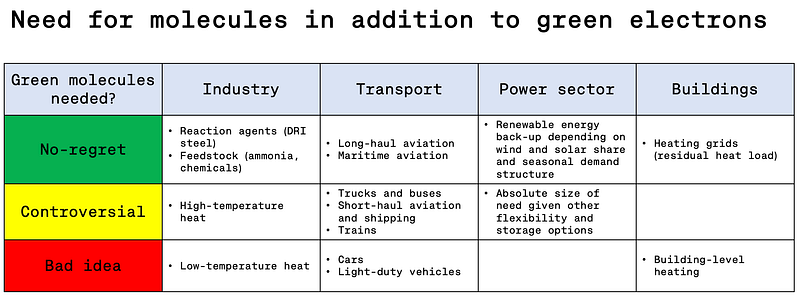
Priority areas for the use of hydrogen are the decarbonization of industry, shipping, and aviation, as well as supporting the energy system based on renewable sources. Therefore, hydrogen infrastructure must be tied to industry, ports, and power grids.
The price of carbon emissions alone may not be enough to rapidly introduce hydrogen into the industry, energy, shipping, and aviation. Therefore, targeted policy instruments are required to provide financing for renewable hydrogen.
Gas distribution networks need to prepare for the end of their usual business model, as large volumes of hydrogen consumption for building heating are unlikely to be expected. This is impractical for economic and technological reasons. If up to 20% pure hydrogen is mixed into the gas grid (a possible limit without major infrastructure changes), this will increase heating costs for consumers by 33% in 2030, while emissions will only decrease by 7% (due to lower energy content). hydrogen compared to natural gas). Switching to 100% hydrogen heating by 2030 will increase costs by six times.
The study explains that for every 100 kWh of renewable energy, a hydrogen boiler will only produce 61 kWh of heat. In contrast, a heat pump for 100kWh of electricity will produce an average of 270kWh of heat, or 135kWh of heat when the outside temperature is below freezing [air source heat pumps]. It is even better to use hydrogen to generate electricity to run a heat pump than directly to generate heat.
To stay on the 1.5°C trajectories, Europe needs to cut natural gas consumption in buildings by 42 percent over the next decade, according to an EU impact assessment.
Similarly, the use of hydrogen in the land transport sector will remain a small niche (“the potential future market for hydrogen vehicles is shrinking daily”).
Any surviving low-pressure gas distribution networks will be located near ports, where refueling and storage infrastructure could provide a boost to the decarbonization of shipping and aviation.
Agora believes that Europe has enough potential to produce green hydrogen and can meet its demand, but to do this it needs to solve two problems: public consent and the deployment of renewable energy sources, since every one GW of electrolysis must be accompanied by 1–4 GW of additional renewable energy capacity. To keep its industry competitive, the EU should have access to cheap “pipeline” hydrogen (green or “nearly carbon-free”) from its neighbors, which reduces transport costs. Purchasing hydrogen on the global market is impractical (transportation costs are too high), so it is advisable to limit imports to renewable synthetic fuels (for example, ammonia) based on hydrogen.
“When the final molecule is hydrogen, delivery from distant countries such as Chile or Australia [where the cost of producing H2 will be low due to high solar radiation] is more expensive than if the hydrogen were produced locally in Germany,” says in the report. At the same time, using imported ammonia directly as a fuel “may be cheaper than local hydrogen production even in 2050.” [See also: Assessment of economic prospects, including green hydrogen imports].
Countries that have enormous amounts of low-cost renewable resources, such as Argentina, Australia, Chile, the Arab region, Morocco, and South Africa, “will become places for the production of sustainable fuels for the entire world,” the report says.
On the other hand, by 2050 North Africa, thanks to its superior solar potential, could provide just under half of the EU’s hydrogen needs at prices well below the European average — and with low transport costs [because H2 can be delivered via pipelines]. “Ukraine also has the ability to supply equally cheap hydrogen to the EU,” the authors add.
I would like to thank Dan Kreibich and the rest of the SQUAKE team for the help.