
Hunting for An Artistic Voice
Where my evolving style has taken me
Writing about art has become one of my most rewarding endeavours, but long before I ever started to think seriously about the history of art, I was a painter.
What kind of painter, I find it hard to say. Blessed with the proclivity for artistic indecision, my archive — to give it a grandiose title — is inconveniently varied. For all the years I’ve been making paintings, I’ve found myself pulled between different mediums and subject matters with a kind of irresistible magnetism.
Commercially, I don’t think it helps.
To sell art, it’s undoubtedly beneficial to have a style, or to put it more prosaically, a brand. It’s useful in order for people to recognise your work at a glance, and if they purchase a piece of it, to know that what they have is representative of a slice of a bigger pie.
Yet when you work across so many different styles as I do, the consistency that branding requires never quite materialises.
Unrestrained by genre or medium, I’ve painted portraits and self-portraits, landscapes, abstract paintings, realistic, impressionistic, hard-edged, soft-edged, monotone and multicoloured works. I’ve dabbled across all of these in both oil paints and watercolours.
I say this not to boast but to reflect on the question: does it matter?
Wandering Brushes
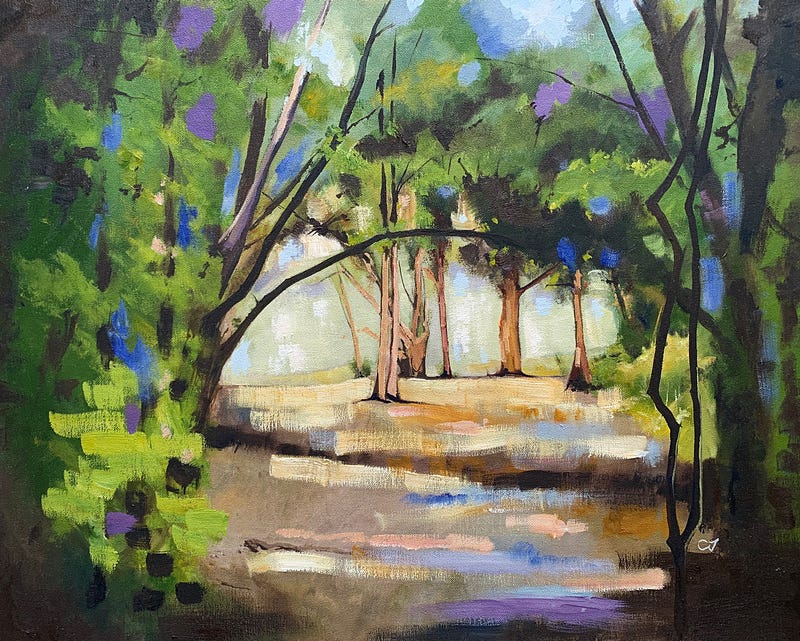
Here are a couple of examples.
The image shown above is an oil painting I made recently after taking a walk through the nearby countryside and finding myself exploring this inviting tunnel of trees.
I was pleased with it when I first made it, and now, after several months of letting the painting settle, I feel the same way. The image gets pretty close to the experience of walking through that woodland on that sunny day, with patches of colour casting ribbons across the ground in front of me. I like the way that some of the painted brush marks sit within the scene — contributing to the depiction — whilst others sit on the surface, hovering unanchored, escaping the portrayal and finding a life of their own. The liveliness of the finish — those hovering brush marks — translates well into the sense of light bouncing off tree leaves and through branches.
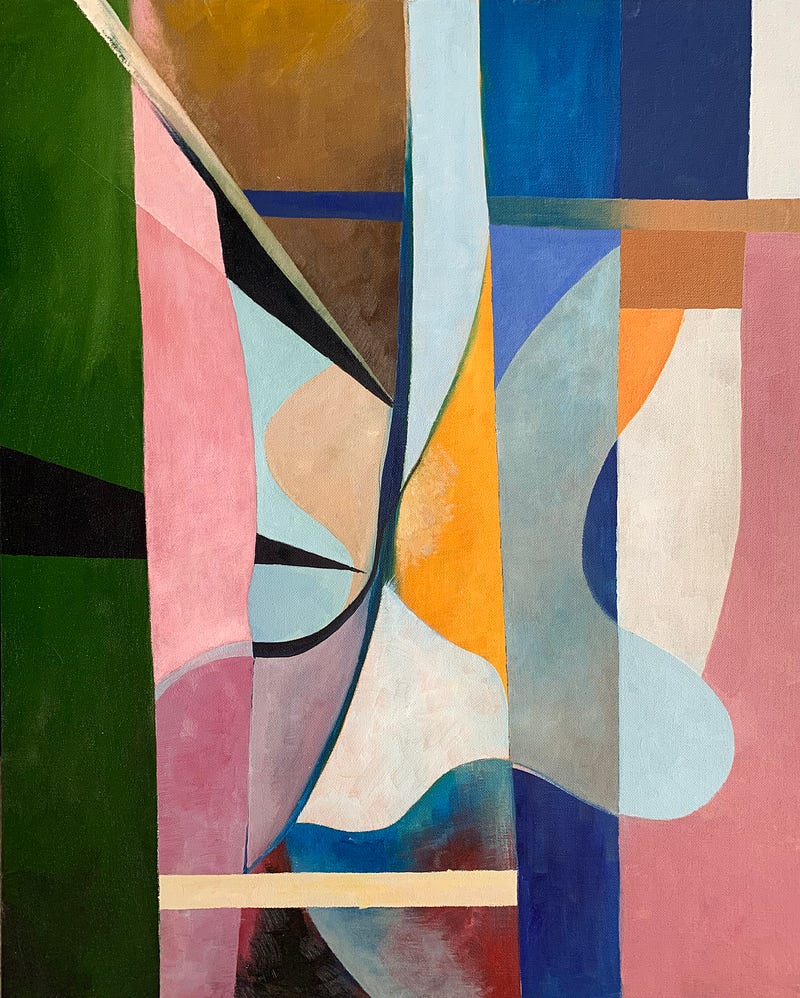
And here’s another painting I was working on at the exact same time. It’s an oil painting again, but this time it’s abstract through and through.
I was happy with this one too. The colours are warbling and unsteady, and the triangular spears that enter the painting on the left-hand side, seeming to puncture the organic curves and misshape them, contribute to the rhythmic, undulating energy that I was looking for.
It’s typical of me to start several paintings at once like this. I enjoy the feeling of several pots bubbling at the same time.
Whenever I say this, I always think of the description of the painter Paul Klee who at one stage in his career found himself with two studios in two different cities. He apparently took pleasure in travelling between the two, going to reacquaint with the “half-finished children” he’d left waiting for him in the studio he’d left several months before.
I very much feel the same way. Having multiple works ongoing at the same time suits my non-linear working patterns. I move between each one anticipating new discoveries as I do so.
When Abstraction Ruled
When I was younger, abstraction was the only form of painting I made.
My art idols back then were modernist painters from the early and middle years of the 20th century, people like Marc Chagall, Kazimir Malevich, Wassily Kandinsky, Paul Klee, and Robert and Sonia Delaunay. Later I took an interest in Clyfford Still and Mark Rothko, and some of the British modernists like Paul Nash, Barabara Hepworth and Ben Nicholson.
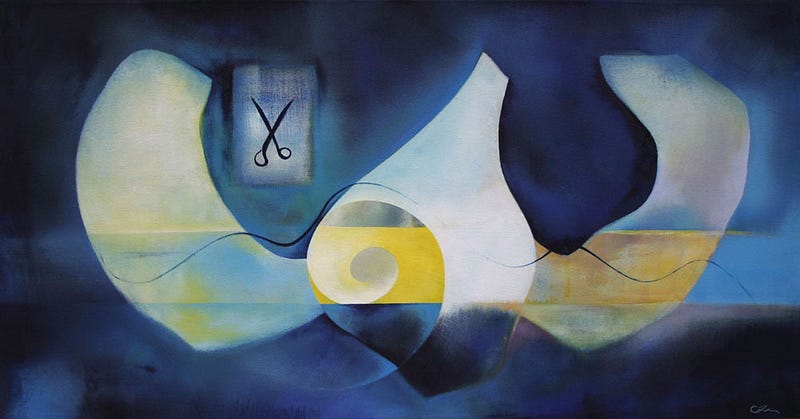
This painting was made in those earlier years. It’s primarily abstract, with a couple of tiny representative “hints” to suggest a deeper narrative. I worked on it for about four years, finding the right shapes and layers, and numerous tones of blue. I always loved this painting. When I began trying to sell my work, I always hoped this one would fail to find a buyer.
Selling my paintings went well in the beginning. Like any creative practice, if you keep at it long enough, sooner or later you end up with a body of work — for me, enough to put on my first exhibition. I discovered that a gallery in my home town was available for hire, so I booked it for a fortnight’s stint. By the time the exhibition was over, I’d managed to sell more than half the work on display. I was amazed.
Abstract to Figurative
And then I began to diversify. I started to learn about art history and found my head turned by figurative painters, from Caravaggio to Edward Hopper.
Perhaps most significantly of all, I discovered the German realist movement, New Objectivity, and found a fresh vein of inspiration. These artists painted people and places with an eye for unnerving details, and included painters like Otto Dix, Christian Schad and Jeanne Mammen.
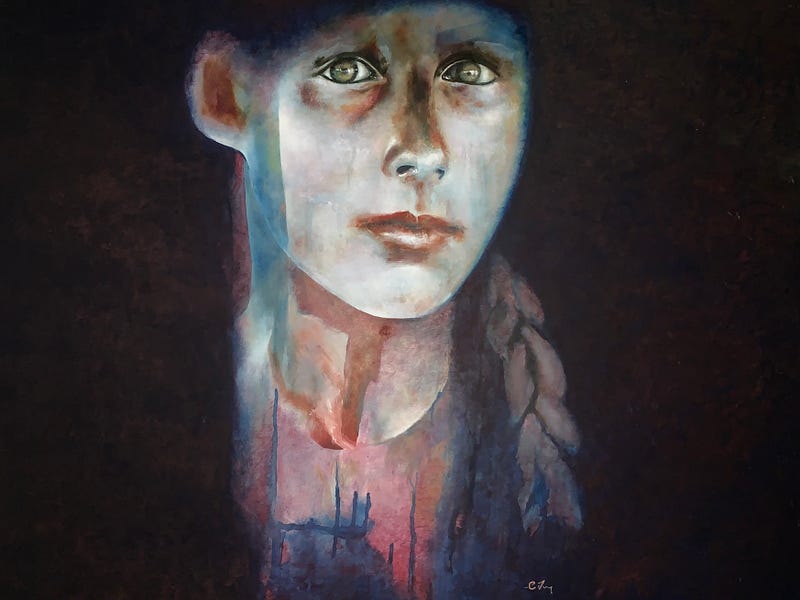
Under this new set of influences I began to paint images of people, and especially their faces, like this one of a young woman. I liked the new range of expressive possibilities that figurative painting gave me.
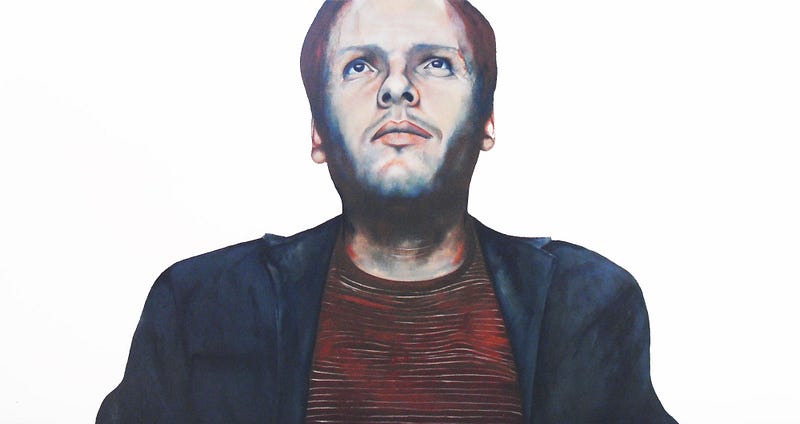
Sometimes I painted people directly from real life, like this painting of myself. At other times, I took images from magazines or books, often amalgamating several faces into an invented portrait.
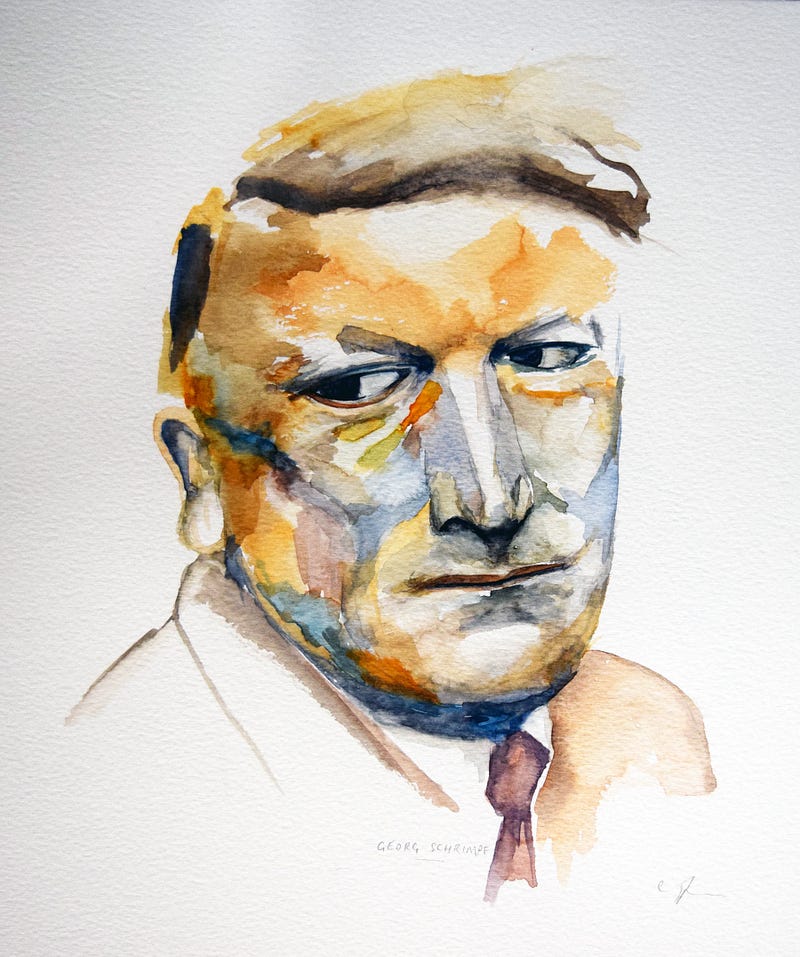
Here’s another painting I did in broadly the same character. Painted from a photograph, it’s a naturalistic portrait of the artist Georg Schrimpf, who was part of the New Objectivity group.
This portrait is a watercolour. I’m absolutely fascinated by watercolour paint even if its reputation in the world of fine art is threadbare. I love the technique, I like the speed of the execution, and most of all I enjoy the sense that I’ve got a lot more to learn.
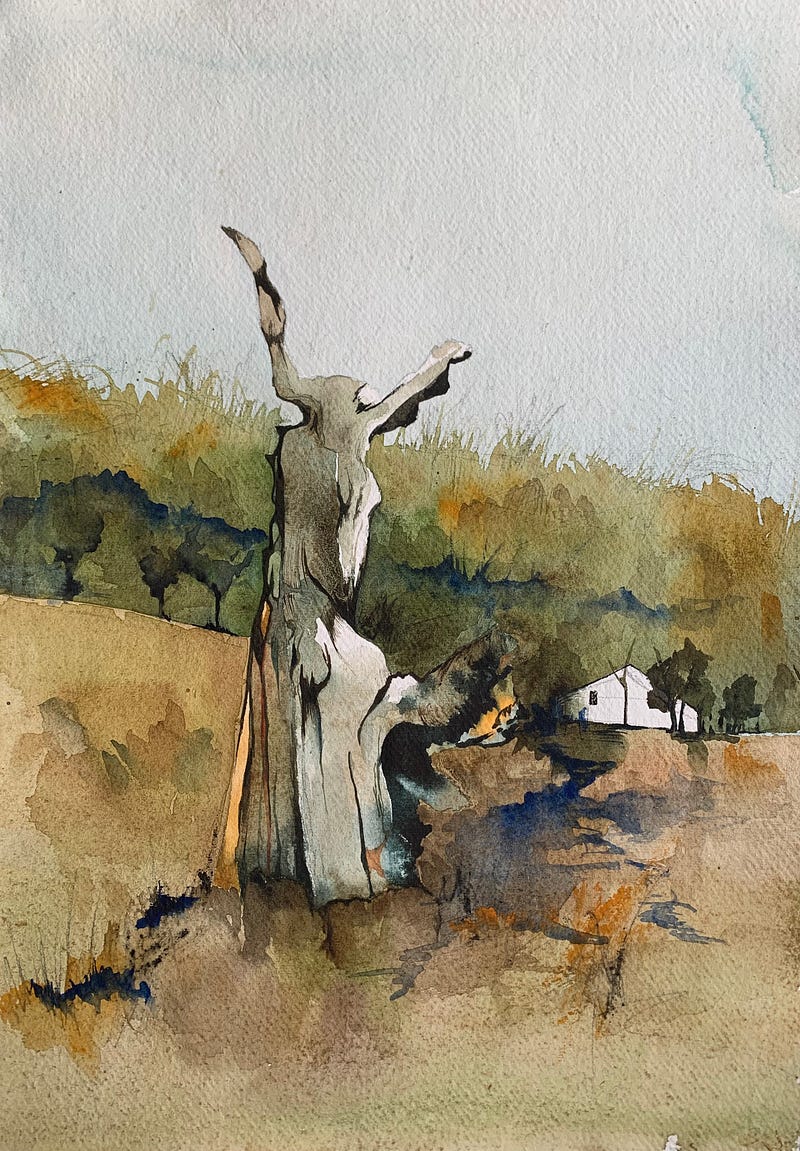
My interest in watercolour has led me to seek out artists who have managed to make the medium credible. The American Andrew Wyeth is one artist who succeeded — he is probably most famous for his painting Christina’s World (1948). The painting above — one of mine — owes a lot to Andrew Wyeth in its muted colours and subject matter.
So that’s how things are with me and my paintings.
So does it matter that I’m restive like this, not able to settle on a single style?
For me, I wouldn’t want it any other way. Ranging between mediums and genres means I never know what’s coming next — and the pathway ahead is full of surprises. There’s also great freedom in paying no heed to what an art market might or might not want.
Finally, there is a small part of me that wonders if I’m getting close to Edgar Degas’ proposition, that:
“It isn’t until the painter has no idea what he’s doing that he makes good paintings.”

My most recent book is Great Paintings That Tell Stories, an exploration of some of the most iconic artworks in history.
Would you like to get…
A free guide to the Essential Styles in Western Art History, plus updates and exclusive news about me and my writing? Download for free here.
Join me…
On Instagram for more great paintings on the go!