
Humming My Way to Higher Consciousness With Imaginary Bees
Who knew vocal toning would turn out to be so special?

The first sound to make is “uh,” explains the vocal toning tutor while glancing around the room. He has kind eyes, a short, neat beard ending in a point, and a playful disposition. I get the impression the “uh” should be guttural and low, kind of throaty, and I practice by letting out a lengthy “uhhh” that vibrates my lower region or base chakra.
I hadn’t heard of vocal toning until a few years ago. Before then, my knowledge of chanting was minimal. It was something hippies did, I thought, or serious new-age practitioners with deliberate, regimentally healthy lifestyles. I was neither, so I gave it a miss.
Now, having studied breathing exercises, vibration, and frequencies as part of my evolution of consciousness, it felt only natural to rethink my outdated assumptions and give it a whirl.
Next, it’s time to vocalize “oo,” similar to the sound made when we say “you,” the tutor remarks. Oo resonates in the second chakra, between the first chakra and the navel. I am surprisingly good at “ooing” and enjoy the buzzing sensation it makes in my abdomen.
Thinking about it, my interest in vibrations probably stems from wanting to increase my lung capacity. In my early twenties, I had a severe case of bronchitis that left me less able to breathe, even when I was supposedly better.
My GP tossed me an inhaler and told me to collect my repeat prescription every few weeks unless I needed it sooner. But I’m not asthmatic, I told myself as I left the surgery and walked to the car. It was then I vowed to expand my lungs in natural ways and regain my health.
My first remedy idea involved jogging. I thought about it for a while, picturing myself running around the city where I lived early in the morning or late at night when I had enough time. Even in my imagination, jogging didn’t work for me, though; my feet ached because my running shoes were poor quality, and back then, I couldn’t afford better ones.
The next idea was to swim. Again, I visualized the scenario in my mind, picturing myself driving to the communal pool and, this time, watching hundreds of kids splashing around, older adults doing water exercises, and serious young swimmers constantly overtaking me. Swimming, then, wouldn’t be my lung-expanding remedy.
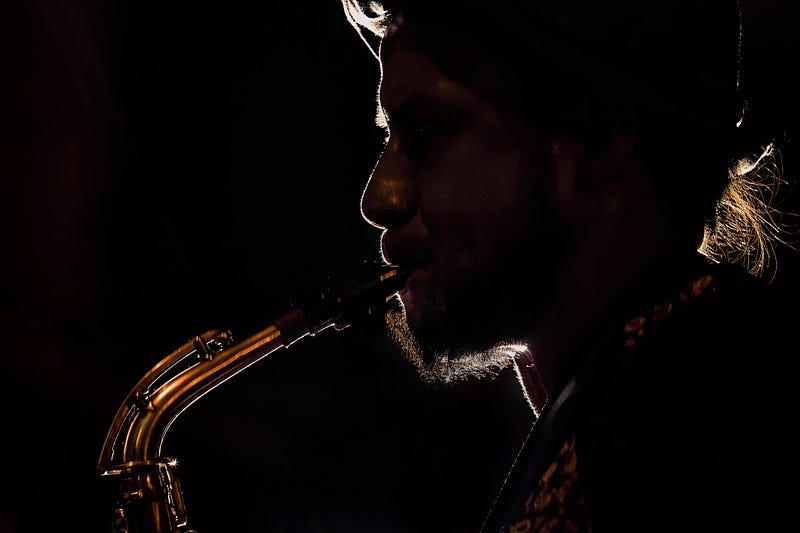
A few weeks later (when I happened to have money in my pocket), I spotted a saxophone in a second-hand shop and instantly knew it was the answer. If you’ve ever played one, you’ll understand how doing so gives your lungs a full workout. Happily, practicing did the job, although, of course, it doubtless wouldn’t work for everyone. I still have a sneaking suspicion I was misdiagnosed and didn’t have asthma, although the decrease in lung functioning after my illness was real.
The vocal toning tutor instructs his audience to say, “Oh.” I especially enjoy the vibrations this creates in the middle of my body or naval chakra. It’s clear that I could become a fan of chanting these vibrational sounds, and I imagine repeating the exercise regularly.
In my first vision, I see myself waiting for my husband, the dog, and neighbors to leave town for the day before I can begin. After all, vocalizing these noises will make me conspicuous, and people might laugh.
However, while I’m busy “oohing” and letting my imagination flow in real life, a group of dog walkers stops outside my window to chat. I hear them clearly, and they must hear me. But I carry on and discover I can, indeed, “oh” despite their presence and quickly get over my insecurity. “I’m fifty-five,” I tell myself. “If I can’t chant sounds fearlessly by now, I never will.”
Instantly, I imagine myself vocalizing whenever I want, and it’s liberating.
I kept my asthma inhaler in the top drawer for a few months, just in case I needed it, but I never did. I felt triumphant the day I threw it in the bin. Of course, I recognized many people did need their “puffers” and would have to keep using them. Knowing this made me see how fortunate I was to have this opportunity to handle my health my way.
“The next sound is “ah,” like “ma,” the instructor says. It resonates in the heart chakra, located in the chest’s center. Again, I like the warm vibrating experience, which this time spreads across my torso. I continue to “ah” seven times.
After taking up the saxophone, I began breathing exercises, too. Somehow, the practices went together because the better I could breathe, the better I could play, and the better I could play, the better I could breathe. When you get good at breathing to full capacity, inhaling and exhaling like a yogi seems like a good idea. Well, it did to me, anyway.
I read a few books on ancient breathing techniques to aid spiritual enlightenment (why not expand the soul while expanding the lungs?) and began strange practices before sleeping each night. My favorite book on the subject is The Amazing Secrets of the Yogi by Charles F. Haanel.

Aha, I’d think. It’s night. Time to close off my right nostril (associated with the sun) and inhale and exhale through my left nostril, linked to the moon, to aid sleep. I learned how we naturally breathe through one nostril or the other, depending on the natural cycle involved, and the benefits of tapping into the various associated qualities of nostril breathing.
Right nostril breathing, for instance, links with thinking, heating the body, and energy. Left nostril breathing links with calmness, intuition, and cooling the body. Blocking off the right nostril with the thumb when you’re anxious or in fight-or-flight can help you calm down, and blocking off your left nostril when you’re tired and need to keep going will raise your energy.
“The throat chakra sound “eye” is next,” says the tutor. I find myself wanting to sing like I’m engaged in a performance. However, the cheerful tutor tells us (his audience) to “let the sound flow without trying to perform.” He’s obviously met people like me before.
My relationship with breathwork is intermittent. Life often takes over, insisting I meet various challenges, and I forget some healthy practices I did before it intervened. When my life returns to a state of flow, I recall those things I did that kept me sane, like diaphragmatic breathing and one-sided nostril breathing, and do them again.
Now, we chant “aye,” much like “may” without the m, which resonates with the third eye. I imagine my third eye lighting up like a bulb after I flick the on switch. I notice it vibrates my nasal cavity and consider it’s probably an excellent remedy for sinusitis.
I like to practice diaphragm breathing, also known as abdominal breathing, while walking my dog. It’s tremendously calming to walk through the autumn leaves while focusing on your stomach as it expands when you inhale and collapses as you exhale.
Some people, like those with COPD (chronic obstructive pulmonary disease), can’t always do it well. For most of us, though, it’s an excellent way to reduce heart rate and blood pressure, aid relaxation, and increase oxygen in the blood.
Finally, we vocalize “eee,” as in “me.” By now, my whole body, especially my head, buzzes. The sound rings from my mouth, and I’m comfortably lightheaded, which, the tutor says, is “normal.” He seems a tad excited because we, his students, have reached a climax and are open to higher consciousness.
We spend about five minutes meditating after vocalizing to see if we have a mystical experience. At first, my mind is a beautiful blank. I see and hear nothing, and it’s the most relaxed I’ve been for a while. But after a few moments, I visualize a tunnel and experience the sensation of quickly moving along it.
Then, everything is blank again until I picture, most unexpectedly, a brown arm and hand reaching toward me and shaking my hand. The experience lasts long enough for me to look at our hands in detail, even noting the shape of the “other person’s” fingernails. They are round and flat and have large white half-moons.
The tutor says I should prepare to return to the room in a few minutes, so I tell whoever I’m seeing in my mind’s eye I am about to go. The next thing I know, I see the being’s hands clasped into a cup shape from which a swarm of golden bees stream toward me and fly down my throat into my belly.
Understanding that the insects are gifts, I say, “Thank you,” and slowly bring my awareness back to the present. I wiggle my fingers and toes. I begrudgingly open my eyes, wanting to meditate longer and knowing I will practice the sounds that hum like bees daily.


