
Part 2 of 3 | Chronicle of Artificial Intelligence
Humans vs. AI: The Face-off
The face-off between human intelligence and artificial intelligence
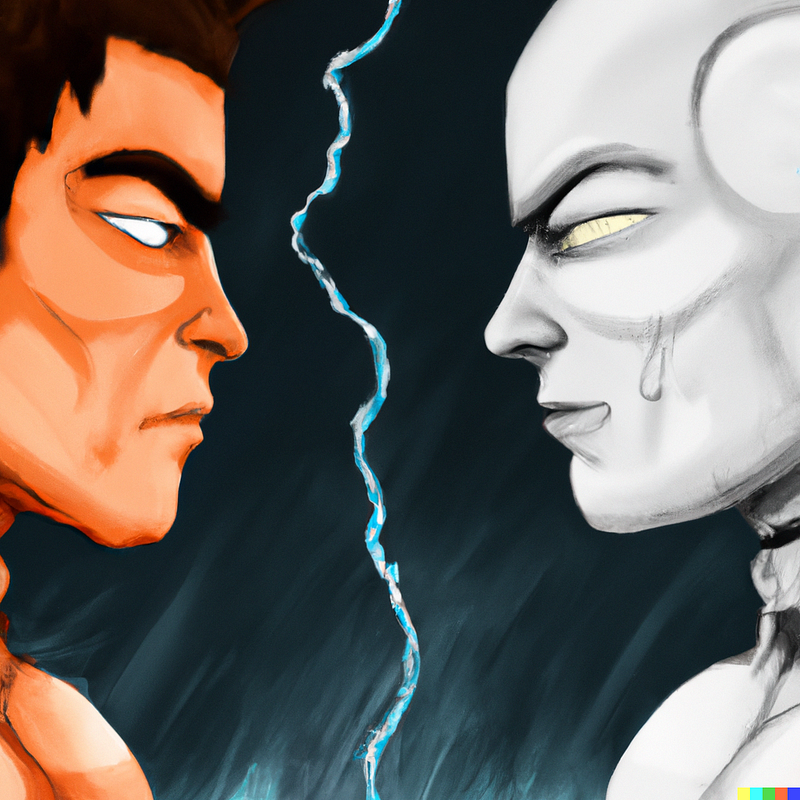
Now that humans created this magical thing called AI, what is next?
Humans were the only intelligent being known to humankind. Here we have another intelligent entity staring right back at us. So, the most natural response for the human creators was to judge and fear their creation. Along came some concerns and brow-raising incidents.
What happened when humans wanted to test their limits?
Or, in other words, what happened when humans tried to poke through the fears of being overthrown by their creation?
Let us find the answers and more in part 2 of our journey into Artificial Intelligence.
Part 1: Different groundbreaking developments that led to the current state of the AI
Part 2: Human Intelligence and Artificial Intelligence come head to head
Part 3: Dilemmas and predictions on the future of AI
In this Part, we will assess the capabilities of humans and AI. We will do that against some defining parameters.
Also, we will lay out the details of a few critical historical instances when humans and AI came face to face. These were when machines with deep learning algorithms faced their human counterpart.
But, before we move further, let us define some specific terms:
What is Human Intelligence?
Human intelligence (HI) refers to diverse and complex cognitive and mental abilities. It includes various aspects such as memory, perception, creativity, emotional intelligence, and social intelligence. These abilities make humans reason, solve problems and use languages to communicate.
What is Artificial Intelligence?
Artificial intelligence (AI) refers to the ability of machines and computer systems to perform tasks that require human intelligence. Tasks such as visual perception, speech recognition, decision-making, and language translation. AI systems use algorithms and machine learning to learn from data and perform better.
Differences between HI and AI:
Human intelligence is often regarded as the pinnacle of cognitive ability. But, this notion came under challenge with the advent of artificial intelligence (AI).
One of the primary differences between human intelligence and AI is their origin. Human intelligence is innate and developed through experience and education. In contrast, AI is programmed by humans to perform specific tasks. Humans can reason, learn, and solve problems using their innate cognitive abilities. While AI requires a set of rules and algorithms to perform particular tasks.
This section will further analyze these two entities’ qualitative and quantitative differences.
Qualitative Differences between HI and AI:
- Creativity: Humans can create originality and imagination with art, music, and literature. AI can only generate art, music, and literature based on pre-existing patterns and rules. In 2018, an AI system called AIVA composed a piece of music performed by the London Symphony Orchestra. The music was technically impressive and well-structured. But, it lacked a human-composed piece’s emotional depth and creative spark.
- Adaptability: Humans are very adaptable and can learn new skills and knowledge. In contrast, AI is limited to the tasks it is programmed to perform. For example, humans can learn to navigate new environments and solve problems. While AI is limited to the tasks it was designed to do.
- Emotional Intelligence: Humans can recognize and understand each other’s emotions. Whereas, AI is not capable of understanding human emotions. For instance, humans can recognize and interpret facial expressions, body language, and tone of voice to infer emotions. While AI relies on pre-programmed algorithms to recognize patterns. In 2021, researchers at MIT developed an AI system that could detect signs of depression in speech patterns with high accuracy. This technology can improve mental health diagnosis and treatment. But, it lacks a human therapist’s empathy and emotional understanding.
- Decision Making: Humans can make complex decisions based on intuition, experience, and emotions. But, AI makes decisions only based on pre-defined rules and algorithms. For example, humans can make ethical decisions based on their moral principles and empathy. While AI can make decisions only based on pre-programmed ethical principles.
- Multitasking: Humans are better at multitasking than artificial intelligence. In 2018, a study at Stanford University found that humans are better than AI at switching tasks. The study also showed Humans are also better at staying focused on many goals at once. It showed that humans could quickly and accurately shift attention between different tasks. While AI systems struggle with task switching. And AI is also more prone to errors when multitasking.
- Common Sense: Humans have common sense. This enables them to make judgments and decisions based on contextual understanding. While AI lacks this ability. For instance, humans can recognize that a person carrying a surfboard is likely headed to the beach. While AI may be unable to infer this without more data.
- Empathy: Humans have empathy. Which allows them to understand and share the emotions of others. Whereas, AI lacks this ability. For example, humans can empathize with a friend going through a tough time. While AI cannot understand the emotional experience of a human. In 2019, researchers at the University of Southern California developed an AI system that could generate empathetic responses in conversations with users. The system could use language and tone to simulate empathy. But, it lacked a genuine emotional connection with the human conversational partner.
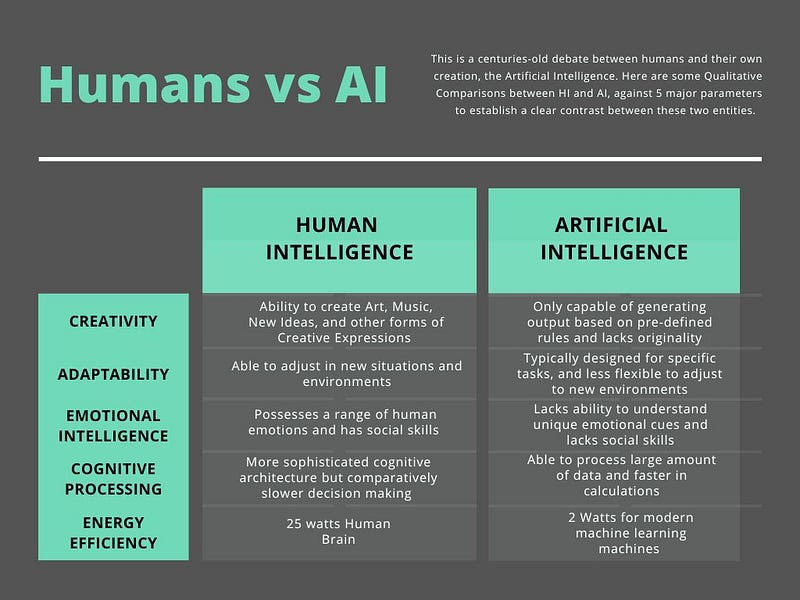
Quantitative Differences between HI and AI:
- Learning speed:
Artificial intelligence can learn faster than humans. For example, in 2017, Google’s DeepMind AI system AlphaGo mastered the game of Go in only three days. In contrast, it took the human world champion 20 years of practice to achieve the same level of expertise.
- Memory:
Artificial intelligence has a near-infinite memory capacity. It can recall more accurate information than humans. For example, IBM’s Watson AI system can store and retrieve vast amounts of data from various sources. This enables it to answer complex questions accurately.
- Speed and accuracy of calculations:
Artificial intelligence can perform complex calculations. And can analyze much faster and with greater accuracy than humans. In 2019, Google’s AI system achieved quantum supremacy. It solved a problem in only 200 seconds. Which would have taken the world’s fastest supercomputer 10,000 years to solve.
- Pattern recognition:
Artificial intelligence is superior to humans in pattern recognition tasks. For instance, AI can accurately identify faces, objects, and sounds from vast amounts of data. While humans may struggle with the same task.
- Precision and consistency:
AI is more precise and consistent than humans with repetitive tasks. For example, robotic arms in manufacturing plants can perform the same task with near-perfect accuracy. While human workers may struggle to maintain the same level of precision.
- Sensory perception:
Humans have superior sensory perception compared to artificial intelligence. For example, humans can perceive a wide range of colors, sounds, and textures. While AI may not be able to distinguish between subtle differences in sensory input.
- Scalability:
AI systems can be scaled up or down to handle varying workloads, which makes them highly adaptable and flexible. For example, cloud computing services such as Amazon Web Services (AWS) can provide on-demand computing resources to handle varying traffic and data processing needs.
The Judgement Day:
So, there are clear distinctions between human intelligence and artificial intelligence. But, who is superior? The creator that evolved through millennia? Or the creation that came from the imagination of human creators only centuries ago?
AI came on top in most quantitative parameters. Whereas they lost in most qualitative parameters to humans. There is actually no perfect or ideal conclusion to this debate.
But, they came head to head on many occasions to quench the curiosity and thirst of the humans. The results were a mix of decision-making precisions, which might surprise many of you.
Here are some critical instances of HI — AI Face off:
Chess: In 1997, IBM’s Deep Blue computer defeated the reigning world chess champion, Garry Kasparov, in a six-game match. This was the first time a computer had defeated a human world champion in a match under standard tournament rules.
Jeopardy: In 2011, IBM’s Watson computer competed against two former champions in the game show Jeopardy. Watson could answer complex questions and defeated both human contestants, winning $1 million.
Go: In 2016, Google’s AlphaGo computer defeated the world champion of the board game Go, Lee Sedol, in a five-game match. This was a significant milestone for artificial intelligence. As Go is much more complex than chess.
Poker: In 2017, an AI program developed by Carnegie Mellon University defeated four professional poker players. It was a two-week tournament of no-limit Texas hold ’em. The AI program, called Libratus, won $1.7 million in chips (Brown et al., 2018).
Video games: AI has also shown success in various video game competitions. For example, in 2013, an AI program called TD-Gammon defeated the backgammon world champion. Moreover, in 2018, an AI program called OpenAI Five defeated a team of professional human players in the video game Dota 2.
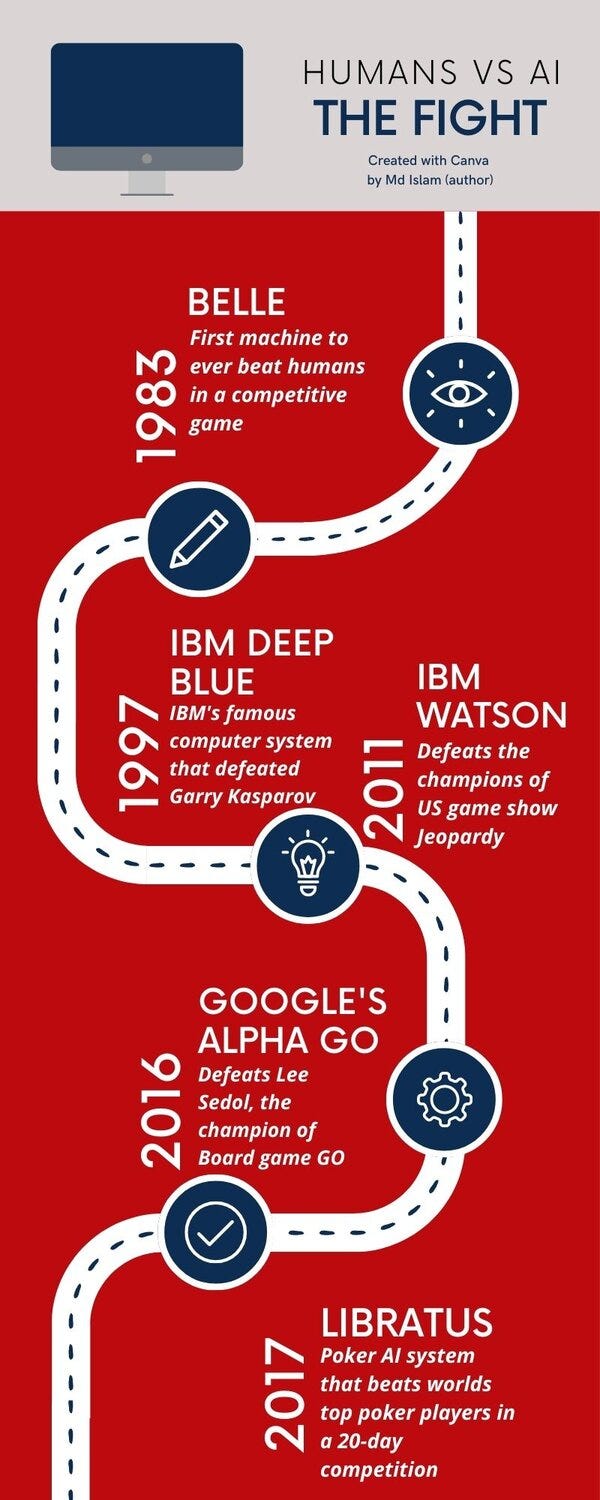
These examples prove how artificial intelligence has advanced in recent years. And it can even outperform humans in specific tasks. But, we must note that humans still have advantages in many areas. Areas like creativity, intuition, and emotional intelligence, which AI still needs to replicate. Moreover, here is how Humans ultimately Seize the day.
Chess: In 1997, IBM’s Deep Blue computer system defeated Garry Kasparov in a six-game match. But, in 2017, a team of two human players defeated an AI system developed by the DeepMind team at Google. Which used a neural network to learn from past games and predict the best moves.
Jeopardy!: In 2011, IBM’s Watson computer system competed against two human champions in the game show Jeopardy! Despite its superior speed and accuracy, Watson struggled with understanding the nuances of language. And making connections between concepts and was defeated by one of the human players.
Image recognition: In 2015, a human expert in a visual recognition task beat an AI system developed by Google called Inception-v3. The goal was to identify objects in a set of images. While the AI system performed well, it confused a toy with a real animal.
Poetry: In 2019, a human poet won a competition against an AI system called PoemPortraits. It generated poems based on user inputs. The AI system produced stylistically similar poems to human poetry. But, the human poet was able to create more nuanced and evocative poems.
In conclusion, the differences between humans and AI are vast and multifaceted. AI systems have demonstrated impressive capabilities. But, they still need to improve in many areas where humans excel, such as creativity, emotional intelligence, and intuition. As AI continues to evolve, it raises crucial questions about the future of humanity. And the role it will play in our lives.
Will AI surpass human intelligence in all or most areas?
Will humans only rely on AI systems to make decisions and solve problems?
Will humans find ways to harness the unique strengths of AI to achieve even greater heights of innovation and progress?
Find out more answers in Part 3 and what experts think or expect about the future of our co-existence.
Thank you for Reading!
Here’s more from me: