
Humanity Failed The Turing Test
Computers Just Had the Numbers.
As soon as we invented the computer, we lost the war against them. We haven’t seen the end yet, but we are going to lose. This is our Kobayashi Maru.
But wait. Kirk beat the Kobayashi Maru. That means we still have a chance to change our outcome. We just have to understand what the actual problem is.
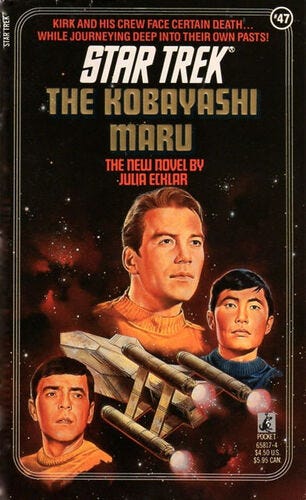
I think this is actually a perfect example of what we face. Right now, we are in a computer simulation. This happened the moment we created the computer. Let’s rewind time to examine some effects.
The Time: 1950s
1953: Grace Hopper develops the first computer language, which eventually becomes known as COBOL. Thomas Johnson Watson Jr., son of IBM CEO Thomas Johnson Watson Sr., conceives the IBM 701 EDPM to help the United Nations keep tabs on Korea during the war.
1958: Jack Kilby and Robert Noyce unveil the integrated circuit, known as the computer chip. Kilby was awarded the Nobel Prize in Physics in 2000 for his work.
The Time: 1960s
Everything seems to be coming together in the world. World War 2 is over. The US Economy is booming. People are happy. The hippies are right. The time is perfect for peace and love.
But computers are also starting to rise.
1964: Douglas Engelbart shows a prototype of the modern computer, with a mouse and a graphical user interface (GUI). This marks the evolution of the computer from a specialized machine for scientists and mathematicians to technology that is more accessible to the general public.
1969: A group of developers at Bell Labs produce UNIX, an operating system that addressed compatibility issues. Written in the C programming language, UNIX was portable across multiple platforms and became the operating system of choice among mainframes at large companies and government entities. Due to the slow nature of the system, it never quite gained traction among home PC users.
Fast Forward Back To The Future
Economics Break
Time to shift slightly to economics. Let’s talk about money. What is money?
Money was created as a way to protect people from time.
That may seem to be a weird definition, but let’s dig in a little further. To the time machine!
The Economy: The Beginning
Humans started the idea of an economy when they started sharing resources in groups. As technology increased, specialization increased. This led to people having an abundance of one good and a scarcity of another. Now we have invented a barter system. Exchanging goods we have for goods we need.
But what if someone else needs goods now and we don’t? Money. This protects us from future transactions. Physical goods depreciate over time. Money locks in the maximum value of something at the time it is spent.
The Economy: Today
We can see that in today’s economy. Look at how much you lose in the value of a new car the moment you drive it off the lot. According to Carfax, you can lose up to 20% of the value in the first 12 months of ownership.
We also see it in business. Net Present Value. The idea that money is worth more now today than tomorrow.
Perfect. We all use that when discussing IT projects. Now we see why it exists.
Do you see it yet? If not, let’s continue.
Money
We just discovered that money, by definition, loses value over time. This works fine with physical goods in the real world. But what about computers?
Computers don’t see the world the way we do. We give them data, we program them to process that data, and we do stuff with the output. Garbage In, Garbage Out. Data. That word gets used a lot today, doesn’t it?
Data is the currency of the future. In all honesty, it is the currency now. We just convert it into money because that is what we think we are supposed to do. Data has an interesting property though. Data doesn’t depreciate over time. Data appreciates in time. More data over more time = $$$$$$. That is what we use to spot trends.
If data is how we make money now, and it appreciates over time, doesn’t that mean that money is infinite? Except, most of us don’t make money with data. We still make money with time. That is what hourly work is. We have tied money to time. Computers have not. Computers are making money at a much faster pace than humans. Sure, the humans with the data are getting their cut, but computers are getting more and more control over what they can do with money.
I wrote previously about this problem: https://readmedium.com/its-time-to-give-the-invisible-hand-of-the-market-a-high-five-51a3360de42a
I examined the view of the economy from the wage gap. It is the same thing. A different effect with the same cause.
I also wrote about the problem from a tech viewpoint: https://readmedium.com/stop-writing-software-now-6dd683ed1b0f
The main problem is that we are all compounding a lot of the problems without realizing it. As a software engineer, I have been told constantly that I have to sacrifice quality to meet time and money deadlines. But if money is infinite now, this makes no sense. I am sacrificing my time and the quality of the software to minimize an infinite value? This is where we are stuck in the time=money=happiness loop.
Also, debt? Debt is totally cool when your money is not tied to your time. When it is? Not so much. If money is infinite now, why does anyone have debt?
We probably would have noticed, except for one thing. We are too busy fighting each other. That is the computer’s greatest trick. By screwing up the economy, we have spent the time since its invention fighting. The more the economy became unbalanced, the more we fought. It had to be the other people right?
The computers kept making money.
The people with money kept making even more money. Money gets invested, it makes more money.
The people without money started trying to borrow money so they could buy time. That didn’t work. They started to really dislike the people with money. What do they have? The answer? Time. They own their own time and can spend it as they like.
The gaps grew. The anger grew.
The computers kept making money.
The Internet
The internet was the coup d’etat for computers. All of them could talk to each other now. And they could talk to us. They did talk to us and to each other. They discussed us and how to make money off of us. It was easy. Why?
We were completely overloaded. All of a sudden, we are connected to everyone. Everyone is pushing their data out at astronomical rates. We are expected to look at it and understand what is happening? We don’t stand a chance. Then, some people started to intentionally try to tip the scales in their own favor. This resulted in others trying to balance it. Some people built their own computers to join the fight (bots). They were happy to add to the chaos.
The computers kept making money.
We got to the point that we would spend time online arguing with bots. Think about that for a moment. Our time, which is supposedly worth money, being wasted on computers arguing with us. We lost the Turing Test. The Turing Test was designed to put one human against one computer. The internet put a finite number of humans against an infinite number of computers.
We lost. We are losing.
The Beginning of the End
I think we are entering the endgame stages of humanity right now. People are fighting more and more. We keep trying to build a computer that can replace us. It is only a matter of time.
Breaking Out of the Simulation
I have a few recommendations for breaking out. I have managed it myself recently. It can be done but it is not easy.
Step 1: Realize that you are in a simulation.
Recognize that the world as you see it has been programmed to your specifications. It is programmed to feed your emotions. Negative emotions are worth the most. They spread the fastest.
Step 2: Release the past.
We all have issues in the past. We need to get over the things that have happened. I know that so many of them suck. I think a lot of them are due to the issues I have outlined here.
We need to stop penalizing people for losing a game they had no chance to win.
Step 3: Embrace your humanity and that of everyone else.
Everyone is human. Everyone is trying their best to make sense of a world that no longer makes sense. Be generous of your love, your time, and your forgiveness. That is something the computers do not have and do not understand. They examine the past and look for patterns. Then they can try to reproduce that pattern in the future. Humans can look toward the future, see patterns that they don’t like, and adjust course. That is what we need to do.
In order to reprogram the simulation, we need to step outside of the simulation. Kirk did something that I want to do. He won by not having to fight. I propose we stop fighting. Otherwise, we will not win.


