
Human-to-Human — Real Communication Skills That Should Be Taught in Schools
How to spot miscommunication and how to become a better communicator

“Oh, I misunderstood at the beginning. I thought you were asking for X, not Y.” “So funny, I thought you meant that I was [negative phrase]” “Why was I not informed about this?” “Ah, I see where we went wrong; I interpreted your comment about X as Y.” “You know, I completely took your comment the wrong way. My apologies for overreacting.” “I assumed you’d say yes.” “I thought you were upset with me, but it looks like you were just having a rough day.”
… on and on; the list can go infinitely.
In this article, I am not interested in public speaking or presentations. Rather, I want to dive deeper into our way of connecting to each other in what we call interpersonal communication. Or communication between humans.
The High Costs of Miscommunication: A Look at Different Industries
In the SaaS world, miscommunication can lead to some productivity loss, a few bugs, or upset clients. However, it can also create anxiety, stress, and employee turnover.
In more critical sectors like aviation or healthcare, communication errors can, tragically, cost lives.
Whatever the industry, an innocent mistake such as using the wrong word, not adapting your tone, or giving mixed signals with your body language has ripple effects that harm businesses and individuals every day. Effective communication is essential, no matter your occupation.
Look at the numbers
The SHRM think-tank reported that the [average cost of poor communication in large organisations (>100,000) is an estimated $62.4 million per year. Even when looking at smaller companies (< 100 employees), that cost comes to an average of $420,000 per year.
The Economist Intelligence Unit also looked at the impact of poor communication in the workplace. “Unclear instructions from superiors, pointless meetings, and other stressors can snowball into larger issues with widespread impacts on the business. Respondents say communication barriers are leading to a delay or failure to complete projects (44%), low morale (31%), missed performance goals (25%), and even lost sales (18%) — some worth hundreds of thousands of dollars.”
Now, let’s do something about it.
Defining Communication: More Than Just Words
Wait, let’s take a step back. What exactly is communication?
It’s not talking. It’s not speaking. It’s not only about the words; it’s not only about the message. Rather, it’s about the successful transmission of the message from one individual to another.
According to Bob Phillips in “101 Leadership Insights,” “communication is a process where information is passed […] via language, signs, symbols, and behavior.”
Effective communication is composed of three elements: words, tone, and body language, which mix together to create either an impactful communication situation or a complete flop.
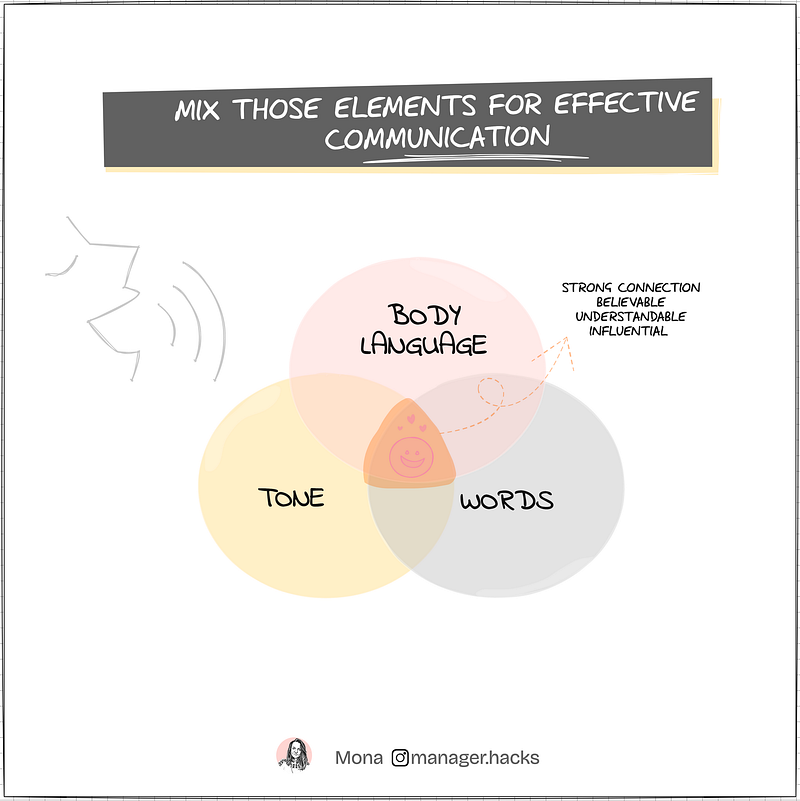
For example, when we congratulate a colleague for a job done well, but we use a monotonous tone (that could be more suitable for giving orders to Alexa), they wouldn’t feel any excitement and would even wonder whether to thank us or whether we are mocking them. Or, if we offer to help a friend move out of her flat but at the same time take a step back and look at our phone, she would get that we didn’t really mean it, and our message would come across as dishonest.
My Personal Journey: Learning the Importance of Effective Communication
When I was in my 20s, I rarely acknowledged my communication limitations. Maybe I used my young age as an excuse to make mistakes; maybe it was more important to move forward than analyse every situation. Maybe my direct style was more appropriate in the multicultural environment of London than in Paris, where I moved afterward. In any case, my self-awareness is now fully aligned, and I often cringe at the things I say or, rather, the way I say them.
Just two weeks ago, right before a much-needed 10-day vacation in Greece, my team was about to hire a new working student. With daily surprises on the candidate’s availability, contract requirements, and our own evolving workload needs, stress was high. On that day, at 6:30 PM, the direct team manager and I consulted our HR VP for a last-minute change we felt was crucial. Although I thought my words were well chosen, my hurried tone and body language betrayed my impatience. I was even wearing my coat, clearly ready to leave. In hindsight, I see how this could have come across as both aggressive and disrespectful.
These are only my examples, but they clearly show how a minor misalignment between words, tone, and body language can cause conflicts nobody needs.
Common Signs of Poor Communication: An Objective and Subjective View
Very well, I made a point that we are bad communicators. But how do we easily recognise the situations in which bad communication is happening?
Signals that a situation is a victim of bad communication:
1. Participants interrupt each other. 2. Participants take things personally. 3. There are no meaningful questions. 4. Body language doesn’t match with the words spoken
That felt very impersonal, didn’t it? If you didn’t manage to relate to any of those situations, let’s make it about yourself.
Signals that you are a bad communicator (and how to get better):
1. You interrupt others (maybe you think you know what they are going to say). 2. Basic conversations cause you to take things personally. 3. You never ask questions (and never get the information you need). 4. You are crossing your arms but offering to help.
If you recognise yourself in any of those situations in the past year, read on.
How Do You Become a Better Communicator
Now, I really wish they had taught us communication at school. While it won’t be possible to summarise what years of experience could teach you, take this checklist as a guide to get one step closer to great communication. This simple technique can foster a deeper connection. Just don’t mimic; adapt subtly.
1. Mirror the other person’s posture — this simple technique can help you connect personally with the person in front of you. Advice from me: don’t mimic; adapt subtly. 2. Paraphrase — ensure you’ve understood the message by paraphrasing what you’ve heard. 3. Every message should have a purpose. Even small talk serves a function. Being clear about your objective helps shape your message for effectiveness. 4. Adapt to your audience. That’s the key. Tailoring your message depending on your audience. With leadership, be concise; with junior colleagues, be more direct; with your team, aim for transparency. 5. Prepare. You might be a professional improviser, or like 99% of human beings — maybe not. When you know a big conversation is coming up, take the time to prepare. For example, for your one-on-ones( (whether you are a manager or an individual contributor), make sure to prepare in advance and make the best of the time allocated.
Take the Next Step
Effective communication isn't a soft skill; it's a critical skill. And like any skill, it can—and must—be improved.
Even if our educational system may not prioritise teaching communication skills, your self-development is in your hands. Use this guide as a starting point, and don’t hesitate to engage in further reading or even communication-focused workshops. The investment in improving your ability to communicate effectively is an investment in your professional future.
If you enjoyed this article, you may consider subscribing. You’ll get access to practical advice about management techniques, tools, and tactics.
You can also find me here: Twitter — Medium — Instagram — My Notion templates


