
Human Knowledge Through The Ages
What will we need to know in the Age of Artificial Intelligence?
This article is a sidebar to Part I of a four-part series, How To Be A Robot Psychologist.
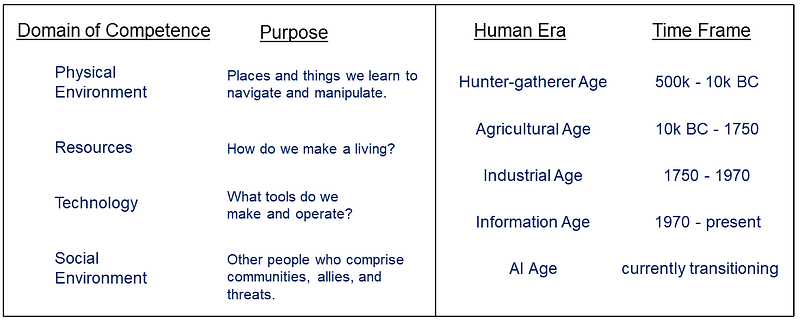
Here, we review the scope and depth of knowledge that humans have been required to master for our survival and well-being through the ages. The trend over time is that any individual, or even group of experts, has been able to comprehend and command relatively less and less about the expanding technology universe that civilization creates. The coming age of AI poses unprecedented challenges to our conception of how nature, technology, and mentally competent beings interact.
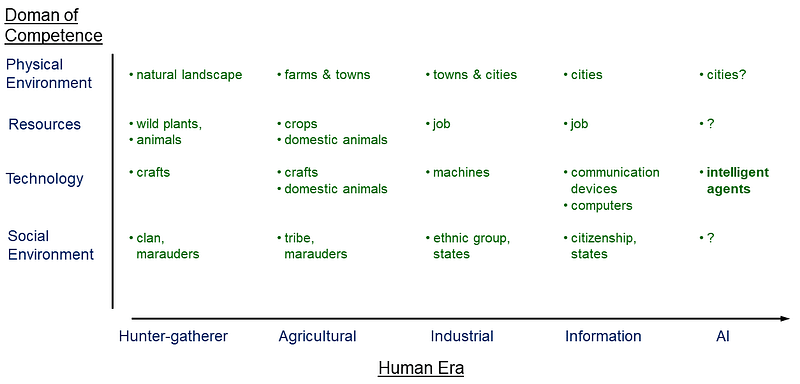
The chart below summarizes four domains of competence and their main concerns at five different eras of human history. For an in-depth discussion of this and related big-picture topics, I recommend the book, Sapiens, by Yuval Harari.
.
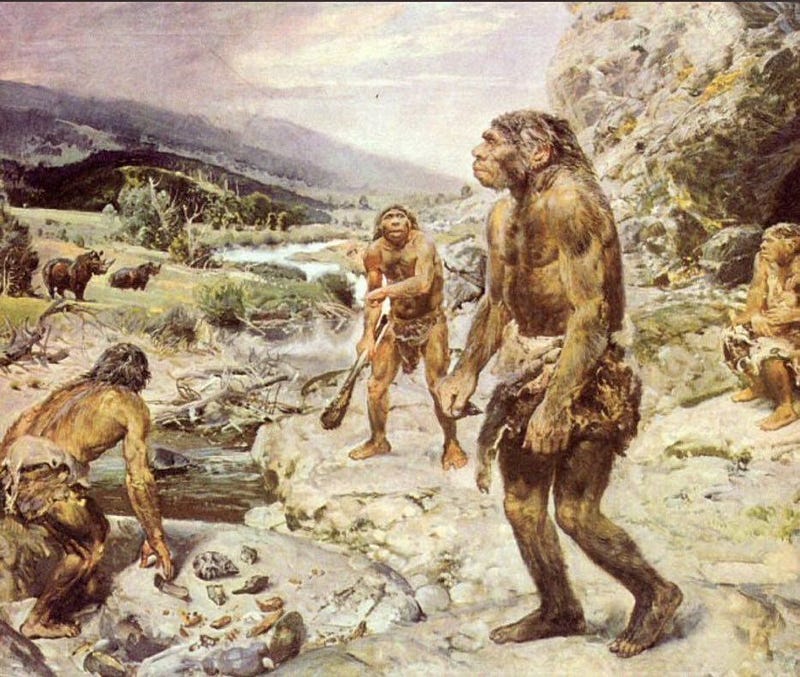
The Hunter-Gatherer Age required learning all about the natural landscape. Where can food, water, shelter, and raw materials be found? What pathways, barriers, and danger zones are traversable or to be avoided? How do the seasons work? Human youngsters learned the survival skills of exploiting wild plants and animals. Indigenous cultures taught craft technology such as baskets and spears to collect, carry, and store nuts and berries and grains, and to hunt and defend against animals. Children learned their social environment to be the extended family or clan. Neighboring groups were regarded as trading partners and allies, but also potential raiders, and sometimes bounty.
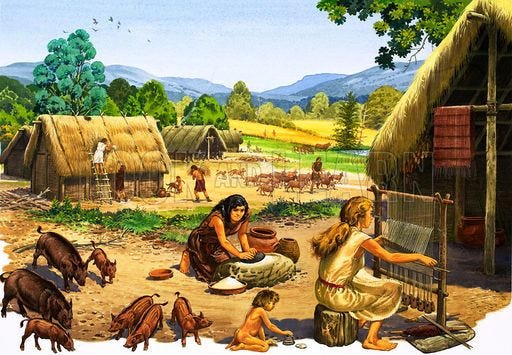
The Agricultural Age saw a transition from nomadic life to permanent settlements in farms, towns, and sometimes cities. Expertise developed in domesticating animals and cultivating crops. Craftspeople passed along specialized skills in implement-making, animal husbandry, metalworking, clothing, building, and weaponry. As food stores and other resources grew, people accommodated to hierarchical social systems that provided common welfare and defense. Citizens and compatriots learned allegiance to tribes and kingdoms.
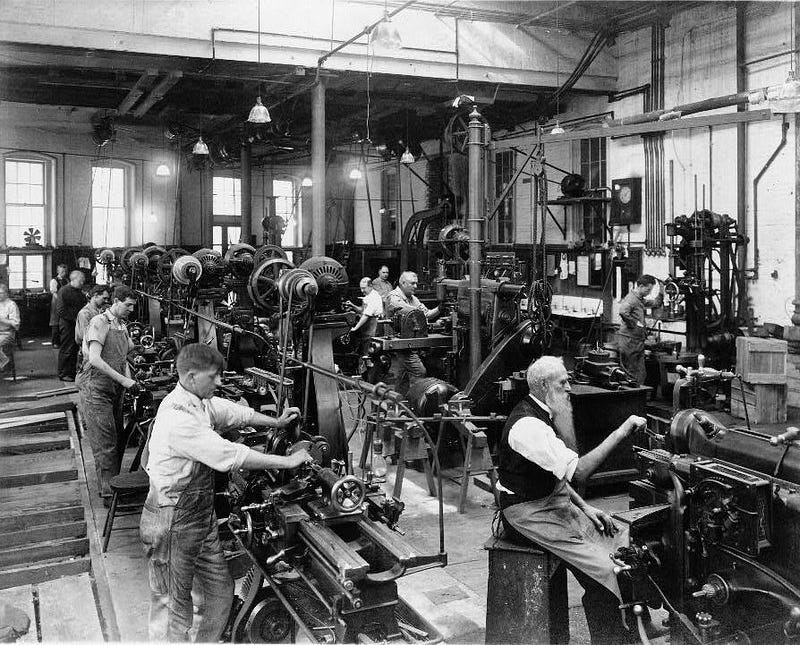
The Industrial Age saw large-scale migration from farms to cities, with their very different kinds of neighborhoods and navigational challenges. In place of living off the land, vastly more people learned to work in “jobs” and manage careers. As technologies matured for harnessing energy, building structures, conducting commerce, and designing and maintaining machinery and vehicles, people were driven to specialize in their knowledge and skills. Industrial age technology demands both physical skills and mental mastery of arcane facts and procedures about synthetic processes and devices. Which way does a screw turn? “Righty-tighty, lefty-loosy.” Nowadays we acquire hundreds of memes of this nature. The complexities of social organization require us to learn not only our families and local communities, but also work organizations, interest groups, political parties, and nation-states.
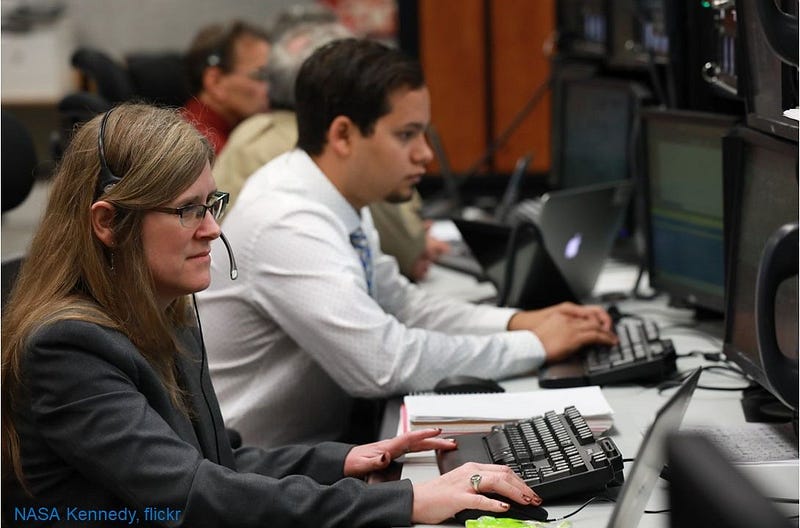
Today’s Information Age demands knowledge and skills far removed from our ancient pastoral heritage. Most people live and work in urban jungles or suburban gardens. Many of today’s jobs could not have existed even 50 years ago because they ride on computerized data and media, electronic user interfaces and displays, and intricate organizational rules and processes. We have learned to navigate a social landscape that extends far beyond people we ever meet or know, into virtual feeds and gathering places governed by “like” counts and viral celebrations and shaming rituals.
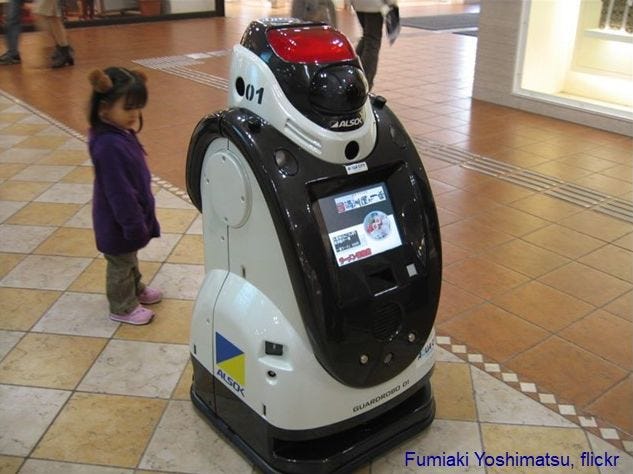
As we head into the AI age, the trend toward urbanization continues. Jobs will be lost not only to physical robots, but to automation of cognitive tasks. Economists debate whether AI will result in net fewer jobs, versus unimaginably different types of new job functions created by AI.
What is certain about the AI age, however, is acceleration of ever more sophisticated technology. Instead working alongside equipment and computer applications that we start and stop and are in control of on a fairly close basis, machines will operate with independent authority, on their own. Some of these entities will be physical robots, others will be purely information manipulators.
The complexity of technology threatens to overwhelm our comprehension. Let us slightly transform the chart of knowledge over the ages. Replace the vertical axis with another measure, the competence or mastery of humans relative to the complexity of the technology of the time. We’ll consider both the individual level, or what a normal person understood about technology, and also the mastery attained if you gathered a group of experts.
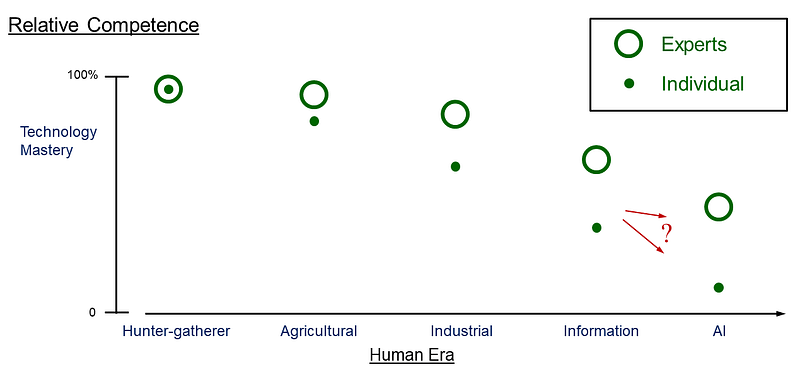
In the Hunter-Gatherer Age, individuals by-and-large were responsible for fashioning the handicrafts they used. Certainly there was division of labor, primarily between the sexes. So perhaps women specialized in basketry while men practiced chipping stones to make arrowheads. But there was no deep mystery to either skill. Everyone pretty much developed expertise equivalent with their peers.
The Agricultural Age saw some specialization of skills. Farmers made implements for tilling the earth and tending animals, while townsfolk learned the trades of metal-working, stone work, and assembling carriages, ships, and large structures. In each domain, skilled practitioners commanded the expertise of the time and could readily share it through apprenticeship.
In the Industrial Age, technological sophistication magnified and specialization deepened. For the first time, the diversity of technological expertise grew out of reach for the average individual to ever master. For any given topic, say, locomotives, telephony, mining, tractors, looms, or finance, expert engineers and managers were challenged to stay abreast of new developments arriving from all corners of the world. And for the first time, even a collection of experts could be overwhelmed by complexity and ignorance, as witnessed by numerous bridge collapses, train wrecks, and dam failures.
The Information Age has accelerated the trend toward our relative ignorance of the technology that surrounds us and sustains us. Most people have no idea how their phone works, what a website cookie is, or how water gets to a faucet. For decades of study and practice, we are rewarded with narrow slices of specialization. Even the experts in any topic have to confess unknowable consequences of what they do. When the electricity grid fails, it can take days to come back on line, followed by months of review to puzzle out what happened.
As we move to the AI Age, can ordinary people, or even experts, be expected to fully understand the technology of intelligent agents? Probably not. It might not be necessary. Somehow the organizational structures and educational apparatus of our society have sustained us into the Information Age. Perhaps we can continue to get away with ignorance.
But it might be wise to hedge our bets. We get along better with technology when we understand it.
The main article offers a guide to how we can gain understanding of the AI agents that are starting to appear around us. The AI age invites us to become Robot Psychologists.
Return to the main article Part I: How To Be A Robot Psychologist