avatarOmar Sanseviero

Summary

Hugging Face and Google Colab have partnered to streamline the use of notebooks hosted on the Hugging Face Hub, allowing users to execute them directly in Colab for enhanced collaboration and computing resource utilization.

Abstract

Hugging Face, a machine learning platform known for its vast repository of shared models, datasets, and ML apps, has integrated with Google Colab to enable users to directly open and run notebooks from the Hugging Face Hub in Colab. This integration simplifies the process of exploring datasets, training and evaluating models, and building demos by providing access to Colab's powerful computing resources, including GPUs and TPUs. The collaboration also emphasizes the importance of notebooks in the development process, as they serve as artifacts and documentation, improving reproducibility and lowering barriers to experimentation. Users can preview notebooks, track their history, and engage with community features on Hugging Face, while Colab offers additional functionalities like comments and sharing to facilitate effective collaboration.

Opinions

  • The integration of Hugging Face notebooks with Google Colab is seen as beneficial for the machine learning community, enhancing reproducibility and collaboration.
  • Hosting notebooks alongside models and datasets on the Hugging Face Hub is considered important for documenting the development process and aiding others in understanding and building upon shared work.
  • The ability to execute Hugging Face notebooks in Colab is praised for providing easy access to advanced computing resources, which can significantly aid in the execution and fine-tuning of machine learning models.
  • The community engagement features provided by Hugging Face, such as discussions and likes, are valued for fostering an interactive environment that supports shared learning and innovation.

Hugging Face notebooks x ColabšŸ¤—šŸ¤

Hugging Face is a collaborative Machine Learning platform in which the community has shared over 150,000 models, 25,000 datasets, and 30,000 ML apps. Throughout the development process of these, notebooks play an essential role in allowing you to: explore datasets, train, evaluate, and debug models, build demos, and much more. As such, the community has shared thousands of notebooks as artifacts and documentation of their development process on the Hugging Face Hub. Sharing notebooks as artifacts along with the models and datasets helps improve reproducibility and can lower the barrier of entry to experimentation.

With the latest Google Colab release, users can open notebooks hosted on the Hugging Face Hub! Let’s look at an example. At our welcome notebook, you can find a simple notebook that loads a dataset of illustrations and displays one of them. On Hugging Face, you can preview the notebook, see the history of the file (by looking at the commits and versions), and access community features such as discussions and likes.
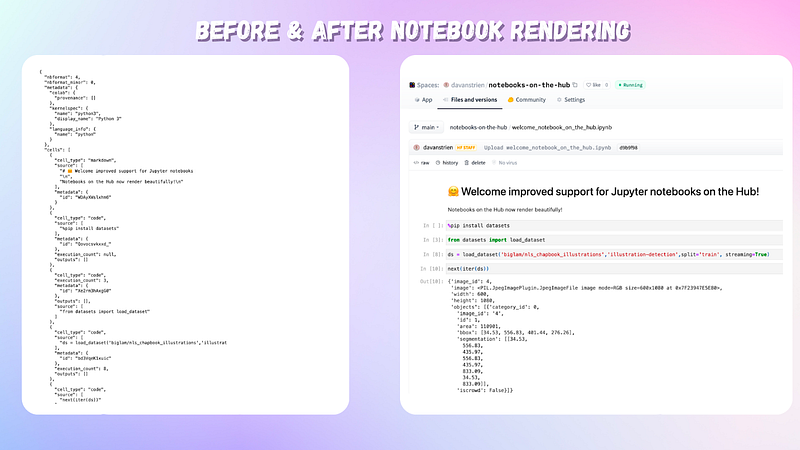
But what if you want to execute the notebook? That’s where Google Colab shines! You can open the same notebook in Colab. Colab provides a platform for executing notebooks using the most appropriate computing resources (including running on GPUs and TPUs) as well as enabling more effective collaboration through features such as comments and sharing. By clicking ā€œOpen in Colabā€ at the top right of the notebooks, you can open and execute them in Colab!

With this new integration, you can go from a model hosted on the Hub to a running notebook showing an example of fine-tuning the model in one click. Enjoy!

Machine Learning
Hugging Face
Open Source
AI
Artificial Intelligence
Recommended from ReadMedium