
The Pale Blue Dot Again — Professor Brian Cox & the Universe
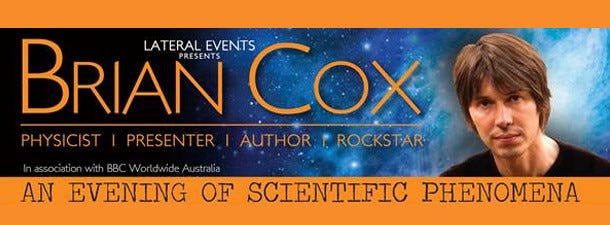
In August 2013 my partner and I went to the PCEC ( Perth Convention and Exhibition Centre ) to hear U.K. Prof. Brian Cox, Particle Physicist, talk about physics and the cosmos. The talk ran for 3 hours from 8pm to 11pm.
We were in Block 201 Aisle 6 and had Seat numbers 14V and 13V, so we turned to the left and up the stairs.
The Theatre is Perth’s largest tiered theatre and has been specifically designed to cater for a wide range of events including concerts, conferences, speaker presentations, ceremonies and graduations. It is capable of accomodating 2,500 people, and it looked to us like every seat was occupied that night.
The sound was excellent, even at the back of the Theatre, and the view was wonderful, thanks to the steeply inclined seats, which could even make one dizzy if you were prone to looking down from a great height at a thousand or so staggered seats in front of you.
I was quite excited as we have watched some of “The Wonders of Life” and “The Wonders of the Solar System” hosted by Brian Cox. There was a backdrop of beautiful stars which soon changed colours as it was imminent Prof. Cox was coming on stage. Then Adam Spencer, Sydney-based broadcaster, comedian, and media personality, the compere for the evening, walked onto the stage.
Adam gave a wonderful introduction to B. Cox assisted by a video montage broadcast on a big screen just behind and to the side of where Adam and Brian sat at a little round table on the Stage. The Introduction began with a significant year, being 1968 when Brian Cox was born and showed him over the years. It told about his early adventures with a Fuse Box and his penchant for Bus Spotting in the U.K. After that, came his foray into music and his stint as a keyboard player for the rock bands Dare and D:Ream ( whom sang the hit song “Things can Only Get Better ).
Brian Cox was greatly influenced by Carl Sagan’s “Cosmos” book. After D:Ream disbanded in 1997, Cox completed his Doctor of Philosophy in high energy particle physics at the University of Manchester. His broadcasting career with the ABC includes “Stargazing Live” to be released in Australia in September on Foxtel.
I learned that due to sudden inflation the Big Bang began something like 13.7 billion years ago from a teeny minute particle that had all the instructions or codes for matter and energy and Life in it. There was an explosion or inflation resulting in plasma, then a fraction of a second after this plasma “soup”of Quarks and Gluons, as the Plasma expanded and cooled, the “soup” became transparent. That is, Light or electromagnetic radiation was emitted more than it was absorbed, and as we probably all know light is made up of Photons or mass-less particles of radiation cum energy that carry electromagnetic forces ( the forces which exist between all particles with an electric charge).
There are 4 known forces or interactions in our Universe — gravity / electromagnetism / weak nuclear forces and the strong nuclear forces. You can read more about them at the web page below.
http://sciencepark.etacude.com/particle/forces.php
Brian presented a Chart or a Table showing the elementary particles of the Universe, including the following.
- Up quarks
- Down quarks
- Electrons and
- Electron neutrinos
Alongside these are two carbon copies of these particles with heavier weights, such as muons and taus, which are the counterparts of electrons. Furthermore there are 4 force carrying particles, such as Gluons, which are the force carrying particles of the strong nuclear force.
I found out from the online New World Encylopaedia, that the elementary or fundamental particles of matter are classified as fermions and bosons, and fermions are subdivided into leptons and quarks. I managed to find an excellent diagram of these fundamental particles on the Internet. Please click on the link below to see the chart.
http://www.livescience.com/13613-strange-quarks-muons-nature-tiniest-particles-dissected.html
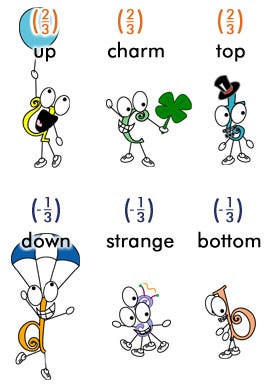
There is a fun representation of Quarks shown below. Click on the link for the Source to read how the names came about.
http://pages.towson.edu/zverev/conceptual/3.htm
In addition to the 16 particles listed above, there is the Higgs Particle.
The Higgs Field demonstrated by the Higgs Particle slows down or causes drag on certain particles, thus giving them mass which is really resistance to movement. It weighs them down. Brian showed us fantastic photos of The Large Hadron Collider in Geneva, which helped scientists to finally discover the Higgs Particle on 4 July this year, 2013.
Amazing pictures of the magnitude of this underground “atom smasher” or “particle accelerator” can be found at the link below. Have a look — it is pretty breathtaking.
Brian then showed us a map of the cosmic background radiation of our Universe which shows a cosmic mirror of our Universe’s interstellar map which emerged after the Big Bang.
According to PhysOrg.com, this Map (called the Cosmic Microwave Background ) also shows evidence that ours is not the only Universe. It can be a matter of semantics what is meant by the word “Universe”. Is it a self-contained sytem or is it “all that was and ever shall be?” I like to call the latter, the “Cosmos”, and to think that there are multiple Universes.
The multiverse concept stems from the idea of eternal inflation, in which the inflationary period that our universe went through right after the Big Bang was just one of many inflationary periods that different parts of space were and are still undergoing. Read more at: http://phys.org/news/2010-12-scientists-evidence-universes.html#jCp
Prof. Cox told us that Scientists know that more than 60 percent of the stuff or fabric of our Universe / Cosmos is called “dark energy” — and very little is known about what this dark energy acutally is. About 40 percent is made up of “dark matter” which is non-luminous matter, and the minority by far of the Universe consists of particles as we know them to be.
He showed us a Line Graph of something or other and pointed to an area showing a gap in knowledge which is mystifying scientists. It could either mean something not good is about to happen physically in our Universe, he explained, or that another Universe is touching or interacting with our Universe.
Of course, I like the latter interpretation. I have always believed that there are other, even parallel Universes or “Worlds” cum Dimensions, and amazingly, empirical Science may yet prove such.
Moving onto the Solar System, Brian explained that Earth’s Solar System is part of one Galaxy, and that there are estimated to be 350 billion Galaxies at least. Wowww!
He advised that both Mars and one of the Moons of Jupiter, Tito, have conditions suitable for Life, and that he believes Life may exist on either or both of these, but in simple form.
On July 19, 2013, NASA’s Cassini Spacecraft took a superb photo of Saturn showing Earth, 900 million miles away from Earth. Click on the Link below to see these truly amazing, awe inspiring photos, which certainly puts some perspective on the fact that Earth is but a tiny drop in the “ocean of the Cosmos”.
http://photojournal.jpl.nasa.gov/catalog/PIA17171
In 1990 Voyager One took a photo near Neptune showing a blue dot ( and the photo is called “The Pale Blue Dot” ), which Brian showed us on the big screen, but I couldn’t see Earth, it was that small.
http://visibleearth.nasa.gov/view.php?id=52392
http://www.planetary.org/explore/space-topics/earth/pale-blue-dot.html
Prof. Cox told us that NASA’s “Curiosity Rover” landed on Mars 12 months ago on 6 August 2012 and continues to gather invaluable data and photos there. See page below for photos.
http://www.theatlantic.com/infocus/2013/08/one-year-on-mars-the-curiosity-rover/100567/
He also touched upon the SKA in Australia and South Africa or the Square Kilometre Array, which I have been very interested in and am following its progress. The Square Kilometre Array project is a global science and engineering project to build the world’s largest radio telescope.
The project is led by the SKA Organisation, a not-for-profit company with its headquarters at Jodrell Bank Observatory, near Manchester, UK. The organisation was established in December 2011 to formalise relationships between the international partners and centralise the leadership of the project. Members of the organisation can be found at THIS page.
http://www.skatelescope.org/the-project/
It is anticipated that construction of the SKA will take place from 2018 to 2023. For more information about SKA in South Murchison, Australia, please click HERE. The SKA will help find out how Galaxies evolve, by mapping the cosmic distribution of Hyrdogen, and what “dark energy” is.
Brian said that the SKA will enable airport radar on alien worlds to be detected up to a distance of 50 light-years away.
Last but not least, especially because I have trained as a Biologist, and I love David Attenborough’s Programmes and B. Cox’s “Wonders of Life” series, I really liked Professor Cox saying that:
Life and Matter is amazing and inextricably interconnected.
Let’s appreciate it.
Originally published at starstruckworld.wordpress.com on August 11, 2013.