
Hsiang Yu and The Lesson Learned from Crushing Your Rivals Completely
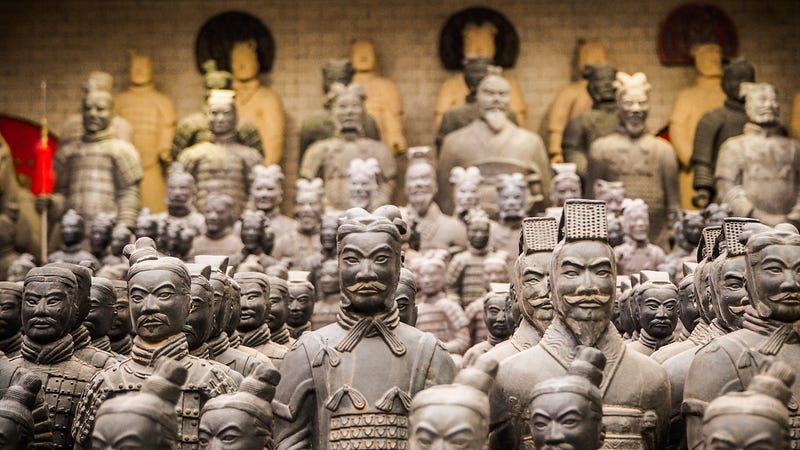
In 208 BCE, Hsiang Yu was a general of the Kingdom of Ch’u. The Ch’u kingdom had existed for hundreds of years but had recently been occupied by the neighboring kingdom of Qin during Hsiang Yu’s childhood. His grandfather and father had both fought the Qin and he came of age just as the Ch’u had succeeded in rebelling against Qin and proclaiming a new king. Hsiang Yu would spend most of his life fighting against the remaining Qin forces, but also against his own rivals in the newly independent Ch’u kingdom.
Hsiang Yu was given orders by his king to invade the neighboring kingdom of Ch’in who were allied with Qin. Another general, Liu Pang, was given command of another army with similar orders. The king promised that whoever managed to first enter the capital Guanzhong, would be granted the title “King of Guanzhong.” Liu Pang won that contest, and when Hsiang Yu arrived, he was so angry that he planned to assassinate his rival.
These two generals had once been friends, but this contest had pitted them against each other. Over the course of several campaigns, they became bitter enemies. Hsiang Yu being fearsome and violent, but also a very capable general, succeeded several times in cornering Liu Pang. However, each time he took pity on his rival and let him escape or pardoned him, even though his advisors told him to not be so merciful.
The Rivalry Grows between Hsiang Yu and Liu Pang
Hsiang Yu was a crafty general and succeeded on the battlefield. He appointed trustworthy men to replace the leaders of the places that he had conquered and continued to consolidate his power. Eventually, he moved the king to a remote location, effectively deposing him and then he later had him assassinated. His old rival, Liu Pang, was reassigned to a remote district. However, he chose not to kill him, and this would prove to be a mistake. Hsiang Yu’s rule was violent and despotic and few people liked him. Liu Pang used this to gain influence and gather Hsiang Yu’s enemies to him.
In 206 BC, Liu Pang attacked. Hsiang Yu was embroiled in campaigns against Qin so this should have been an opportune time for Liu Pang. However, Hsiang Yu prevailed and routed Liu Pang. It was a total defeat and Hsiang Yu could have finished off his rival and be done with it. Unfortunately, his counterattack was half-hearted and this allowed his rival to escape. Perhaps Hsiang Yu believed that Liu Pang was no longer a threat, but his advisors warned him that this was a mistake.
Liu Pang regrouped in the East and consolidated leaders who had fled from Hsiang Yu’s abusive rule or who had lost their lands to him. This allowed Liu Pang to form a coalition. While not strong enough to defeat Hsiang Yu in open battle, it was strong enough to withstand an invasion. Hsiang Yu was not deterred and this led to the battle for the city of Xingyang, where Liu Pang was besieged and heavily outnumbered. Hsiang Yu was on the point of capturing the city when they surrendered, but this gave Liu Pang just enough time to once again make his escape and again, Hsiang Yu did not pursue him.
The campaign had been costly for Hsiang Yu and it was far into enemy territory. As it happened, he had managed to capture valuable hostages, including Liu Pang’s father, whom he threatened to boil alive. Liu Pang appealed to their past friendship and was able to convince him to choose another option. He suggested a truce, and because of the difficult position that Hsiang Yu was in, he had no choice but to agree. It was called the Treaty of the Hong Canal, dividing China into East and West. This was worse than a Pyrrhic victory for Hsiang Yu because his rival had once again escaped unscathed and this time even managed to force a peace treaty out of it. Hsiang Yu marched his troops home but in shame.
The next time Liu Pang took the initiative. He immediately tore up the treaty and took the opportunity to quickly attack the exhausted army retreating out of the kingdom. He even recruited neighboring generals to join the battle and the plan was to attack from three sides. Unfortunately for Liu Pang, the neighboring generals were fearful of Hsiang Yu’s power and his reputation for cruel vengeance, so they were half-hearted in supporting Liu Peng.
When the battle Battle of Guling started, only Liu Pang’s forces arrived on the battlefield. Hsiang Yu was able to counter-attack and again soundly defeat his enemy. Liu Pang had no choice but to withdraw but with heavy losses. Like before, Hsiang Yu did not pursue, but historians are puzzled by this decision. Perhaps it was that his troops were too exhausted, or perhaps he was hoping to keep the treaty, or maybe he still harbored some forgiveness for his former friend, but he ordered his army to turn around and continue home. This would be the final opportunity that Hsiang Yu would have to capture Liu Pang.
In early 202 BCE, Liu Pang again convinced his neighbors to join him in a campaign to defeat Hsiang Yu. With another 3-pronged attack, they fell against Hsiang Yu’s still weak army. They used psychological tricks to further demoralize their enemy. Never one to back down from a fight, Hsiang Yu was eager and ready to end this war once and for all, but his army was not. The battle of Gaixia was a lopsided one from the start. With desertions and slowly depleting numbers, it was clear that this battle would only have one ending. Towards the end, only a few men were left standing and they fought on valiantly, until finally, only Hsiang Yu was still able to wield a weapon. Before being captured he slit his own throat and his body was torn to pieces by enemy troops hoping to receive a reward.
As a result, Liu Pang eventually won the war, crowned himself emperor, and founded the powerful Han Dynasty that we remember today. Hsiang Yu’s rule over Ch’u, on the other hand, is hardly known. Despite eliminating the former king, making himself the supreme ruler, and winning almost every battle, he is largely forgotten to history.
Lessons Learned
Once Liu Pang finally succeeded in gaining enough strength for an attack, he was quick to attempt a decisive victory. Hsiang Yu was not easy to defeat, and Liu Pang was checked several times in the attempt, but he was relentless. While Hsiang Yu would always let his rival slip away, Liu Pang had no such reservations. The lesson here is clear: crush your enemies completely. This is a lesson that other generals throughout history, from Sun Tzu to Alexander, Caesar, Napoleon, Clausewitz, and Patton clearly understood.
There is another lesson here that should be noted. It’s a lesson not just for generals on the battlefield but also for anyone interested in leadership. What Liu Pang and these other more successful generals have in common is an appreciation for the lessons of the past. Hsiang Yu, although born into aristocracy, was a brash, violent and tyrannical leader. He was not an educated man other than with a weapon. He did not listen to his advisors, those who’s job it was to know the past. To be a great leader is to learn from the mistakes of others so that you don’t make them yourself. As Liu Pang showed, it is the way to win in the end.
As a business leader today who is responsible for groups, teams and resources, it becomes important to pay attention to what came before; that is, to know history. In 3rd century BCE China, failure meant being torn to bits on a battlefield, boiled alive after the battle, or die in some other gruesome execution when captured. Thankfully today’s workplace is a little kinder but failing on a large project or as a leader, can still feel like a slow boil that only ends in bad-tasting soup.
If you liked this story and would like to know when I publish more, then consider clicking on the little envelope icon under my picture.
If you are not a member of Medium yet, and don’t want to be limited to just 3 free stories, then consider becoming a member and supporting all the great writers here: https://medium.com/@tijmenal/membership.


