
How Your Time Focus Can Affect Your Growth and Productivity (and What to Do About It)
Lessons from a psychologist and two productivity experts

A life well lived is the best antidote to that fatal truth. Be active, not a passive worrywart. Find magic in the moment, joy in making someone smile. Listen to a lover’s sigh; look into the dancing eyes of a child you made feel special. Most of all, marvel at the wonder that eons of evolutionary time and all your unique experiences have joined to comprise the symphony that is YOU. — Philip Zimbardo — The Time Paradox
Imagine for a second you are a teenage male riding the bus. You see a gorgeous girl get on the bus. You try to wrack up the courage to speak to her but can’t seem to bring yourself to do so. You don’t know what to say. You don’t know how to naturally sit closer to the girl without looking like a creep. To your delight, you see the girl get off at the same stop as you. Just when you are about to go your separate ways (where you realize you may never get to see the girl again), you walk up to the girl, tell her how pretty she is, and then ask if she would like to get a coffee sometime. She looks at you in disgust and says, “No.” Although the experience was not positive for you, you shake it off and forget about it. A few weeks pass, and you again see a girl get on the bus that you would like to talk to. Again, you build up the courage and approach her, and again, the girl says “No.”
If you gave it some thought, you could probably think of the different ways people think about time. People can be future-oriented, present-oriented, and past-oriented. But in fact, Philip discovered that the past-oriented thinkers could think of their past in two ways: positively and negatively.
If you were the teenage male in the situation above, you could look back at the two experiences in different ways:
- You can think of them as learning opportunities where you learned something about yourself and that it might not be the best idea to approach women as they are walking home.
- You can think of them both as failures and that you’re ugly and no woman wants to go out with you.
In one case, you think about your past as ‘failures’ and have a past-negative-oriented way of thinking. On the other, you think of your past as ‘learning opportunities’ or ‘interesting experiences’ and have a past-positive-oriented way of thinking.
Why being past-positive-oriented or past-negative-oriented matters
In a study with American veterans (a group of people with high depression and suicide rates), therapists found that veterans largely focused on their negative past. They were past-negative-oriented (and by the way, they were also present-oriented). And when you are in this time perspective, you can easily catch a hamster. What the heck is a hamster?
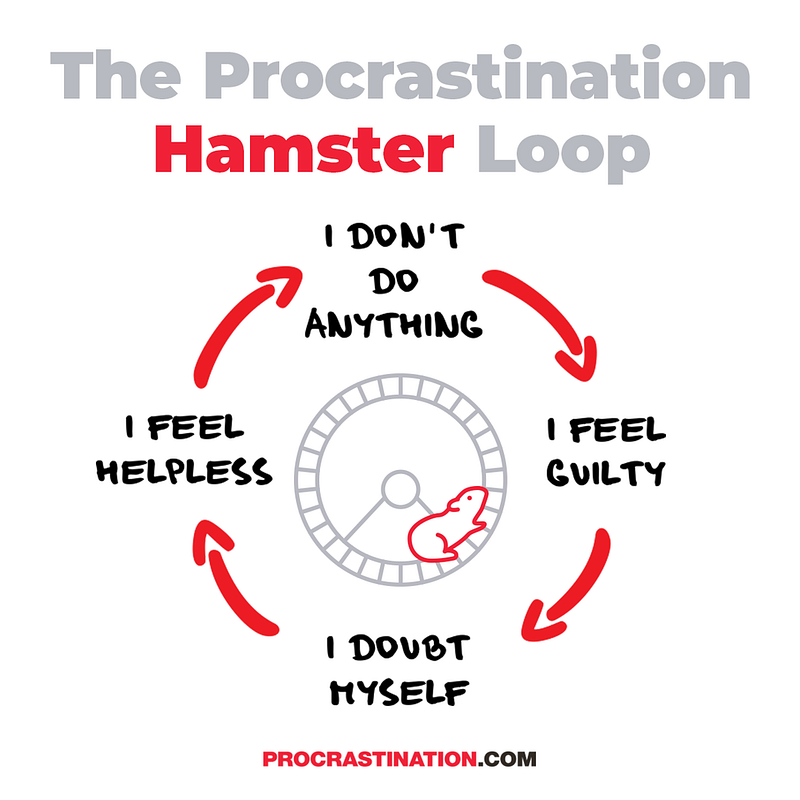
You may have caught this hamster yourself. I know I have: I make a mistake at work (I feel guilty), think I am a big imposter, and nobody should have hired me (I doubt myself), I have no idea what to do (I feel helpless), and so rather than unconfidently doing one small thing, I sit and wait (I don’t do anything).
In fact, it’s this same mechanism that saps your energy and motivation for getting work done. You think about how much work you’re not getting done. You tell yourself even if you start now, you’re not going to get it all done, so why bother. You feel overwhelmed with how much work you have. So you don’t even get started.
Two ways to short-circuit your hamsters and become more productive
I am about to share the two tools come from The End of Procrastination by Peter Ludwig and Adela Schicker, two productivity experts. These tools help you get out of your time perspective, where you might easily catch a hamster.
Tool #1: Developing a vision
With the veterans, the researchers reminded them of the value of time and asked them what they would like to devote their time to. You can do the same thing — think about 10, 20, or 50 years down the road. What would you like to be doing? What would give your life meaning? Is it spending time visiting the countryside? Is it being with family? Is it giving back to kids through teaching and lectures?
And if you need more motivation? This video always gives me a push in the right direction:
Tool #2: Switch from being past-negative to past-positive
Even though the veterans had a vision and were becoming more future-oriented, if they failed, they would only add to their past-negative experiences, so they had to learn how to change the way they saw their past from negatives to positives.
The tool to do this? A flow-list.
A flow-list is where you, in the evenings, write three positive things that happened to you and then next to those three things, write on a scale of 1 to 10 how happy you felt that day (10 being the greatest happiness imaginable, 5 being average, and 1 being very little happiness).
For example, one of my recent entries:
- Finished a LinkedIn Learning course, Exercised for 20 minutes, Hugged my partner — 8
The flow-list helps you practice gratitude, and you already know it changes your brain.
But another benefit of the flow-list is it helps you re-live all the positive things that have happened to you in your past, and rather than viewing your past as negative, putting things into a positive light.
Takeaways
- Everybody has four different time-perspectives they can take on: future-oriented, present-oriented, past-negative-oriented, and past-positive-oriented.
- When people are present-oriented and past-negative-oriented, they can get caught into ‘hamster’ thinking.
- To get out of being present-oriented and becoming more future-oriented, develop a vision, and remind yourself of your vision often.
- To get out of being past-negative-oriented and becoming more past-positive-oriented, use the flow-list tool, or in other words, a gratitude list of great things you experienced and how you felt that day.
“Be happy for this moment. This moment is your life.” — Omar Khayyam


