
How You Can Quit Work Using Nine Unique Forgotten Steps
Financial Independence: How I Retired from the Rat Race By Using Your Money or Your Life: 9 Steps to Transform Your Relationship with Money
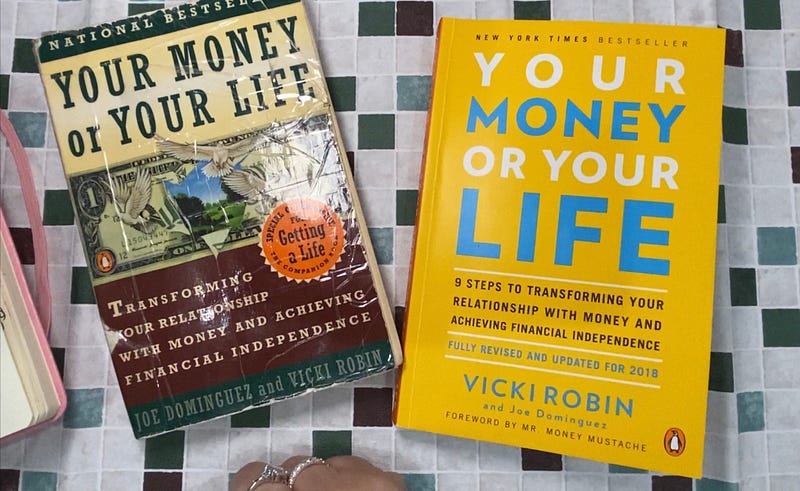
This is a review of Your Money or Your Life (YMOYL), by Vicki Robin and Joe Dominguez, second edition. I read the first edition, our financial bible, back in 1999, and followed the steps with my husband in 2004 and 2005. I quit the rat race at age 38, using the steps from the book. Quitting or retiring from the rat race did not mean I quit work, I worked only half a year and volunteered or traveled the other half with my husband. This book, and the steps within it, transformed our relationship with money.
You Can Achieve Financial Independence Too!
I believe it is possible for you as well to do these steps, get out of debt, and get a better relationship with money. Even if you are not in debt, but you do not want to be spinning around the hamster wheel forever, these steps will help. I believe in you!
The Second Edition YMOYL 2018
I read the second edition to the book in 2022, well after I had reached financial independence, which is called FI in the books. While I have never met Vicki Robin in real life, I took training in 2011, and read Mr. Money Mustache blogs in 2014 and 2015. Most of his followers follow the FIRE, Financial Independence, Retire Early movement. These are younger people who want to do something different than the 9–5 job and make a difference in the world. I applaud them as well.
At the very beginning of the new YMOYL, there is a story called The Turtles and The Hares. This story is not in the old YMOYL. Joe was like the hare, with a timeline to get to FI while Vicki was a turtle, slow and methodical, moving towards Financial Independence.
Overall Differences Between the Books
- The font is larger in the new book with a Georgia font, while the old is Times New Roman.
- There are less “tips” for frugality or saving money
- Some stories are similar, with increased salaries, but without the full names
- More spending categories in new than old
- Talks of different new movements that the old book did not have, such as Take Back Your Time and Slow Food movements.
- Catching FIRE vs The Pot of Gold at the End of the Wall Chart, of chapter and step 8, the crossover point. There are several new parts in this chapter, including the ABCs of Natural Wealth, and compounding interest.
- Lastly, the old talked about US Treasuries 30-year bonds only; new talks about several different methods to stash your cash.
What I Found Interesting, Different, and Similar in the Books
While the first book had definitions for three FIs, the new one had four: Financial Intelligence, Financial Integrity, Financial Independence, and Financial Interdependence, doing for one another, creating with one another, is what makes our lives rich.
The content overall is still the same. Instead of saying, “I am a writer”, I would say, I write as a job. I am a person, and I work in this area for my money. I found the happiness levels they looked at in both books the same, we are not very happy Americans. They also dive into the environmental and sustainability of the world, and how consumption is ever present.
I forgot that the creation of the word “Consumers” happened during the Hoover Administration, where the first “standard of living” phrase came about and how it is a marketing ploy to get people to work more.
The First Step: Making Peace with the Past:
No Shame, No Blame helps people look over how much they earned over their entire lifetime. And then the balance sheet, what do you have now, my husband and I completed in 2004 and 2005.
The Second Step: Money Ain’t What it used to be and never was:
This was a major upgrade. She took what Joe said and condensed to make it easier to understand. Basically, we all have a certain amount of time on the earth, not just in years but in hours. This step tracks your hours as life energy. The first part is your actual costs in time and money to compute your REAL hourly wage.
The second part is to track EVERY penny coming in AND out of your life. We have been doing this part since 2006/2007. We did take a break in 2020/2021 when we were building our new home, but I started it back up in 2022. I had missed doing it, and felt I needed that structure back.
Only a few changes here, such as Daily Money Log in the old, while Notebook in the new. The checklist was funny, in the old, they talked about meeting with a color consultant! I actually did something like that back in the early 2000s, it was a big deal so that you could pick the right colors for your skin tone. So funny!
The Third Step: Where is it all going?
Figure out your categories such as Food, Clothing, Housing, Transportation. I ultimately came up with eight this year, but when we started, I believe I had 12 to 15 different categories, as I had my own business.
But the most important part is seeing your true hourly wage and showing how many life hours you are spending per category. This is one of the biggest surprises of them all. When we did this step, we realized how much time we were working to pay off the mortgage, not for the fun of living.
The Fourth Step: How Much is Enough The Quest for Happiness (New) / Fulfillment (Old)
Vicki goes between the two words of Happiness and Fulfillment in the new book. That is fine, because the content is still the same.
The THREE QUESTIONS of Step Four that will Transform Your Life!
- Did I receive fulfillment, satisfaction for the life energy spent?
- Is the expenditure in alignment with my values and life purpose?
- How might this expenditure change if I did not have to work for money?
We went through these questions after tabulating each month’s expenses, with three extra columns per category. We found we did not want a mortgage, and all the stuff that came with it.
You know, the two-income family who pay for cleaning the home, landscaping, handyman, utilities, dry cleaning, all of the services needed to work and live. We did not want that.
This part was mind-altering for us, and allowed us to stick to the program to realize we did not need any of it.
The Fifth Step: Getting it out in the Open
People are so worried about what other people think about money. But instead, even if your own family sweeps the talk of money under the rug, you can bring it out and talk about it sensibly. The making of the Wall Chart and becoming a Super Saver. Showing on the Wall Chart the income and expenses every month.
This is where the new book shines. They talk about having groups talk about money together, to help each other. I took the training in 2011, and hoped to make a go of it, but instead, I learned a bunch, but kept working for the National Park Service as a seasonal park ranger instead.
The Sixth Step: The American Dream — On a Shoestring
While the step did not change, the information on how to keep expenses low did. I almost felt it was a disservice to new readers to not have all the helpful tips that the old book had. However, she did talk about frugality in a new way, stating that
Frugality is enjoying the virtue of getting good value for every minute of your life energy and from everything you have the use of.
Step Six is valuing your life energy and minimizing your spending. Choose Quality of Life over Standard of Living.
The Seventh Step: For Love or Money, Valuing Life Energy, Your Work and Income
Redefining work and increasing your income levels. I especially liked that she included the gig economy as well as the 9 to 5 one. It shows the future of work in today’s society. Maximizing income is the seventh step.
The Eighth Step: Catching FIRE (new) or The Pot of Gold at the End of the Wall Chart (old): The Crossover Point
This is the crossover point, where your investments exceed your expenses. Investments are not tied to your income, but are plotted out to show how you can stop working and live off of your investments. In the new book, she talks about Passive Income from a source other than your job and the ABCs of Natural Wealth. The ABCs is a brand-new part of the book, and was very exciting to read. It is how you get to the Financial Interdependence.
The Final Step, Nineth Step: Where to Stash Your Cash for Long Term Financial Freedom
Both Vicki and Joe, and probably even Mr. Money Mustache (MMM) know people tend to flip to the end of an article or book to see the summation or cliffhanger ending. I know it too, which is why I will say: old book, we did what they suggested and new book, we did what they suggested. In the end, we have diverse and sustainable long-term investments.
She also suggested, besides reading MMM blog posts, to read the book, Minimalism — Live a Meaningful Life by Joshua Fields Millburn and Ryan Nicodemus. I would suggest reading that one as well. I plan to get their book on Amazon. While it was published in 2011, I think it still has great value. Or I’ll get it at the library the next time I swing by.
All in all, these books were great reads yet again. If you are interested in learning more, I would suggest going by your local library and picking up Your Money or Your Life by Vicki Robin, the newer version of the book.
I plan on showing the steps in future articles. They will be tagged with Financial Freedom or Financial Independence.