
How to Let Go of The 3Ps of Shame and Feel That You Are Enough
The 3Ps of Shame are found in people-pleasing, perfectionism and procrastination. Find out about you can let them go.

Many of us show up with one or more of the 3Ps of shame. The shame stories that we create about ourselves could be on our failures, inadequacies, faults, mistakes, body imperfections and so on. The following is a breakdown of what each P means…
People-pleasing — refers to seeking approval from others and pleasing others in their needs and wants and often at the sacrifice of our own.
Perfectionism — the need to be perfect in the way we are, do or have and the refusal to accept flaws, imperfection or mistakes.
Procrastination — refers to the constant postponement of activities & employing distraction tactics, so that we can hide from our shame.
Our shame stories are often kept on the inside. The reality is that no one likes to openly talk about their shame. Nor may we be entirely aware of how we have been shaming ourselves unless we are willing to be brutally honest. What drives the 3Ps (people-pleasing, perfectionism or procrastination) often spring from the belief of “not good enough”.
Indeed, shame is often shrouded in secrecy. It requires us to be vulnerable. Owning our painful feelings can cut deep and no one likes the idea of seeing ourselves as weak.
Shame Stories Found in the 3Ps
Refer to the diagram below on what our shame stories could look like…
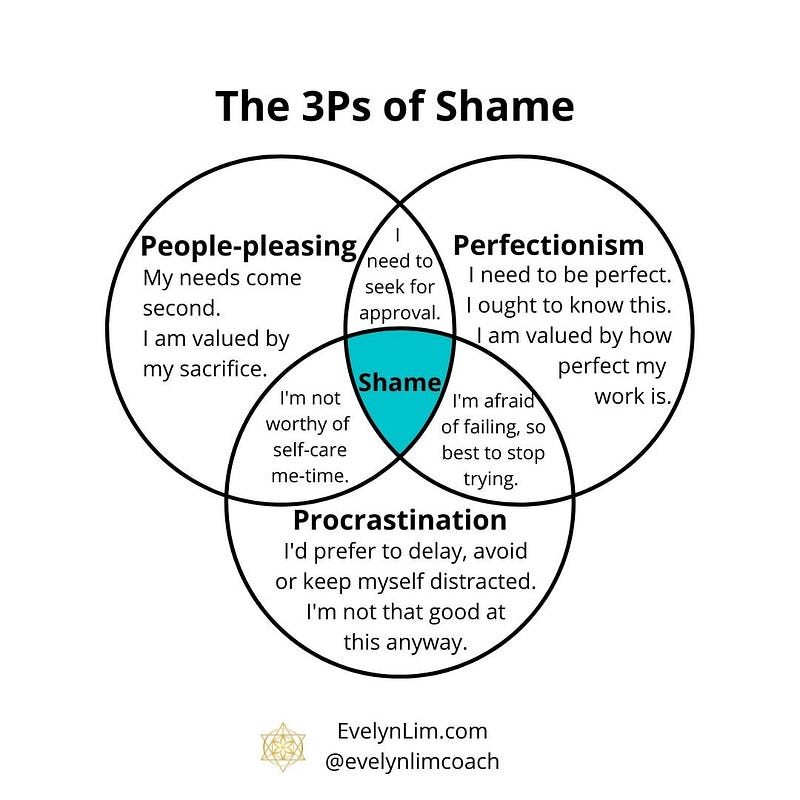
People-pleasing: My needs come second. I am valued by my sacrifice. Perfectionism: I need to be perfect. I ought to know this. I am valued by how perfect my work is. Procrastination: I’d prefer to delay, avoid or keep myself distracted. I’m not that good with this anyway.
People-pleasing + Perfectionism: I need to seek for approval. Perfectionism + Procrastination: I’m afraid of failing, so it is best to stop trying. People-pleasing + Procrastination: I’m not worthy of self-care me-time.
People-pleasing + Perfectionism + Procrastination = Shame
If we are to leave shame unaddressed, we are only passing it on to the people around us and our children too. We manifest it through shaming not just ourselves, but others too. When we project our shame stories, we risk creating harm to our relationships — it could be our relationship with our loved ones, relationship with our kids, relationship with money etc.
Thankfully, shame can be addressed.
Working Through the Layers in My Shame Stories
As I’ve discovered, shame is something that I needed to work through in layers. As I peel each layer, I would find another layer that requires me to be even more vulnerable. The way I see it is that working through shame is effectively answering a call for greater authenticity.
At first, I felt like I would rather die than let others find out about how I used to shame myself over my body or how I used to face rejection from others. Well, surprisingly, after I decided to be courageous to share them online, I experienced a sense of liberation. It was interesting that I got positive responses from people who read my blog posts. Which led me to sharing more vulnerable stories about myself with others.
Just a few weeks ago, I realised that I was procrastinating asking for help. I wanted to paint the perfect picture that I was doing fine on my own when I actually needed assistance. My belief was that it was shameful to appear that I didn’t know what I was doing. Well, just like everyone else, I have to work on letting go of the Ps that were holding me back from moving forward. In fact, it’s how I got inspired to write this article.
Mindfulness and Inner Work in Letting Go of Shame
With mindfulness, we become aware whenever…
- [People-pleasing] we put our needs second or last and we get into our burnout.
- [Perfectionism] we become self-critical when reality does not match expectations.
- [Procrastination] we are in resistance to showing up fully.
Inner work with letting go of the 3Ps of shame does help a lot! Sharing it with a trusted friend or working with a practitioner helps too. We give ourselves the opportunity to process our feelings and the roots of shame.
Brene Brown, researcher on shame and best-selling author, shares that shame is “the intensely painful feeling or experience of believing that we are flawed and therefore unworthy of love and belonging.”
Shame is to be distinguished from guilt. Shame is “I am a mistake” rather than “I made a mistake.” To let go of shame, we need to be vulnerable and own our stories.
When we feel shame, our energy is in contraction. Shame has the lowest vibration, according to the Map of Consciousness by David Hawkins. Compared to Enlightenment of 700+, shame is only vibrating 20. Releasing shame helps us to shift into a more expansive energy and the only way is up, since shame is already at the lowest.
If Your 3Ps of Shame Are Deep Rooted
Shame is often embodied at deep levels. If we are experiencing deep shame, it is imperative that we let it go using a somatic approach. Shame can manifest in conditions such as eating disorders, mental illness and so on. It’s why a body-based approach for healing is most helpful.
Shame often arises from something that we’ve learned in the past especially in childhood. Releasing deep shame will involve courageously facing up to our fears of “not good enough”. We may need to reconnect with our wounded inner child in order to help her release shame.
Alchemy happens when we make the shift from shame into our authentic selves. We are no longer held back by the need for people-pleasing, perfectionism and procrastination. Instead, we give ourselves the permission to show up courageously, ever-present and embodying enoughness.
Subscribe for more of Evelyn’s writings on emotional healing.


