
You Don’t Have to Avoid Sugar
How to eat sugar and stay lean and/or lose weight!

Every day, I eat hundreds of grams of sugar. And, I retain a physique both lean and muscular.
Sugar is so sweet and delicious. But, we’re constantly told sugar is “bad” for us.
I’m here to tell you that in moderation, it’s not.
But, if you’re on some stupid diet, you probably don’t get to enjoy sugar.
Sorry…
In this article, I explore how I eat hundreds of grams of sugar a day and stay lean.
Sugar Doesn’t Make You Fat…
Overeating does.
Sugar is often demonised as the reason many of us are overweight, but eating sugar is not inherently bad for you. Despite what a lot of health and weight loss marketing tells us, it’s completely fine to eat sugar in moderation.
Newsflash! If you’re overweight, it's not because of the sugar. It’s because you overeat.
Eating sugar can contribute to the number of calories we eat, but it's not the reason itself for being overweight.
A 2013 study found that replacing sugar in a person’s diet with another form of energy (food source) with an equal number of calories did not affect a person’s weight. The systematic review and meta-analyses of research on dietary sugars and body weight concluded that how much a person eats dictates whether they’re overweight.
“We observed that isoenergetic replacement of dietary sugars with other macronutrients resulted in no change in weight. This finding strongly suggested that energy imbalance is a major determinant of the potential for dietary sugars to influence measures of body fatness.” — Te Morenga, 2013
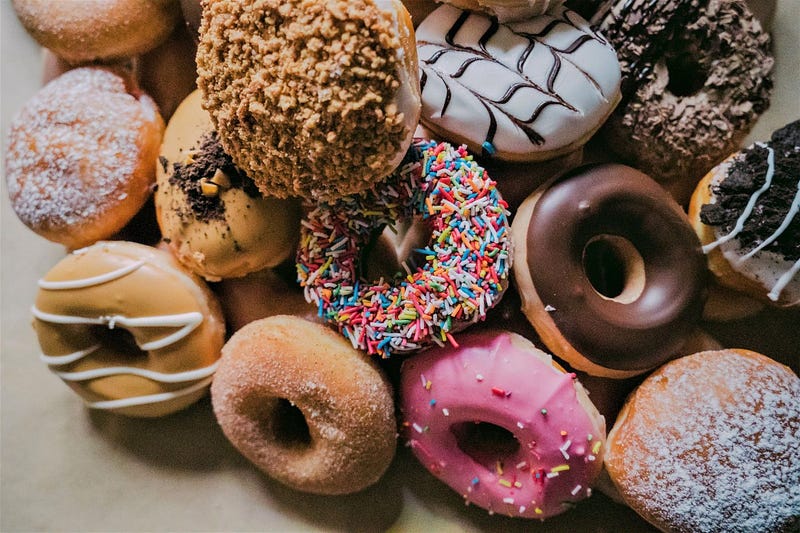
Sugar can be good for you!
Well, not the sugar itself… But, by eating lots of fruit that is filled with sugar, you'll also consume a lot of micronutrients.
Fruit is full of fibre and vitamins and minerals — which of course, is excellent for us. Each fruit type has a unique micronutrient profile, meaning some fruit will be higher in one or two vitamins or minerals than others.
Hence, it’s good to eat a variety of fruit.
Fructose and Glucose are sugars both naturally occurring in fruit. The difference between them is:
- Glucose is the body’s preferred carb-based energy source.
- Fructose has a sweeter taste but has the least impact on your blood sugar.

How much sugar do I consume?
Jam, muesli, muesli bars, fruit juice, smoothies, canned fruit, yoghurt, and shit loads of fruit.
This is what one day might look like — banana in my breakfast smoothie, peach, mandarin, watermelon, gold kiwifruit, another peach, blueberries, more watermelon…
That’s probably on the higher end of one day's worth of fruit consumption. But, it's not unrealistic. It sounds like a lot, but it’s only about 500–600 calories from 120 grams of sugar.
This is the equivalent of around 4 cans of Coke.
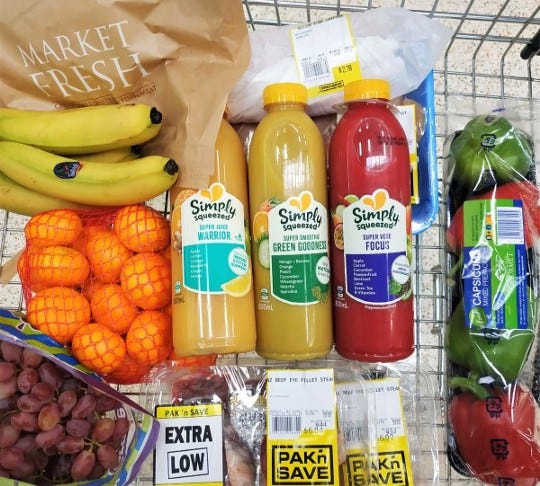
Below is an image of my shopping trolley and my favourite juice range. There’s no added sugar — which is the biggest issue with juice. Many popular juices might contain 5–10% juice, which means they have a lot of added sugar.
Drinking a lot of juice with added sugar means the calories add up fast.
Remember, read the label.
Bottom Line: Total Calories
Calories control your weight.
Full stop.
Eat more calories, and gain weight. Eat fewer calories, and lose weight. It’s that simple.
This process is governed by the laws of thermodynamics. Food has a certain energy content that is transferred from the food to the person consuming it. Any excess energy consumption is then stored as body fat.
We shouldn’t think of it as a day-by-day thing — even though we should have an average daily calorie amount we should aim to consume.
But, if you overeat today, you won’t gain kgs of fat overnight — despite what the scale tells us, it’s probably water weight.
If you consistently undereat, your body will use the stored body weight as energy. That’s how fat is burned.
If some days you overeat, and some days you undereat, your total calorie consumption is averaged out and your weight will remain fairly stable.

Avoid overconsumption
The big problem with sugar is that it is very easy to overconsume if you’re eating junk food such as candy or drinking lots of soda. This is the connection between sugar and weight gain.
Sugar that comes from candy or other processed products is called refined calories. Refined sugar is empty calories.
We do not want empty calories. An empty calorie has no nutritional benefits. We want calories that also come with protein, fibre, or vitamins. Candy doesn’t give us any of that.
However, eating empty calories doesn’t mean it is going to go to your thighs instantly. It just goes towards our energy (calorie) total for the day.
But, junk food full of sugar is very calorie-dense — meaning that food has a high number of calories given the volume of the food itself. The calories add up fast and that is the problem.
Concluding Thoughts
Many people think sugar is inherently bad for us and the reason we are overweight.
In this article, I have discussed that it’s not sugar making us fat — instead, it’s overeating making us fat.
Overeating junk food means we will consume a lot of sugar and accordingly a lot of calories.
If we replace that junk food with fruit, we can still get that sugar hit and for far fewer calories. Fruit is low in total calories for the volume of food, meaning it fills us up without eating more energy (calories) than we need.
Fruit is also very nutritious. Many people should be eating more fruit — so don’t avoid fruit just because you heard that they’re high in sugar.
Thank you for reading.
If you enjoyed the content, you may be interested in this article about 6 common fat loss mistakes.
Read More Medium Articles
Non-Medium members can only read 3 articles a month.
Become a Medium Member for unlimited access to my content and articles from thousands of other writers, for just $5 a month.
Subscribe to be notified when I publish new content.