
How You Approach The Hotel Breakfast Buffet Can Reveal Your 'Learning Style'
Are you an Activist or a Pragmatist? Or do you just love pancakes?

On my recent holiday to Portugal (yes I am very lucky, please don’t hate me), I was once again reminded of the gaping difference between how my partner and I experience life. Case in point - the hotel breakfast buffet.
While I jump right in, immediately diving for the eggs and pastries, my boyfriend plans his approach carefully. He’ll take a lap, observing the options. Where I will end up with a mish-mash of savoury and sweet all on one plate, he’ll have a logical order of dishes.
“How did you get back here so quickly? And why the hell have you got bacon, baked beans and a pain-au-chocolate all on the same plate?” he asked me upon returning to his seat.
Keen to defend my buffet decisions, I reached for an explanation. “It’s because I’m an Activist”, I pronounced proudly. “I learn by doing and incline towards action.”
Cue a long winded discussion on the four Honey and Mumford learning styles and how they relate to the difference in approaches to the breakfast buffet.
Sounds tasty. So what are the Honey & Mumford learning styles?
Despite the title of this article being about breakfast, 'honey’ in this sense is not the stuff you get in the jar and put on your porridge. Rather, Peter Honey and Alan Mumford and were two leading psychologists who were committed to discovering how humans learn new things.
Research shows that there is no ‘one-size-fits-all’ approach to learning. Rather, whereas one person might find that listening to a lecture helps them to retain new information, another person might find it easier to learn by engaging in a role play.
In 1985, Honey & Mumford identified 4 distinct learning styles that differ in approach: Activist, Theorist, Pragmatist and Reflector. Each is based on behavioural tendencies that centre around doing, feeling, watching and thinking. It’s important to note that you can be a combination of two different styles.
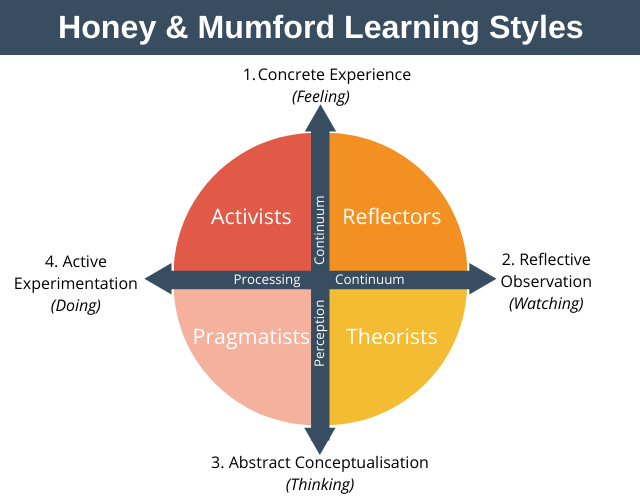
So how do you find out what type of learner you are? Well, Honey and Mumford created a detailed questionnaire which asks the participant about their general behavioural tendencies, such as “do you often seek out new experiences?” or “do you solve problems with a step-by-step approach?”
But to make it even easier, I propose taking a very concrete scenario — like the hotel breakfast buffet — and considering how you tend to behave in order to identify your Honey and Mumford learning style.
With that in mind, let’s consider the learning styles through the medium of the breakfast buffet:
1. The Activist
If you’re an Activist, you’re likely to jump into situations head first. At the breakfast buffet, you’re the first in line, and get stuck into piling your plate immediately. Activists learn by doing, not thinking.
You’re not interested in the practicalities of the buffet, like scoping out what’s on offer first before making a decision on what to choose. Rather, you need to be hands on, learning as you go. And even if the weird ‘sausage stew’ looks dubious, you won’t be put off — you need to experience it for yourself.
Sometimes, this willingness to jump in and come up with creative ideas on the fly can lead to great discoveries (see cream cheese and jam on toast — nom). Other times, it can lead to terrible abominations, like the person I witnessed adding a fried egg to their pancake and chocolate spread. Just no.
How to harness your Activist learning style:
In life, Activists learn best by getting involved in group discussions, brainstorming activities, puzzles and role-play. They prefer immersive experiences, so seek out opportunities where you can play a role in a learning activity.
However, while being an Activist is great, sometimes your desire for action in life can lead to hasty decisions — so it’s worth sometimes stopping and thinking first before you act. Theorists and Reflectors can help you slow down and think things through.
2. The Theorist
We all know someone who learns the hotel breakfast timetable in advance and comes up with a clever approach to beating the queues before arriving (“It’ll be busy between 10 and 11, because that’s when checkout is and it’s Sunday morning). Theorists might read the reviews of the hotel breakfast on Google or ask the serving staff what’s the best thing on the menu to gather useful information that might inform their breakfast approach.
If you’re the person who comes up with an idea of your ideal buffet dish before heading to execute on your plan — you’re a Theorist. And look — there’s nothing wrong with dreaming about your stacked pancakes, maple syrup and bacon before you even get through the dining room doors.
How to harness your Theorist learning style:
Theorists are conceptual, analytical thinkers who use data points to come up with their own theories of how the world works. They learn best by using models, statistics and stories to apply concepts in theory to the world around them.
Much like the breakfast buffet, life can be unpredictable. While things may seem right in theory, it’s often too easy for Theorists to plan too much, only to find that reality throws up a different set of cards — or provide scrambled eggs over the omelette you had in mind. Partner with a Pragmatist to help you react to the world (or buffet) in front of you.
3. The Pragmatist
In the story above, my partner is a Pragmatist. These are the folks that focus on the reality of the world around them above anything else.
Pragmatists are likely to follow a logical, set order of dishes at breakfast (savoury first, followed by sweet, then a coffee to digest) and first scope out what’s actually available before committing to anything on the plate. They might be more practical about having a light breakfast if they know they’re having a big lunch, or deliberately plan the order of their plates based on the size of the queue for each breakfast item.
You won’t see a Pragmatist going for anything overly adventurous (no fried egg and Nutella combo for them) and are likely to take their time, methodically working through each plate rather than trying a little from each.
How to harness your Pragmatist learning style
Pragmatists learn best by putting their ideas into practice and seeing how the results come across in reality. Experimentation and iteration are important. You probably prefer non-fiction books, and it’s a good idea to apply any high level, abstract concepts to a tangible example in order to ensure the information sticks. Theorists can help provide the ideas, while Pragmatists can help with the execution in reality — an unstoppable combo.
4. The Reflector
My auntie is a Reflector, and she is always one of the last up from her seat. Her preferred approach at a buffet is to watch and observe others and contemplate what they chose, before making an informed decision on what she should choose.
If you prefer to get a coffee and watch how others pile their plate before getting your own breakfast, you might be a Reflector. These folks are self-reflective and may consider their hunger levels, the calories, their mood before making a decision on whether they want pancakes or not.
Reflectors are the ones that come back with a breakfast plate so beautiful, so well put together, that you think — “how did they do that?” Usually, it’s because they learned from others mistakes, trod carefully, and didn’t make any hasty decisions. Well played, Reflectors.
How to harness your Reflector learning style
Reflectors learn best when they can take the time to observe situations and consider events from various different points of view. They don’t like to be rushed, and find one-on-one discussions and self-reflective activities such as surveys and questionnaires to be helpful when it comes to learning new things.
While sitting back and observing first can often lead to well-thought-out decisions, sometimes Reflectors might wait too long and miss out on key opportunities (such as getting the good bacon at the buffet). Reflectors might do well to work with an Activist who can help them to execute on their ideas and get things done.
Thank you for reading! If you enjoyed this and are considering signing up for Medium to gain access to a plethora of awesome articles (also from far better writers than me), please do use this link (I will earn a small commission) 🙏