
How Writers Can Overcome Perfectionism and Achieve Next-Level Growth
Perfectionism will hinder your progress as a writer.

I remember my first client assignment like it was yesterday.
It was a spin on mission statements — mission questions. Instead of “we do [insert corporate jargon],” mission questions try to inspire companies and their employees to constantly strive for more by asking “how can we do [insert more corporate jargon]?”
The purpose of this 600-word ghostwriting assignment was simply to explain the concept and outline my client’s mission questions.
The idea was simple enough. The outline was intuitive.
It took me all day.
I painstakingly reviewed every word, space, comma, quotation mark, em dash, and period — everything between word 1 and word 602. I read my draft once, twice, thrice…I couldn’t stop checking my work. It had to be perfect.
At the time, It didn’t matter — I was just thrilled to have a client and be a paid writer.
However, there was an obvious problem with my meticulous approach.
Perfectionism doesn’t pay the bills
As writers, the more time we spend nitpicking every word, the less time we have to make money. It’s a harsh reality of freelancing.
After a year or so of full-time writing, I realized the importance of valuing my time. An article by Zulie Rane inspired me to start calculating my implied hourly rates. If I spend five hours on a project that should only take me two hours, I’ve squandered three hours of potential income or productivity. If that project pays me $200, my implied hourly rate would be $40 — when it should’ve been $100.
Adding dollars and cents to the equation opened my eyes.
Once I considered the monetary impact of my perfectionism, I was motivated to counter my ill-timed tendency to critique while I write. Recognizing the issue was a necessary initial step, but it wasn’t enough to solve the problem.
Here’s how I combat my perfectionism as a writer.
Outlines pave the way to enormous content output
Think of an outline as a map for a road trip. It’s much easier to stay on track and reach your destination when you know where you’re going. Otherwise, when you wing it, you risk taking a wrong turn, getting lost, and giving up altogether.
My creative process changed when I started mapping out my thoughts ahead of time. A blank page is a lot less intimidating when there’s an outline holding your hand through the process.
Outline approach #1
I use two types of outlines. The first is pretty standard — it segments an article into sections: introduction, body paragraphs, and a conclusion. Within each section, I add key terms or discussion points. Here’s an example outline, which is for a guide about managing finances as a freelance writer.
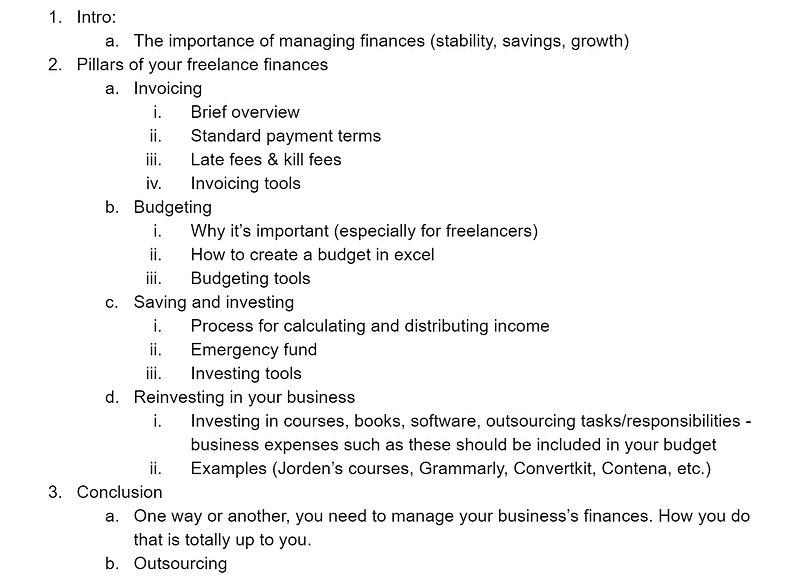
It’s essentially the skeleton of an article. This guide was roughly 4,500 words, but I plowed through it because I had a mental blueprint to follow.
Outline approach #2
I learned the second outline structure from Zulie too — she’s awesome, what can I say? The idea is to list (1) the problem, (2) the symptoms of the problem, and (3) the solution. I recommend reading Zulie’s article for a more in-depth overview.
Here’s a simplified example:
- Problem: Cold pitching is hard.
- Symptoms: Simply finding prospects takes a long time. Pitches usually go unanswered. Even if you get an answer, it’s often a rejection that comes days or even weeks later.
- Solution: Warm pitching
Together, these three components form the basis of an introduction. You introduce the reader to the problem, highlighting aspects of the problem that are relatable, before teasing the solution.
Then, for the rest of your article, you’ll expand on these three components. Your first body paragraph speaks more to the problem, such as the root cause or why it’s important. Your second body paragraph takes the same approach but with the problem’s symptoms, before leading into the solution, which you can now explain in detail.
If the topic is more abstract versus explaining a cut-and-dry concept, I’ll usually use the latter approach. That said, sometimes I use both outline styles to get my brain moving.
Clear your mind ahead of time
It takes absolute mental clarity and concentration to avoid scrutinizing every word as I write. My fingers naturally want to jump to the “control” and “left arrow” keys. It’s embedded somewhere deep in my brain.
Clarity is necessary to escape perfectionism’s clutches. Otherwise, we slip into old habits. Awareness is a powerful deterrent, but you need a clear mind to maintain focus.
To encourage a flow state and enter “the zone,” try:
- Drinking coffee
- Taking a walk
- Stretching
- Taking a warm shower (one of Tim Denning’s frequent recommendations)
I can’t function without coffee — so I’d be drinking it regardless. Interestingly enough, consuming a hot cup of joe is not the best technique for clearing my mind. Taking a walk holds that title. A brief stroll around the neighborhood or park does wonders for the mind.
Writing is a sedentary job. Sitting all day isn’t good for the mind or body — move around, stretch, and get your blood pumping to rejuvenate your creativity and clear your head.
Preemptively evade distractions
Distractions will interrupt your flow state, halt your progress, disrupt your clarity, and — again — cause perfectionism to resurface.
To preemptively evade distractions to ensure you stay in the zone, try:
- Silencing your phone (a no-brainer)
- Closing or hiding other tabs
- Listening to focus music
- Writing in intervals
If I had a dollar for every tab I had open right now, I’d have $32. That’s actually pretty good for me. Fortunately, Google Chrome lets you group tabs together — which you can read about here. It’s straightforward and allows me to hide projects I’m not actively working on.
When I write, I listen to a focus playlist on Spotify called “Binaural Beats.” It’s my go-to evasive technique. It’s a concoction of smooth, ethereal sounds that block out external noise.
Lastly, I write in timed intervals to not only maximize output but also avoid burning out. The human brain isn’t designed to endlessly pump out structured thoughts. It needs breaks.
If I’m working on a longer assignment with an impending deadline, I’ll set a timer for 60–90 minutes — and then take a 10–15 minute break. If it’s a casual writing session, I’ll do 30–45 minute timers with 5–10 minute breaks.
Turn off Grammarly
I have to turn off Grammarly or else fluid writing is impossible. Yes, this qualifies as a distraction — but I want to emphasize this one specifically.
If you’re a freelance writer, Grammarly is a must-have tool (I use the free version, but they also offer a paid version with more features). However, if you’re a perfectionist like me, Grammarly can destroy your writing rhythm. Those bright red lines will pull the reins on your eyes, as if to say, “HEY. YOU MESSED UP. GET BACK HERE.”
Even if you can resist stopping, Grammarly’s underlining is intentionally obvious and, thus, intrusive. Grammarly doesn’t want you to inadvertently miss your mistakes, which is beneficial during editing sessions but detrimental during writing sessions.
Fortunately, you don’t have to uninstall this feature — you can simply disable Grammarly until your next “visit” (i.e. whenever the page refreshes).
The clichés are right
I was a perfectionist — hell, I still am. It’s a hard habit to totally shake, but my words flow much faster now — like a stream that gradually erodes its rock-strewn shore and expands into a small river.
Overcoming perfectionism requires quite a bit of mental rewiring, which takes time and dedicated practice. The journey from “I don’t think I can do this” to “Wow, I didn’t think I’d ever get here” is grueling. But it does happen, I promise.
Start with one technique, get accustomed to it, and then gradually incorporate another into your routine.
Practice makes (un)perfect. See what I did there?


