
How do Conservative Party members rank prospective leadership candidates? A small-scale experiment
The Conservative Party is in a state of crisis. The HMS Britain is heading towards the iceberg of Brexit and instead of deciding on a route past the danger the crew seem more concerned with choosing a new captain.
The failed December 2018 leadership challenge against Theresa May secured her position within the party from a formal challenge for another year. Still, rumours abound that she will resign should the Withdrawal Agreement fail to pass… again.
There has been a lot of interest in who the next leader of the party will be. Most polling on the issue asks a simple question along the lines of ‘Who should be the next leader of the Conservative Party, after Theresa May?’.
The main problem with this approach, however, is that it completely misrepresents how the Conservative leader is chosen. Instead of members getting a wide choice of MPs to vote for, Conservative MPs whittle down the number of candidates to two, and the members choose the leader from those final two. For a history of this process, see the House of Commons Library Briefing, and the Institute for Government’s compilation of previous results.
So, it’s all well and good Boris winning 18% of the ConHome member vote, for example, but if 82% of members absolutely hated him and would never vote for him, it’s a meaningless result.
What I wanted to know was how Conservative Party members rank prospective candidates.
To do this, I created a short survey asking party members to do just that. Between 8th and 15th May I had 203 respondents, 194 of whom were party members. They were presented with 15 potential leadership candidates and had to rank all 15.
The results were then run through an instant runoff election calculator, to see which candidate would emerge with over 50% of the vote — this only happened in the final round, in a one-on-one contest, which shows how open the field is at the moment.
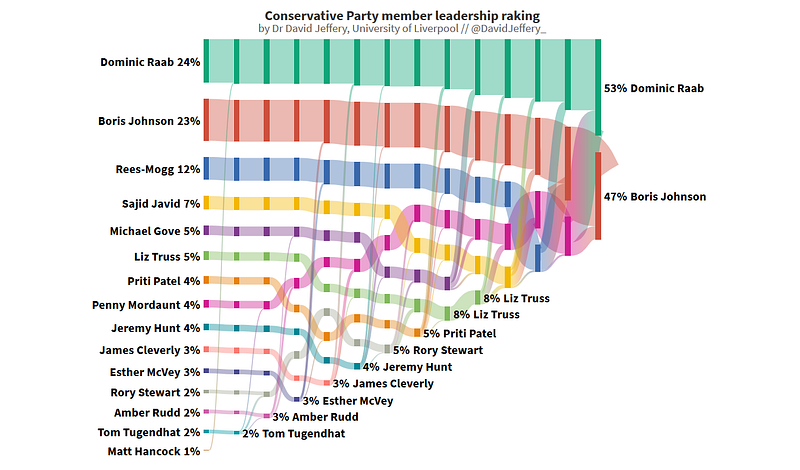
The results are shown in this interactive Sankey diagram— you can click anywhere on the diagram to see the flow of votes, or just follow the story by using the big arrows in the top left of the image.
(I appreciate that this might not be easy to read on a mobile or tablet, although the text at the top of the story should be. You can see a full-screen version of this story here. The full interactive chart is here, and I have included a text version of each round, and a static image, below).
Result
Dominic Raab wins, with 53% of the final-round vote.
Raab was the first-placed candidate for the vast majority of the survey, except for when Jacob Rees-Mogg’s preferences are reallocated — Boris Johnson briefly steals a lead, but this is reversed in the next round when Penny Mourdant’s preferences are reallocated, leading to Raab’s victory.
Dominic Raab seems to be the unity candidate the Conservatives need.
Ultimately, Raab wins because he seems to be the candidate best placed to appeal to those who support remain and leave candidates, while Boris seems to appeal more to hardline leavers— Boris does very well from Mogg’s preferences but fails to capitalise on preferences from Gove, Truss, Javid or Mourdant supporters.
This suggests that a Raab-Mordaunt joint ticket would be formidable, with Mordaunt complementing Raab by picking up support from areas where Raab failed to reach — namely on the left of the party. With two-thirds of voters backing Mordaunt going to support Raab, it seems she’d carry her support with her.
I hope to use the data for more analysis — future blog posts will compare the difference between those who back May’s deal and those who don’t, and also looking at the preferences of those who wrote in Andrea Leadsom, Johnny Mercer, and Steve Backer as alternative preferences (see the Other Candidates section below).
I’m also happy to collaborate with others, or try and answer other questions — just send me a DM here or on Twitter!
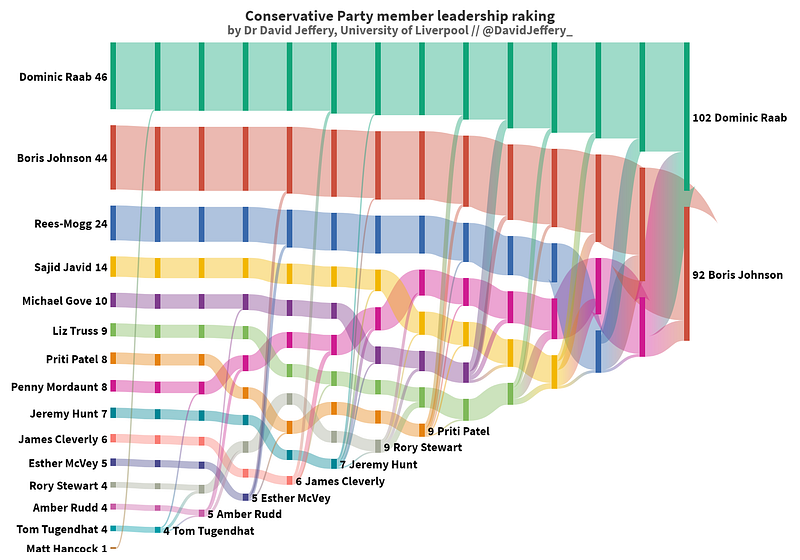
Text version of results
Starting point: Dominic Raab leads with 46 votes to Boris Johnson’s 44. Matt Hancock is last, with just 1 vote.
ROUND 1: The second preference for Matt Hancock’s vote goes to Dominic Raab, brining Raab’s total to 47.
ROUND 2: The new last-place candidate is Tom Tugendhat. His four votes are distributed to Penny Mordaunt (1), Rory Stewart (2) and Amber Rudd (1).
ROUND 3: Amber Rudd is the next final-placed candidate. Her 5 votes go to Michael Gove (1), Penny Mordaunt (2) and Rory Stewart (2).
ROUND 4: Ester McVey is now in last place, and her 5 votes go to Boris Johnson (2), Jacob Rees-Mogg (2), and Priti Patel (1).
ROUND 5: James Cleverly is next out — his 6 votes are re-assigned to Raab (2), Mordaunt (3), and Liz Truss (1).
ROUND 6: Jeremy Hunt is next out — his 7 votes go to Raab (1), Johnson (1), Sajid Javid (1), Mordaunt (2), Gove (1), and Stewart (1). This pushes Mordaunt into fifth place.
ROUND 7: Rory Stewart is now out, with just 9 votes. His votes go to Mordaunt (2), Javid (1), Gove (2) and Truss (4).
ROUND 8: Priti Patel is next to go, with her 9 votes going to Raab (3), Johnson (2), Rees-Mogg (1), Mordaunt (1), Javid (1), and Truss (1) — i.e. everyone except Gove. Sorry Gove.
ROUND 9: The Govester is next out, with his 14 votes going to Raab (6), Johnson (3), Mordaunt (3) and Javid (2).
ROUND 10: Liz ‘Freedom Lover’ Truss is next out, with her 15 votes distributed between Raab (3), Johnson (2), Mordaunt (6), and Javid (4). None for you, Moggster.
ROUND 11: Sajid Javid is out next — probably for the best, considering how the last PM to come from the Home Office fared. His 23 votes go to Raab (4), Johnson (6), Mordaunt (11), and Rees-Mogg (2). Penny jumps from fourth to fifth.
ROUND 12: Rees-Mogg is out, with his 29 votes going to Raab (9), Johnson (18), and Mordant (2). BoJo finds his mojo to take first place, for the first time in the contest.
ROUND 13: With 41 votes to Johnson’s 78 and Raab’s 75, Penny Mordaunt is out — 27 of her 41 votes go to Raab, with just 14 for Johnson.
RESULT: Dominic Raab is the winner, with 53% of the vote to Boris Johnson’s 47%.
Caveats
Being the good social scientist that I am, there are a few caveats to my study which I’d like to lay out (and which I’m sure you’ve already picked up on). But there’s a reason that this is a blog post and not a peer-reviewed journal article — so if you’re unhappy with any of the below, I want you to know I tried my best to keep it all above board.
If you’re still unhappy, there’s a lot of other stuff on the internet for you to be angry at. Don’t @ me.
Sample size
Yes, 194 Conservative Party members is not a large sample, and I do not have demographic information to see just how representative they are.
However, in terms of opposing May’s deal the results are similar to ConHome’s panel (55% say to reject vs 54% in ConHome, but I have fewer saying MPs should vote for, and more don’t knows than ConHome — 37% to 42%, and 8% to 5% respectively).
In terms of whether May should go, I get 83% saying yes (ConHome: 82%), 13% saying no (ConHome: 16%), and 4% saying they don’t know (ConHome: 2%).
Because of the sample size, I don’t think that the figures for the early rounds are too useful — but for the final few rounds I think we do see important trends occurring, which I am confident would play out with a larger sample.
I had contacted ConservativeHome to see if they would like to do something similar with their excellent members panel, but they did not. So there we are.
Data Gathering
Obviously, the survey was done on trust. To try to ensure a good sample of party members, I posted in a closed Facebook group for party members and replied to DMs on Twitter from people who were also party members.
At no point did I post the survey link in the plethora of leadership ‘grassroots’ groups on FB, nor did I DM it to any of these accounts. Based on the timestamp of respondents, it was quite rare for any candidate to be ranked first twice in a row — there was no Boris bounce or Raab rally suggesting that the link had got into one of their support groups, for example.
Ultimately, I cannot be sure all those who said they were members were actually members. It is done on trust. It is interesting to know that even including the whole sample (members and non-members) the results were unchanged.
Other Candidates
I included 15 MPs, based on who ranked highly on ConservativeHome surveys and used my own judgement to exclude/include other (based on declarations, Mercer resigning the whip, and hunches). Based on the write-ins below, I should have included Leadsom and Mercer. My bad.
From a methodological perspective, I used Google Forms for the data collection, and 15 was too many choices — Google Forms was not optimised for this and the respondents reported that the survey was not very user-friendly. However, it was the only system with no limit on the number of responses without having to pay for a premium service.
Either way, if your preferred candidate was missed off, I’m sorry. There was a box to write in other MPs, which some people did:
10+: Andrea Leadsom 23, Johnny Mercer 19, Steve Baker 16
2–9: David Davis 6, Geoffrey Cox 4, John Redwood 4, Tobias Ellwood 3, Andrea Jenkyns 2, Chris Philp 2, David Davies 2, Marc Francois 2,
1: Ben Bradley, Bernard Jenkin, Craig Tracey, Douglas Ross, Gavin Williamson, Greg Hands, Iain Duncan Smith, Jesse Norman, Justine Greening, Marcus Fysh, Nadim Zahawi, Neil Parish, Philip Davies, Robert Jenrick, Ruth Davidson, Suella Braverman, Theresa Villiers.
Erm…: Nigel Farage 2


